Thursday, June 9, 2011

"Down These Mean Streets," by Piri Thomas


"Down These Mean Streets" gets you three books for the price of one.

The first book is true to its title: a young man's coming of age along the dangerous byways of Spanish Harlem.

Here we see the perils associated with traversing the concrete jungle, the need for toughness and concomitant death of tenderness in youth.

Author Piri Thomas details what life was like for Puerto Ricans moving into what had been an Italian neighborhood and the Italians' response to their displacement.

Thomas was born in the 1920s, so that the time covered here ranges from the '30s to, perhaps, the early '50s, rendering his once hip track of new-lit jargon and streetjabber something of a timepiece.

Thomas' novel came out in 1967 and one can imagine the liberal chic set of Mayor John Lindsay's New York jumping like cats to nip at his rough-edged peek beneath the shiny Big Apple's skin.

Although this kind of literature has become stock in the book trade (James Frey anyone?), Thomas' autobiographical recounting of life among the rough Puerto Rican boys on his street can still shock.

His detached description of when the bored kids willingly go up to the apartment of some transvestites for homosexual interaction, pot, and booze, is rather striking and unsettling.

The second "book" deals with young Piri's identity crisis. One which can be extended to all the Puerto Ricans of his time.

highwayscribery is ignorant of what they are thinking today, but in Thomas's time, there was much ado over skin color, the islanders running from evening black to lily white as they do.

Thomas' problem was that he was darker, while his brothers were white. As a Puerto Rican, he did not, at first, view himself as being in the same boat as the African-Americans with whom his people crowded Harlem.

But when the family makes an escape to suburban Long Island, Piri comes in for a bit of a shock, and slinks back to "El Barrio" with a severe chip on his shoulder and a deeper sense of shared experience with the American Negro.

This issue is aired-out in discussions with folks of different skin pigmentation, each of whom expresses a unique understanding of the related questions. For this reviewer, it went on a little too long, and seemed a little self-indulgent.

Especially for a young man confronted with the serious matter of economic survival in a cruel and unforgiving city.

Nonetheless, Thomas' youthful obsession generates an anger which serves as bridge to the third book, which is a jail tale.

Identity issues unresolved, his skin color serving him poorly in prejudiced city, the young man goes on a crime spree, again remarkable for its matter-of-fact execution, which lands him in the state penitentiary.

Perhaps it was novel at the time, but today his efforts to maintain a tough guy's rep -- primarily to avoid being sodomized by bigger, harder criminals (no pun intended) -- while rehabilitating himself with a little Nation of Islam cant and some in-house masonry training are now familiar fodder.

Thomas' attempt to forge a street-seasoned prose is uneven. He never really finds a groove and seems almost relieved to let more articulate characters do some of the heavy lifting where the expression of complex ideas is involved.

Nonetheless, he succeeds in engaging the reader, pulling of that time-tested trick of getting people to root for a guy doing bad things, by peeling back the hard layers and revealing a human and worthy heart.
gets you three books for the price of one.

The first book is true to its title: a young man's coming of age along the dangerous byways of Spanish Harlem.

Here we see the perils associated with traversing the concrete jungle, the need for toughness and concomitant death of tenderness in youth.

Author Piri Thomas details what life was like for Puerto Ricans moving into what had been an Italian neighborhood and the Italians' response to their displacement.

Thomas was born in the 1920s, so that the time covered here ranges from the '30s to, perhaps, the early '50s, rendering his once hip track of new-lit jargon and streetjabber something of a timepiece.

Thomas' novel came out in 1967 and one can imagine the liberal chic set of Mayor John Lindsay's New York jumping like cats to nip at his rough-edged peek beneath the shiny Big Apple's skin.

Although this kind of literature has become stock in the book trade (James Frey anyone?), Thomas' autobiographical recounting of life among the rough Puerto Rican boys on his street can still shock.

His detached description of when the bored kids willingly go up to the apartment of some transvestites for homosexual interaction, pot, and booze, is rather striking and unsettling.

The second "book" deals with young Piri's identity crisis. One which can be extended to all the Puerto Ricans of his time.

highwayscribery is ignorant of what they are thinking today, but in Thomas's time, there was much ado over skin color, the islanders running from evening black to lily white as they do.

Thomas' problem was that he was darker, while his brothers were white. As a Puerto Rican, he did not, at first, view himself as being in the same boat as the African-Americans with whom his people crowded Harlem.

But when the family makes an escape to suburban Long Island, Piri comes in for a bit of a shock, and slinks back to "El Barrio" with a severe chip on his shoulder and a deeper sense of shared experience with the American Negro.

This issue is aired-out in discussions with folks of different skin pigmentation, each of whom expresses a unique understanding of the related questions. For this reviewer, it went on a little too long, and seemed a little self-indulgent.

Especially for a young man confronted with the serious matter of economic survival in a cruel and unforgiving city.

Nonetheless, Thomas' youthful obsession generates an anger which serves as bridge to the third book, which is a jail tale.

Identity issues unresolved, his skin color serving him poorly in prejudiced city, the young man goes on a crime spree, again remarkable for its matter-of-fact execution, which lands him in the state penitentiary.

Perhaps it was novel at the time, but today his efforts to maintain a tough guy's rep -- primarily to avoid being sodomized by bigger, harder criminals (no pun intended) -- while rehabilitating himself with a little Nation of Islam cant and some in-house masonry training are now familiar fodder.

Thomas' attempt to forge a street-seasoned prose is uneven. He never really finds a groove and seems almost relieved to let more articulate characters do some of the heavy lifting where the expression of complex ideas is involved.

Nonetheless, he succeeds in engaging the reader, pulling of that time-tested trick of getting people to root for a guy doing bad things, by peeling back the hard layers and revealing a human and worthy heart.

Wednesday, June 8, 2011

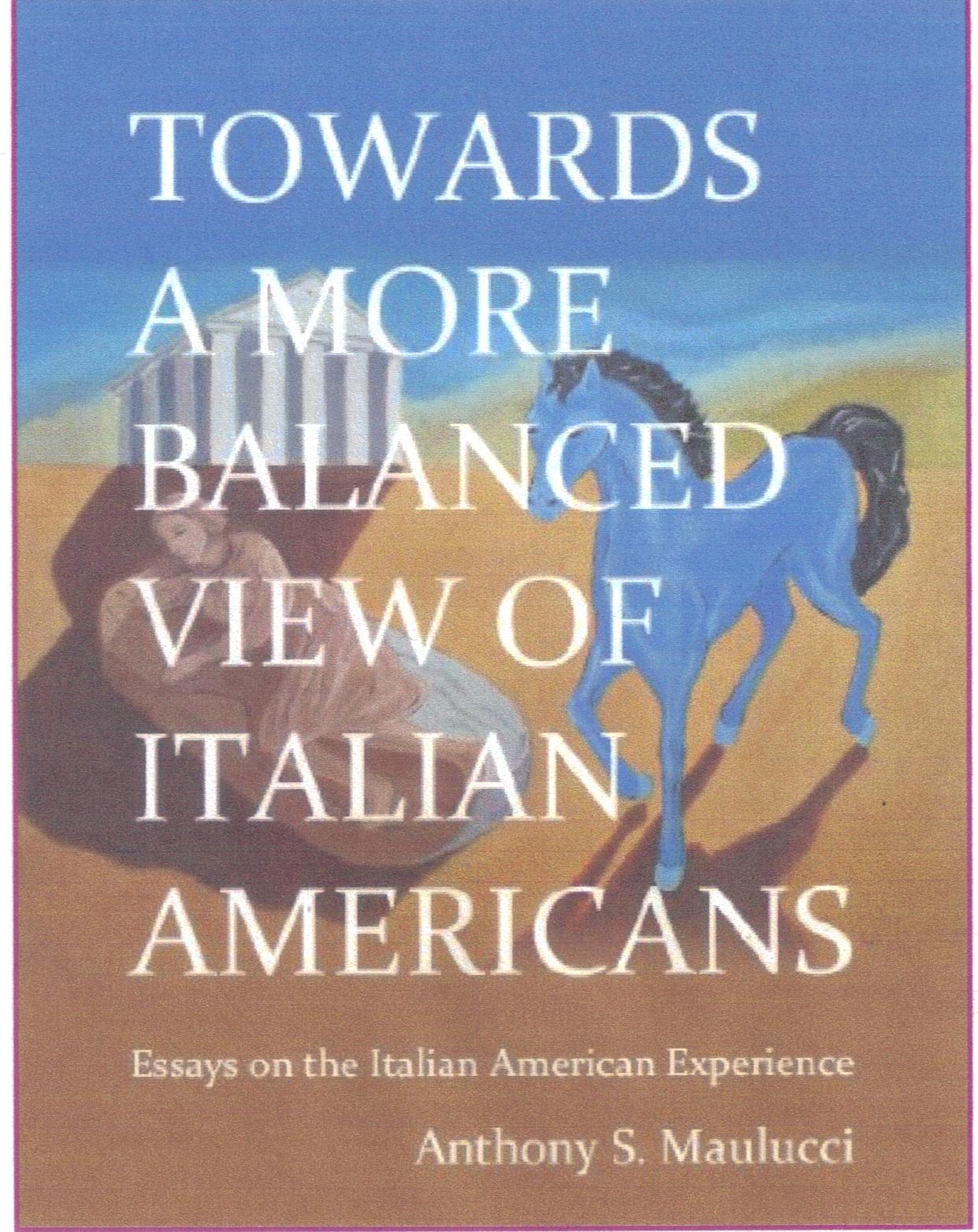
Toward a More Balanced View of Italian Americans by Anthony Maulucci


Italian-American artists create! You have nothing to lose but your homogenized and degraded ethnicity.

In his short-ish book (long-ish pamphlet) "Towards a More Balanced View of Italian Americans," Anthony Maulucci issues a clarion call for artists sharing his background to, "assert their love and respect for their own cultural heritage."

His essay proposes a map for achieving this and the main road links to the old country's intellectual and aesthetic splendors.

When urging Italian American artists to celebrate their cultural heritage, Maulucci makes clear his reference is not to some of the ethnicity's leading luminaries such as Dean Martin, Jimmy Durante or Annette Funicello.

Suckled on the success of such celebrities in the 1950s, Maulucci did not see heroes.

"I saw them as cultural failures," he writes, "traitors to the rich heritage and great traditions of their family roots. To my mind they were pathetic fools who had sold their cultural souls for gold and glory."

Sure, that was a long time ago and Maulucci is willing to at least tip his hat at more authentic latter day saints like Martin Scorsese or Robert De Niro. But here again, the touch of love is qualified:

"Presumably, they are proud to be Italian, but what does that mean? of what, exactly are they proud? From the roles they play and the projects they create it's impossible to deduce whether they have even the most rudimentary understanding and appreciation of their European heritage."

Maulucci details the peculiar case of the first generation Italian American, his/hers embarrassed association with a poor and undemocratic mother country, their burning desire to assimilate and Americanize, to leave the past behind.

So successful were they in this drive, "the only traditions that were kept alive, as they were in my family, were the ones connected to food preparation."

And while Italian American artists have always striven to encompass the old country passion for what is "bello" in their work, these efforts have found scant acceptance, even among those with the best chance of gaining enrichment.

"Most people can name at least one prominent Italian American figure in the world of business, politics, sports and entertainment, but how many people," he asks, "Italian Americans included, can identify a single great American author of Italian descent?"

It is hard to argue with these sentiments or the author's larger assertion that Italian American culture is on the verge of extinction.

The answer to the crisis, he posits, lies in Italian Americans supporting "their authentic artists, the ones telling their own stories as honestly as they can." In particular, he calls for the open support of writers and filmmakers, "since they have the most widespread influence."

An Italian surname, however, should not be sufficient to gaining such support.

Instead, it must be lent to those artists who assume, "a proactive role in broadening society's view of us beyond the simplistic caricatures of lovable lunkheads, menacing mobsters, madonnas, wine-soaked imbibers, and happy gourmands."

This piece is written with a warm passion that adds to, rather than detracts from, the clarity of its arguments and insightful historical analysis.

For Italian Americans willing to confront these issues, Maulucci makes them short and sweet matters of common sense.

The author closes with an emotional elegy for Sacco and Vanzetti; rooting the challenge he has issued in the martyred anarchists' unstinting drive to make America more just and the barriers to this effort their ethnicity erected.

There is much to be learned from "A More Balanced View..." with the smallest investment of time and attention.

Monday, May 30, 2011

"The Daughter of Sienna" by Marina Fiorato


Siena, take a bow.

In Marina Fiorato's "The Daughter of Siena: A Novel,"
the principal characters turn out bit players, and the Tuscan city, a star.

Set in 18th century Italy, this is a tale of sanguinary political tribes, horseracing, love unrequited, and palace intrigue with a Sienese flavor.

The novel charts the slow-forming alliance of the low-born Riccardo Bruni, a maiden groomed for sale via marriage, Pia Tolomei, an ineffective duchess, and a street urchin, in their battle against some treasonous nobles bent on sacking Siena for their own enrichment.

"The Daughter of Siena" is as hermetically sealed as any self-respecting provincial European municipality.

The author effectively weaves Siena's ever-present swallows, rival "contrade" or neighborhoods' vibrant colors, and legendary "Palio" race -- the city's landmarks and identifying symbols -- into the stuff of the story.

The dome, towers, scalloped central square, urban landscape, pageantry and peculiar ways of the provincial burg not only inform the story, but are the very stuff it is made of.

The novel's tightly wound plot makes it difficult to do a summary without giving things away.

Perhaps it is enough to say that the cast are introduced, en masse, in the first Palio of summer, and the city's fate, which all will enlist to influence, is tied to the outcome of a second run in August.

"It is a little risky," says Pia. "To bet a city on a horse race."

Arrayed against the motley, but loveable, crew recruited to save the rein of the de Medici clan in town are some sinister city fathers with bloody predilections and a difficult-to-crack plan for seizing power from the Duchess Violante de Medici, of whom the omniscient narrator comments:

"She was aware of the new thinking, the new sciences, the enlightenment of the world, but she devoured instead legends and tales of old, because she herself was preserved in the amber of a bygone era."

As are the literary passions of Ms. Fiorato.

When Riccardo apprises Pia of so much that has occurred during her imprisonment at the hands of evil-doers, she observes, "He might have been telling her fairy tale by the fire, so incredible did it sound to her ears."

A fairy tale for adults, wherein the history and culture of a unique location are skillfully strung in narrative threads the writer successfully resolves, without the facts about Siena and its history ever appearing inorganic or forced.

The narration is rendered in a straight-up grammatical English and the whole is well-polished.

Subjectively speaking, highwayscribery prefers things a little raggedy, whereas this story stays between the lines, ties up all loose ends through sensible set-ups that can, at times, appear obvious. The resolutions comes across as neat and pat.

But that is mostly a matter of taste, not the skill so amply on display in this story of characters trying to cope with the weight of Siena, and it's history, on their efforts to hack individual paths through Italian life.

Thursday, May 5, 2011

"I Could Love You," by William Nicholson


If you are middle class, or doing a little better, "I Could Love You," is not so much an escape as it is a mirror.

William Nicholson's characters can be difficult to distinguish from one another. They have generic names (Alice, Laura, Jack), are all white, and each luxuriating in the search for meaning or LOVE.

They talk similarly as well. Idioms, slang, and varied voices are not the author's strong suit, but narration itself changes pitch and tone as his assemblage of characters take turns under the literary microscope.

"I Could Love You," comes off as one of those ensemble movies that Hugh Grant stars in, featuring lots of people living in close proximity, yet only mildly conscious of one another.

"Love Actually," comes to mind.

And that's the set-up. Sometimes paths cross unexpectedly and narrative flames are sparked as a result.

This is a zeitgeist piece including references to Facebook and the MP3 player. If you are wondering whether you'll have much in common with these folks, you will, unless you're the kind who helps people in Africa or works as an undercover agent in the war on terror.

Whether you'll care about them is another question, but Nicholson is a writer of true command, a deft hand relaying a story that seems milquetoast on the surface, but offers edgy and insightful moments, meanings, and passages.

"Once you know that you don't know," he writes, "everything changes. The absurdity of so much of our lives ceases to be a puzzle. Of course we're ridiculous. Of course we make fools of ourselves. Why wouldn't we? We are fools. We know so little. But are not any the less loveable for all that."

One of the novel's strengths is its multi-generational tack. Literature has never scanted young love, but Nicholson renders the complexities and epiphanies of middle-age very nicely.

For example, Tom Redknapp finds himself oddly removed from a big issue at the hospital where he performs plastic surgeries. As the conference room debate rages, he is thinking about his extramarital affair:

"In some strange way he feels as if he's started his life over again. This time round there's no drive to achieve, no deferring of pleasure in the interests of later gain. This time, the pleasure."

The art world comes in for some particularly pointed observations the indoctrinated, and not-so-indoctrinated, may find provocative.

Nicholson's portrait of the forgotten and declining painter Anthony Armitage is a strong departure and counterpoint to the rest of the youthful, mainstream ensemble.

But as the title suggests, love is the big issue here and the characters' experiences are varied enough to offer succor, advice, and cautionary tales for those who like, enjoy, desire, or think a lot about the big L.

The author does an intelligent job of putting something across that is light and entertaining, yet somehow substantive and unsettling.

His larger point is best summed up in this passage, also from the brain of Tom Redknapp, daydreaming of his paramour who is no great shakes in the looks department:

"Nothing to write home about. And there's the wonder of it. Beauty turns out not to create desire after all. Desire creates beauty."

With its many contemporary and hip references, "I Could Love You," is not bound for the classics shelf, but its author was not trying to achieve that.

Still, what Nicholson sets out to do, he does well in this easy and entertaining read.

"The Wrong Blood," by Manuel de Lope


Manuel de Lope's The Wrong Blood is tough to review without giving up the ghost, literally.

It is the story of three people bound by a series of shared spawned by the Fascists deathly advance through the Basque Country during the Spanish Civil War.

Situated for a few passages at the front, the novel mostly broods in the enclosed worlds of two houses on the coast: "Los Sauces" and "Las Cruces."

In one of them live two victims of the conflict, in the other a lame doctor, whose affliction allows him to escape the generalized carnage, yet still be affected by its perversions

The young lawyer Goitia, looking for a place to study, returns to his childhood home at "Las Cruces" whic his deceased mother has left to her life-long house servant, Maria Antonia.

The biggest secret is revealed to the reader at the three-quarter mark, though not necessarily to the young lawyer.

But his rare visit, coupled with the advancing age of the doctor and the house-servant, provide a last chance to rewrite a small history, and the tension to keep from, or unleash upon him the truths they know, form the crux of the conflict.

"Between them," De Lope notes, "the doctor and the old woman could awaken the inexistent memory of young Goitia, assuming that young Goitia had any interest in the stories the old woman and the doctor could tell him."

The path toward that resolution is dominated by an unnamed narrator with no dog in the fight being covered. The action and exchanges between principal characters are employed to sparing effect.

Most of the narrative progress is unspoken, but latent in the air each character is sharing; air rife with narrator's presentiments and ornate musings.

"The Wrong Blood," is mostly back-story, the young man's arrival provoking "the powerful flood of memories" that had "overflowed the sluice gates."

It is a running commentary on what the trio have endured, what they are thinking at any given moment in the history; a history not presented chronologically, rather leapfrogging back and forth along the line of time.

The author's focus is trained mostly on ambience, on environment, on the oppressive realities that precede each character's birth. There are not very many choices available to these people, and still less offering a dignified path.

The liner notes for this Other Press addition quote Gabriel Garcia Marquez deeming De Lope's work, "a celebration of our language."

Since that language is Spanish, the consumer of the English-language effort must take the master at his word. Or at least the word of translator John Cullen who teases a wide vocabulary, a rich thicket of words, and somber palette out of whatever De Lope intended.

In the opening passages, the author depicts the roses of 1936 to be "plump as wet nurses breast."

Later, in a passage more characteristic of, than exception to, "The Wrong Blood, De Lope writes that, "The curtains of rain in the distant, dull-gray clouds bursting over the sea filled her with nostalgia, because, for her, the weeping of the heavens was the ultimate poetical sensation, and nothing compared with the lyrical emotions of abandonment and dispossession that the rain promised.'

In this fashion does the omnipresent narrator mostly hold forth on details and objects surrounding, giving them prior lives, symbolic charges; casting them as witnesses to both a tragedy and a forced permutation in an otherwise natural order by class and the war's outcome.

These can be historical details, the product of fine research, such as the "strange straw wraps used in those days to cover champagne bottles with a kind of cape or hood that protected the glass," or much broader and social in aspect.

Describing how the ill-fated Captain Herraiz and his bride Isabel made it work, the writer observes, "It was said that certain in those years were happy, cautious, and dissolute, and those terms included everything that a judicious and seductive mixture of good breeding and carnality entailed."

If this novel is back-story, it is also a tale of the rearguard, of noncombatants flailing about in a great and sudden disruption. Del Lope conjures it as a place no less harrowing than the front.

For more than power and money, the meaning of each being upended by the times, it is the war which forces the hope-killing obligation to compromise one highest aspirations.

The doctor, by way of example, settles for "the peace of the weak and the just, and it granted him the tranquility of opening the gate and limping back to his house to pour himself of cognac. There was no sadder peace than that."

Tuesday, April 19, 2011

"Freedom," Jonathan Franzen

Most present-day American archetypes will see a reflection of themselves somewhere in Jonathan Franzen's "Freedom: A Novel."

And they will most likely cringe.

The author may or may not be the second coming of the greatest American novelist, but he is definitely a good, and most American novelist.

And for sure, he forgoes a place in the classical canon with his frequent pop references and appeals to the current national sensibilities, but Franzen's got a few things to say about the people of the United States and gosh darn if he isn't going to say them.

It reportedly took the author 10 years to write "Freedom," but he was not simply grooming something that was drafted in 2002. He followed the nation's progress, or lack of progress as he seems to suggest, growing his story right up until the financial crisis of 2008.

"Freedom" represents the triumph of a kind of literary reporting. Franzen's people swim in the zeitgeist the way we all do, like it or not.

The novel charts a Midwestern family of four's wade through the 1970s all the way to the aforementioned sub-prime market meltdown with a keen eye on what makes an American throughout the epoch under examination.

This family of his mind's creation, the Berglunds, with the help of their antecedents, siblings and offspring, swim in the current of contemporary events without the author ever seeming to stretch things to fit his scheme.

He comments on our ugly national mood, growing intolerance, gaping inequalities, corruptions, perversion and decadence with irrefutable accuracy, sparing none, right. left, straight, gay, Christian, secular, blue or red.

There is a density to the prose. Some have said the author uses too many words, but if that is the case, it is rarely in useless or neurotic digression. The action moves along all the while employing the kind techniques that separate finer literature from a good potboiler.

And for all the darkness and foreboding Franzen thrusts upon his ample readership, he manages to close on an optimistic note, which, too, makes him very American.

All of it while seemingly riffing an effortless path through his own sentiments, when those in the know will understand how much more went into this fine and worthy work.

Monday, April 18, 2011

"The Bed of Procrustes," by Nassim Nicholas Taleb

A better title for The Bed of Procrustes: Philosophical and Practical Aphorisms might have been "Crusts of Bread from a Pro."

The classically accented moniker refers to a character in Greek mythology who fed guests at his road house and, afterward, either cut off some part of their body to fit the bed he offered them, or stretched them to achieve the same.

Author Nassim Nicholas Taleb resorts to Procrustes' bed as a parable for modern thought. Taleb says his collection of disparate aphorisms are about the Procrustean bed in which humanity currently reclines, "facing limits of knowledge, and things we do not observe, the unseen, resolve the tension by squeezing life and the world into crisp commoditized ideas, reductive categories, specific vocabularies, and prepackaged narratives, which, on the occasion, has explosive consequences."

Fair enough, although it was not easy for highwayscribery to see a way that, "You never win an argument until they attack your person," however true, fits into the author‘s main idea of “how we deal, and should deal, with what we don‘t know...”

Not to say that there are no engaging or provoking passages found in this mélange of thoughts plucked from Taleb’s mind. highwayscribery liked this one and found it fitting the author’s purposes:

“Pharmaceutical companies are better at inventing diseases that match existing drugs, rather than inventing drugs to match existing diseases.”

Then there is this one, which many would probably take issue with:

“To understand the liberating effect of asceticism, consider that losing all your fortune is much less painful than losing only half of it.”

Tell that to Bernie Madoff’s clients. As a journalist, highwayscribery took exception to this offering as well: “An erudite is someone who displays less than he knows; a journalist or consultant, the opposite.”

In fact, if you’re a businessperson or academic or, worse, hold down a job, you may find yourself among those polluting the purity of classical thought Mr. Taleb so reveres:

“Karl Marx, a visionary, figured out that you can control a slave much better by convincing him he is an employee.”

“The Bed of Procrustes,” is littered with criticisms of those who aren’t lucky enough to have Random House pay them for musings conjured during long, carefree walks through a blessed and jobless existence.

There may be, for certain readers, something off-putting about the author’s deigning to know what is right from wrong. These aphorisms imply that Taleb is on the side of the angels he hopes to hook us up with.

To wit: “I suspect that they put Socrates to death because there is something terribly unattractive, alienating, and nonhuman in thinking with too much clarity.”

(The way I, Nassim Nicholas Taleb, do).

Anyway, this assembly of vaguely organized sentiments possesses its gems and is usually entertaining, which may or may not have been the author's intent. You don’t have to agree with every thought you read to be engaged.

Besides, if nobody assumed they were smarter than the rest of us, there'd be no books attempting to advance our thinking.

Perhaps affecting this assessment is the fact highwayscribery is unfamiliar with Taleb’s earlier effort, “The Black Swan,” which appears to be his signature work and the foundation upon which “The Bed of Procrustes” is built.

Which is another way of saying those who seek this book may gain more from than those who are found by it.

"Small Memories," by Jose Saramago

The aptly titled "Small Memories" deals in the earliest recollections of writer Jose Saramago which are, themselves, diminutive in scale.

These memories are "small" because they recall a child, because of their size, and for what they ultimately convey.

The remembrances recorded here do not constitute a breathless page-turner, rather represent a look at the early formation of a future notable.

Childhood is childhood is childhood and only a handful of times does the Noble Prize winner connect the sapling person to the one he would become in full bloom.

That said, pretty soon they won't make memoirs like this anymore. It has been a curious paradox of modernity that so much time would pass before it truly affected all people in all places more or less equally.

While machines hummed and factories rattled, great expanses of the world, even in Old Europe, lagged behind. And literature has reflected this slowly evolving reality.

Writers from such laggard places as Portugal, Saramago's country, have regaled the modern among us with fairy tales rooted in their still-traditional cultures.

These stories offered an alluring literary time-travel, an escape on the time continuum, a chance to go backwards in history and contrast old ways with those foisted upon us by the relentless drive of industrialization to make everyone over in the same image.

Saramago was born in 1922 and died in 2010. He was long-lived and sprung from the rural and pastoral setting of Azingha, complete with farm animals, harvests, and tiny villages featuring operatic occurrences seemingly foreign to the big city or suburb.

And that is where much of "Small Memories" takes place, although he alternated between the capital city of Lisbon and the country home of his grandparents.

Perhaps the most attractive section of this slim tome is the final stanza, penned as a love-letter to the family elders whom offered him that door to Azingha where, he says, "I would one day return to finish being born."

It is probably true that the publishing of this memoir would never have occurred minus Saramago's fame as the author of "Blindness" and other literary tours de force; that, on its own, it is simply not striking enough.

But there are passages where the writer of world-renown surfaces to illuminate a distant time, assembling its simple elements into beautiful literature. We'll close with this remembrance of the young boy and his uncle driving pigs to market, by way of example:

"I sat up in the trough, blinking and still sleepy, dazzled by an unexpected light. I jumped down and went out into the yard: before me, pouring a milky light over the night and the surrounding landscape, was a vast round moon, making the white seem still whiter where the light struck it full on the black shadows still deeper. I would never see a moon like that again. We fetched the pigs and set off very cautiously down into the valley, where the grass was very tall and there were thick shrubs and rocks, and the piglets, not used to being out so early, could easily stray and get lost. Once in the valley, it was easier. We walked along a dusty path, the dust slaked by the cool of night, past vineyards in which the grapes were already ripe, and I leapt in among the vines and cut two large bunches that I slipped inside my shirt, looking around all the while in case a keeper should appear. I returned to the path and handed one to my uncle. We walked on, eating the cold, sweet grapes, so hard they seemed almost crystallized."

Without "Small Memories," this limpid world might have passed without comment. Instead, it is there for those curious enough to visit.

Thursday, March 31, 2011

"The Help," by Kathryn Stockett

"The Help" author Kathryn Stockett employs clean lines in rendering the jagged ones impacting the lives of her characters.

This book is a mainstay on the bestseller lists and blessed with a nutshell profile that boils down to "black maids in old Mississippi and the women who employ them."

And the line between these two classes of women is established primarily by the colors of their skin, although in the end, it turns out be more jagged and broken than initially proposed.

Dominant employers on the surface, beneath it the southern belles typify a disappearing breed invariably affected by their reliance on the ladies from across the tracks to raise their children and smooth over their glaring imperfections.

And though at times the good girls in this story can seem too good and the bad ones excessively evil, Stockett treats us to shades of gray and cracks in the facades that allow lovely ambiguities to blossom.

The color line is not the only one rendered here. Class rises its ugly head in the form of a lesser-pedigreed country girl from Sugar Ditch who the powerful Miss Hilly and her minions reject for lack of polish and poise.

The grayest of the gray is embodied by Ms. Skeeter, whose failure to snare a man during her undergraduate turn at Ole Miss thrusts her into the netherworld of the working woman in a time and place where women didn't work much.

The slowly growing distance between she and her Ladies League friends provides space for a relationship between she and one of her friend's maids, Aibeleen, to develop.

The lines between these two women of markedly different experiences are the lines they scribble on the page. They are lines of truth in a story very much about the written word and its potential to propel social change.

Ms. Stockett's story is tightly wound with a strong narrative spine hardly interrupted by extended introspection or flights of poetic fancy - the aforementioned clean lines - so we must be wary of telling too much and spoiling the whole.

It's okay to say Aibeleen is only the first of the maids who decide to tell fledgling scribe Skeeter her story. And it's okay to reveal that this odd and dangerous literary adventure is launched in the searing crucible of the early '60s civil rights movement.

Banking on the slimmest of promises from a New York publishing editor, the white girl must mix with the black girls. Some of the more important ones have secrets we are informed of, but lack specific details about until the book's final stanzas.

Whether Skeeter's book gets published, whether the white ladies are abused or elevated by their maids, and if or how they respond will not be revealed here.

It is worth most readers' time to take the plunge and find the answers themselves.

"American Gunfight" by Hunter and Bainbridge


In "American Gunfight: The Plot to Kill President Truman--and the Shoot-out That Stopped It" the authors' duty to assemble a historical record around a forgotten news event sometimes gets in the way of what is otherwise a gripping story.

This true tale of two committed Puerto Rican nationalists, who failed to assassinate then-President Harry Truman, renders the high hour of American imperialism. In its depiction of duty-bound, patriotic law enforcement officers, its revisits a type of American male mostly departed from the scene.

The gunfight designed to shed light on the plight of oppressed Puerto Rico, and gain the larger world's attention, lasted less than a minute.

The authors make up for this lack of material with portraits of the few players who starred in the violent drama.

For the most part, the renderings are too in-depth and arrest the narrative's progress. The same goes for the detailed discussion of guns, their types, and the ways they are fired.

Less nettlesome and better-crafted is the background information on the political fortunes of Puerto Rico and how these spawned the would-be assassins.

It is a testimony to the long-ago happening's allure that a reader probably wades through the sea of superfluous facts, to see how something they already know turned out, turned out. If you follow.


Nonetheless, Mssrs. Hunter and Bainbridge have done yeomans' work in creating a one-stop and shop nonfiction record of how things went down all those years ago.

Had they not dedicated themselves to the effort, this not-unimportant tragedy, its victims and heroes, would have been lost to the dustbin of history (as they say). Though, at times, taxing their own narrative, they triumph with the scholastic challenge "An American Gunfight" posed.

Best for readers really looking into the history of Puerto Rican politics.

"The Little Book," by Selden Edwards

In "The Little Book" what comes round goes round and round and round...and comes back again.

Shelden Edward's novel is an exquisite time machine that feeds itself events which provide the impulse for later events, and earlier ones, too.

We have before us a case for the interrelatedness between persons and epochs alike.

The main trunk to this story, with significant secondary branches, follows '70s hippy rocker Wheeler Burden on a time travel trip through the fin de siecle Vienna of Sigmund Freud, Ludwig Wittgenstein, and Gustav Mahler.

Edwards brings to life the intellectual ferment that powered the Austrian capital’s rise to prominence in the worlds of music, philosophy, painting, and psychiatry of the time, without being so smart as to turn off those who've come simply to savor a fine tale.

For texture and plot-thickening, the author takes advantage of his time-travel meme to visit the stuffy and WASPy world of a New England prep school, and the more open-aired environment of the Sacramento Valley.

While dabbling in matters both deep and cosmetic, mixing Frisbees with Austrian empresses, and '70s rock with the rise of anti-Semitic thought in Europe, this complex novel sustains a comfortable readability throughout.

The author is masterful in his handling of deep and important subjects in a most entertaining way.

Saturday, February 26, 2011

"A Place of Greater Safety," by Hilary Mantel


"A Place of Greater Safety" proposes that revolution is a deadly game, even when you win it.

Hilary Mantel uses brushstrokes broad, thin, short, and long in rendering the French Revolution's three main characters: Georges-Jacques Danton, Camille Desmoulins and Maximilian Robespierre, along with enough secondary and minor characters to fill a 1940s period film.

The novel depicts the desperation of those who want to be the protagonists of recorded history. For these hallowed names are certainly larger when attached to their political achievements than when cleaved to their actual personalities.

The author confects the expansive Danton, master orator, accumulator of wealth in defense of the people, slave to his appetites. Desmoulins is stripped down to an uneven boy who craves his father's love, but can write a mean-streak across genres. The in-house scribe to the bloody insurrection.

And then there's Robespierre: ascetic, asexual, emotionally economical, but increasingly haunted by conspiracies and complots, both real and imagined.

Each of them dreams a society the world might adore and imitate.

Robespierre dreams of "a free people, gentle bucolic, and learned. The darkness of superstition had drained away from the people's lives: brackish water, vanishing soil. In its place flourished the rational, jocund, worship of the Supreme Being. These people were happy; their hearts were not wracked or their flesh tormented by questions without answers or desires without resolution. Men came with gravity and wit to matters of government; they instructed their children, and harvested plain and plentiful food from their own land."

But the only gravity in matters of government visible is that pulling guillotine's blade down on some poor, and second rank, royal's neck as the radicals' dreams usher in something infinitely more ghastly, something they'd like to purge from their resumes, but can't, because they are its architects.

"A Place of Greater Safety," is a behind-the-scenes tale that takes the reader from the house of one member of the troika to another, imagines what the wives and lovers of these famed players might have thought, what those drawn to their political strength saw in them, what their nasty habits were and how they impacted the course of Western civilization.

Lady Mantel loves her politics.

If "Wolf Hall: A Novel" is mostly consigned to the inner workings of the English court and a reduced company of players, "A Place of Greater Safety," takes in the sweep of raging Paris. There are many sly and slippery exchanges among the wittiest men and women of their time, detailing the policy stuff that drove these manic activists.
The piece's tone oscillates dramatically with heroic descriptions of the terrible riots and rampages the revolution unleashed, while dishing up small-bore details like the little red chokers women took to wearing as the terror and guillotine became fixtures of city life.

"Greater Safety" is long and meandering, begging a reader's complete commitment, taking the time for multiple characters to affect one another in organic ways, for planting the deep seeds of their ultimate antagonisms, cutting the sails so that all the windy power of this historical chapter can be captured and drive events forward.

Wednesday, November 24, 2010

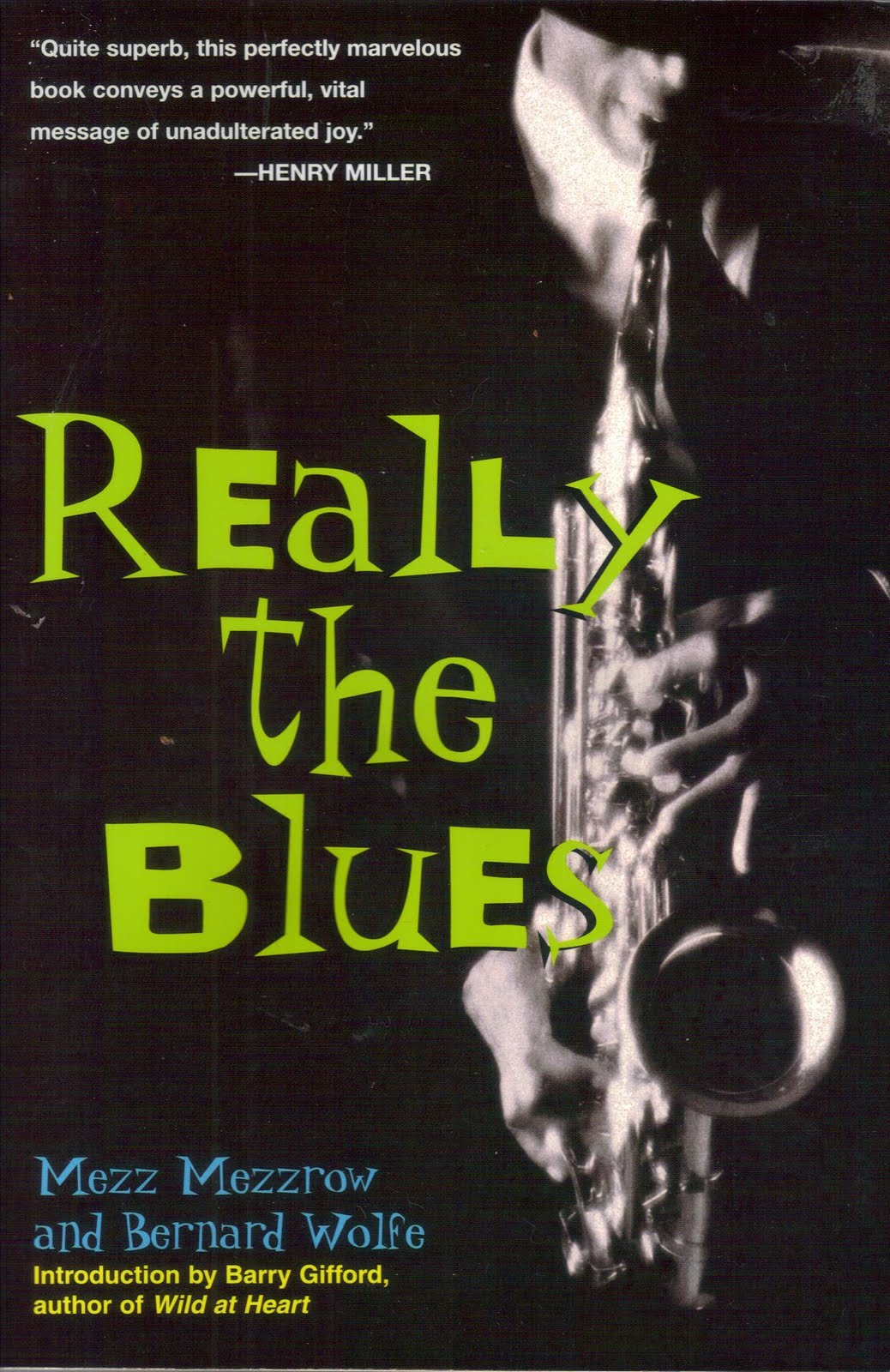
"Really the Blues," by Mezz Mezzrow


"Really The Blues" demonstrates how it's good to have something to do.

Talk about alternative paths. Milton "Mezz" Mezzrow blazed one through the jungle of conformity, "went black," lost time to drugs, fomented early 20th century jazz, became too familiar with jail, but remained focused on a vision.

Were it not for the journey New Orleans jazz made up the Mississippi to Chicago in the early paces of the 20th century, Milton Mezzrow would have had, like all of us, a story to tell, but no audience.

His story stands on three sturdy and utterly novel legs.

One was a total adhesion to all things African-American, or Negro, as they said in his day. A second was the aforementioned passion for a very specific jazz that came up out of the Crescent City and got amplified by his friend, Louis "Pops" Armstrong. The third was a commitment to the manifold virtues of marijuana or, as he alternately referred to it: golden leaf, gauge, muta, and -- highwayscribery's favorite -- muggles.

Tee-hee.

Raised on Chicago's south side, "Mezz" landed in jail early. More stupid than criminal, his interest in the clarinet and saxophone kept the young Jewish jailbird on the up-and-up; focused and ennobled his misbegotten adventures.

His story really takes form upon moving to New York with Gene Krupa and a tiara of future jazz-era jewels in an attempt at storming the music industry's gates with their hot new toy.

Settling in Harlem, establishing his base at the intersection of 133rd Street and Seventh Ave., Mezzrow became the "white mayor," the "link between the races," ambassador for muggles, purveyor and recorder of a unique argot -- the poetry of the proletariat -- "jive."

The Mezz was an influential fellow in his moment and this jive the dominant tongue at the intersection of Cool Street and Downbeat Avenue.

"Really the Blues," came out when Jack Kerouac was digging the music Mezz expounds upon, and it's no fantasy to surmise that the beat poet's jazz-infused prose are not heavily influenced by this book and the way it is told.

We're suggesting, without a hint of accusation, that Kerouac borrowed heavily from, or at least riffed on, the Mezzrow's mostly forgotten text. It's called research and is born of the writer's anthropological duty.

Colorful or operatic, Mezzrow's life was rarely easy, but he kept blowing horns, in and out of jail, searching for a soul-state firmly rooted in his beloved New Orleans jazz.

An uncompromising commitment to the style finally bore fruit in his savoring of Sidney Bechet's "Blues of Bechet" and "The Sheik of Araby."

He describes the epiphany thusly:

"It meant: Life gets neurotic and bestial when people can't be at peace with each other, say amen to each other, chime in with each other's feeling and personality; and if discord is going to rule the world, with each guy at the next guy's throat, all harmony gone -- why, the only thing for a man to do, if he wants to survive, if he won't get evil like all the other beasts in the jungle, is to make that harmony inside himself, be at peace with himself, unify his own insides while the snarling world gets pulverized."

The next natural and positive step for Mezzrow was to team-up with Bechet.

In a publication called "The Record Changer," reviewer Ernest Bornemen said that these tracks, "went back beyond Louis and beyond Bunk Johnson and beyond Buddy Bolden, to the very roots of music, to the cane and the rice and the indigo and the worksongs and the slave ships and the dance music of the inland Ashanti and the canoe songs of the Wolof and Mandingo along the Senegal River."

The review represented Mezz's crowning moment. Not as a professional poo-bah, but as proof that he had reached an important milestone in his musically inspired drive for spiritual wholeness.

Mezzrow closes his tale by relating how writer Bernard Wolfe convinced him to cough-up an autobiography. Wolfe's words best describe what's on tap in "Really the Blues."

"Not very many people have gotten a good look at their country from that bottom-of-the-pit angle before, seen the slimy underside of the rock. It's a chunk of Americana, as they say, and should get written. It's a real American success story, upside down: Horatio Alger standing on his head.

"In a real sense, Mezz, your story is the plight of the creative artist in the USA. -- to borrow a phrase from Henry Miller...It's the odyssey of an individualist, through a land where the population is manufactured by the system of interchangeable parts. It's the saga of a guy who wanted to make friends, in a jungle where everybody was too busy making money and dodging his own shadow."

Mission accomplished, Milton.

Sunday, September 12, 2010

"Servants and their Masters," by Fergus Reid Buckley


highwayscribery knows first-hand how falling in love with that magnificent state of place and mind known as Spain comes at a price.

Had he fallen in love with England, author Fergus Reid Buckley's "Servants and their Masters," might have become a text of reference in matters related to that country's mid-20th century aristocracy.

Perhaps the BBC might have picked it up and sorted out a new "Forsythe Saga" series, or an "Upstairs Downstairs."

In penning his nine-book, many-hundred-paged epic, Buckley learned that, "I don't think you can sell novels chock full of Spanish names to American readers."

Yet.

But clearly, writing "Servants and Their Masters," brought joys to an author who immersed himself in all things Spanish, learned to dance flamenco, and clap the various compas that mark the form's musical time, as preparation.

There are books aplenty about the Spanish Civil War. The horrors, or relative peace, of the Franco era are documented in fiction and nonfiction alike. The vaunted democratic transition is still being written about by those who forged it.

But "Servants and Their Masters," stands practically alone in its English-language rendering of 1960s Spain. A period when the country slouched toward prosperity and into the community of Western democracies in spite of the dictator's longevity.

The tale begins with the unflattering portrait of a softened aristocracy eating, drinking and whoring away its dwindling influence in a Madrid exploding with recent wealth and a newfound rich to exploit it.

Supporting this decadent class are a cast of brigands, victims, guttersnipes, schemers, sex predators, and bordello types rendered ever-so-faithfully, by a gentleman who has seen much in his days.

Says Buckley, "I have never been able to comprehend a character unless I had some fix on that person's parents and kin and the society that person descended from. I view almost everything from a perspective of three generations, when, and only then, the person begins to make sense to me."

As such, "Servants," bounds from the death-rattle of the noble clan under its microscope, to the centuries-old warfare they engaged in their northern homeland of Sacedon, while weaving in the progress of a recent Basque peasant for fine measure.

Almost every character gets (at least) one chapter about themselves, their background, urges and vices, without the exposition ever getting in the way because, given its obvious size, the reader is aware of their commitment to something large and worthwhile. And also because Buckley's scenario grabs from the start while establishing a fever for illumination.

The author is a rambunctious prosodic force, in command of English and possessing a vocabulary both extensive and colorful. Moods change throughout the yarn's meticulous unspooling, sometimes macabre, others satirical, alternately noir-like, journalistic, philosophic, or comical.

In a favorite moment, Buckley resorts to thick and somber strokes in conjuring a poem of the coastal Basque country:

"On clear days, especially in the autumn, when the air seems to have been distilled in crystal goblets, their highest crags are sculpted against the horizon. More often, the crags are shut out; and clouds rolling, rumbling herds press down and nearly snag themselves on the belltower of the church, and often blot out entirely the ruins of the castle. The whole northwestern flank of Spain heaves down to the Cantabrian in a front scalloped by coves and tidal lagoons, great bluffs, studding the coast and forming amphitheatres connected to each and within vast sand beaches stretch like ligaments."

Highlighting that passage exalts the writer, but misrepresents the larger work wherein Buckley's rapier pen renders mordant portraiture of rotten people both high and low on the social ladder.

There are good people, too, but they're for contrast and respite from the psychic and physical slaughter the ugly ones unleash.

"Servants" links the lower class with the highest until a reader begins to forget who hails from which side.

Which is somewhat the point Buckley is trying to make through the glib and insightful narrative recounted by the American businessman C.O. Jones in an ambience that effectively blurs which way is up and which way down.

Friday, September 10, 2010

"Anarchism and The City," by Chris Ealham


Anarchism and the City: Revolution and Counter-Revolution in Barcelona, 1898-1937decodes Barcelona's urban landscape for reasons behind the unlikely rise to power of anarchist elements in those years preceding the Spanish Republic and the civil war that consumed it.

Chris Ealham brings an urbanist's tools to this interesting proposition, positing sometimes insightful, other times idealistic, explanations to questions about the Confederacion Nacional de Trabajo's (CNT) season of sway over Europe's then-most productive city.

Academic in style, "City," serves up enough good stuff to offset the loss of momentum resulting from the historian's job of stringing evidence from various sources and affixing them to each other with footnote glue.

Ealham documents the geographic reordering of Barcelona as undesirable immigrants from the south of Spain swelled its working class in an era when the city was considered "Europe's factory."

Viewed as something "other" (the author proposes), as fomenters of vice and carriers of disease, this surging class of workers was subjected to a bourgeois reordering of the urban terrain that isolated and marginalized.

Ealham's view is that, left unto themselves, the working class folk of Barcelona wove themselves into a collection of tight units clear on what the issues facing them were and how to address them.

For a while, the anarchist policy guys showed real prowess in organizing neighborhoods, winning their loyalty to the CNT unions' causes, and channeling a universal resentment against the existing order.

Then they put that existing order to work for them:

"Making full use of improvements in the transport system and the growing availability of bicycles, and backed by the Barcelona CNT's paper, Solidaridad Obrera, which played an essential auxiliary role, advertising union meetings, talks and social activities across the city, the local federation would receive feedback from, and send instructions to, the comites with the great speed. This enabled the CNT to respond swiftly to events on the ground and generally mount a more sustained and coordinated opposition to capitalism."

A big policy winner for the CNT was embracing the despised Andalusian and Murcian migrant laborers, and other groups not found on the industrial shop floor.

"Ever ready to mobilize beyond the factory proletariat," Ealham writes, "the radicals applauded street gangs as a vanguard force in the fight against the police."

Harassed ambulant street vendors and the unemployed alike also responded when the
CNT called for action; action that transcended the workplace and transformed the streets.

The union and its minions expanded public space, cultivating working class interaction that produced a dense web of community relations only a civil war sunder.

As its title suggests, this is about the CNT in Barcelona, even though the union's influence stretched well-beyond Catalonia's borders. There the organization thrived under the conditions so painstakingly detailed by Ealham, and did so in its own way.

Resorting to violence didn't hurt.

The author quotes one source as saying, "This was an original type of criminality that was typically Barcelonese. The anarchist robbers of Barcelona are nothing less than the Catalan equivalents of Al Capone...Today it is the fashion among all thieves, pickpockets and swindlers to pass themselves off as anarchists."

"Anarchism and The City" was published by AK Press, an anarchist imprint, and Ealham, while maintaining a balanced tone throughout, is okay with the idea that, at some point, a people being exploited have the right, are obligated by the dictates of survival, to kill the guy who is killing them.

It's a chicken-or-the-egg quandary. For Ealham, the question of whether the anarchists and their constituency had any choice in the matter of violence is worthy of a deeper consideration.

In his examination of how the loosely structured union federation interacted with the working class barris, the relation to and impact of the Federacion Anarquista de Iberia (FAI) upon the CNT, and how shadowy associate groups used the gun to "appropriate" banks and erase political enemies, Ealham's efforts are first-class.

It's fascinating stuff that renders Spanish anarchism more understandable, if not completely dispelling the notion the rank-and-filers were a little nutty, or appear so thanks to their disparate ideas for reorganizing society.

Noting that the anarchist revolution was the first of its kind in the automotive era, the author observes how workers were seized by an "irrationality" after appropriating the cars of the merchant and capital classes.

"But revolutionary motoring possessed its own logic," Ealham writes. "In the first instance, the destruction of cars reflected a desire to usher in a new set of spatial relations as well as resistance to the attempts by the local and central Republican authorities to impose a new urban order of controlled consumption, consisting of new rules of circulation and traffic lights designed to improve the flow of capital and goods."

Or not.

Rather than ushering in new spatial relations the armed workers may have just been having a crazy time in cars. It happens, you know.

He observes that, "On the day after the birth of the Republic, as a gesture of solidarity, the Barcelona CNT declared a general strike that affected all branches of industry apart from the essential food and transport services."

The Republic/Spanish Civil War epoch is akin to a family fight and the multi-sided affair can tug at one's loyalties depending upon which side's version is being aired.

Read the well-written diaries of Republican leader Miguel Azana and savor the portrait of a rational, intelligent and literate man burdened with allies and governing copartners bent on overthrowing the enterprise he's been elected to lead.

It's hard to imagine Azana viewing the general strike as a gesture in solidarity.

While sympathetic, Ealham is not so blind as to ignore the fact that, as anarchists and their allies launched a revolution in red Asturias they hoped would throughout the Iberian peninsula, "Francisco Ascaso, 'Nosotros' member [an anarchist affinity group] and secretary of the Catalan CRT, issued a call to the Barcelona proletariat to return to work from a radio station controlled by the Spanish army."

My revolution, not yours, you see.

The anarchists thrived for a season as the CNT, FAI and related groupings were wonderful at forging a cohesive culture and strategy for the beleaguered barris residents. But Ealham lifts the lid on the corner committee meeting and details the inner-workings, the feuds, and fault lines that hampered the movement.

Ealham spends less time on the CNT's temporary reign over the streets of Barcelona after fascist generals rose up to destroy the Republic. And he does well in eschewing too detailed a rendering of those events, because that is much-tilled terrain.

The real triumph of "Anarchism and The City" is its fulfilling the title's pledge. Showing how a metropolis's geographical configuration, industrial bent, and raw social arrangements made a bed comfortable enough for some very unique individuals to sleep in.

Wednesday, August 11, 2010

"The Red and Black" by Stendahl


Post-Napoleonic France was no meritocracy.

Stendahl's ambitious and ambiguous protagonist, Julien Sorel, is a peasant with a great memory for Latin and Biblical passages. These academic talents are joined to a youthful sensuality that earns him the romantic admiration of two women, one a bourgeois and the other a titled aristocrat.

The young intellectual does well to depart the family run mill where his father metes out brutal beatings as reward for his lack of interest in the enterprise.

This unfortunate childhood means that Julien, like most people, has multiple dimensions, some of which are off-putting to those around him (and to the reader).

Sorel’s cold calculations, his toying with the feelings of smitten and repressed women, serve him well on the way up, but rampant internal dialogues and painful inexperience litter his progress with self-made obstacles.

Julien is a closet admirer of Napolean (Red) during the post-revolutionary restoration (Black) and opts for the life of an aspiring Catholic cleric to ensure his future, staining himself with the same hypocrisy he sees and loathes all around him.

As such, "The Red and the Black" sketches a panorama of what the social climber faced both in the provincial setting, where this “Bildungsroman” begins, and among the Parisian aristocracy, where it ends.

The novel is a confirmed classic with a compelling narrative that should hold a reader’s attention all on its own.

However, an interest in how young Dukes and Counts of the era conversed with, and considered, each other will increase the appeal of "The Red and Black." A curiosity about bourgeois comportment and France generally will help, too.

Diane Johnson, tapped to pen the introduction of the Kindle version review here, notes that Stendahl’s portraits of the two principal female characters, Madame to Renal, and the aristocrat Mademoiselle de La Mole, are deeper and more loving than those typically found in novels of the time.

The ladies are, like Julien, alternately admirable and flawed and therefore realistically rendered, chafing at the limitations of their classes and gender.

To give away the end is to give away the book so prospective readers will have to take the plunge content in knowing that “The Red and Black” maps a rake’s progress while exposing, via the author’s own experiences as a man of consequence and leisure, 19th century French society and its maladies.

Monday, August 9, 2010

"A Diary from Dixie" by Mary Boykin Miller Chesnut


If the Confederacy had survived Lincoln's invasion, Mary Boykin Miller Chesnut might be a household name in the literary world.

And that's pretty good when one considers that her oeuvre was written without the slightest whiff of literary pretension or ambition.

highwayscribery is not sure if a deep interest in the Civil War, from the southern side of things, is necessary for her scribbling prowess to impress. But if it's there, "A DIARY FROM DIXIE" is for you.

Chesnut was well-positioned to chronicle Dixie's misery both as a South Carolina lady intimate with Jefferson Davis and his wife, and wife to a Confederate officer whose competence is apparent in his upward trajectory throughout the book's (and war's) course.

The authoress succeeds in engaging the reader without any real structure other than the natural chronology of events as she lives them. The gentle lady moseys from one happening to another, recounting those things she witnesses, and those others have told her about, with nary a transition.

But the recounting is so casual, the prose so clean, the reader is niever tried, taxed or bored. Chesnut was a feeling, seeing person with the literary chops to put what she felt and saw into words, as in this passage describing the family plantation, Mulberry, in Camden, South Carolina:

"It is so lovely here in spring. The giants of the forest -- the primeval oaks, water-oaks, live-oaks, willow-oaks, such as I have not seen since I left here -- with opopanax, violets, roses, and yellow jessamine, the air is laden with perfume. Araby the Blest was never sweeter."

There are fascinating, first-hand insights in "Diary" as to the way slaves and masters interacted, and the ambiguous attitude of negroes in the south when freedom beckoned, but their familiar world crumbled.

Chesnut's tones are not the stark blacks and whites of Harriet Beecher Stowe's south, rather a wide array of grays.

The relations between the furiously independent member states are also depicted, with Virginians, and Kentuckians, and Carolinians both north and south, remarked upon for their peculiar, geographically bound traits.

In these times, as a single electronic culture inexorably engulfs humanity, it is interesting to read about the differences between neighboring communities and see how they celebrated those differences.

The book's tone morphs from light to dark as the northern noose tightens around the Confederacy's neck. Noteworthy is the early opinion, expressed by rebels in high places, that the South had no chance of winning the war.

"Diary" tells us that had clearer heads prevailed, the cataclysm might have been averted.

The dominant portrait is that of a small, agrarian society confronting a behemoth that will leave no stone unturned, no home unburned, and kill-off a generation of fine young men -- not all of them enamored with slavery -- so much as loyal to their homeland.

"Others dropped in after dinner; some without arms, some without legs; von Boreke, who can not speak because of a wound in his throat. Isabella said, 'We have all kinds now, but a blind one.' Poor fellows, they laugh at wounds. 'And they yet can show many a scar.'"

Chesnut is in the rearguard, her lofty status slowly reduced to a state of hunger bourn with ladylike dignity. Hers is the Confederate women's story, a dreadful enumeration of lost sons, sundered families, and mothers literally dying from grief.

"Isabella says that war leads to love-making. She says these soldiers do more courting here in a day than they would do at home, without a war, in ten years."

Perhaps most valuable are those anecdotes Chesnut recorded which give the war between the states, and the Confederacy in particular, a greater depth and richer texture.

Without her we might not have known that President Davis' little boy died at home, nor of the suspicions that a turncoat on staff, or a spy snuck into the house, actually killed him in a cruel effort to demoralize Dixie.

The tragic deaths of innocents stepping out from a cave for some air in Vicksburg during the Union siege might have gone unrecorded. We could not be aware that France's last Count de Choiseul had thrown his lot in with the south and died for it, too.

Without her desperate scribblings, we would have known only the winner's account, and been denied the terrible beauties associated with losing, which is so much a part of life.

Friday, August 6, 2010

Mr. Sammler's Planet


"Mr. Sammler's Planet" (Penguin Classics) makes the case for sticking with an author's big hits before delving into their more exotic offerings.

Saul Bellow, of course, is/was a famous writer whose big triumphs were "The Adventures of Augie March" (Penguin Classics)and "Herzog." (Penguin Classics)

highwayscribery decided upon "Mr. Sammler's Planet," thanks to its being mentioned in a column by David Brooks of the "New York Times."

In "Children of the '70s," Brooks sought to put a damper on recent enthusiasms for 1970s New York as a dangerous, but freewheeling and artistically sympathetic urban landscape that, on balance, was much better than the white flight and capital disinvestment that characterized it.

highwayscribery, who grew up in that New York, indulged just such a flight of fancy in his post memorializing the recently deceased downtown poet, Jim Carroll.

Brooks noted in his piece that, when the city tried slum clearance on the upper West Side, "Crime did not abate. Passivity set in, the sense that nothing could be done. The novel, 'Mr. Sammler's Planet,' by Saul Bellow captured some of the dispirited atmosphere of that era -- the sense that New York City was a place of no-go zones, a place where one hunkered down."

Some.

"Mr. Sammler's Planet," to the extent that it is about anything, fleshes out the post-Holocaust relationships between Jewish folk in New York: their mutual aid toward one another and the friendships forged by their unique and tragic recent history.

It is, briefly, about a pick-pocket Sammler watches and with whom he later experiences an unfortunate encounter. It is about the pending death of a close friend and benefactor. It is about his wacky daughter and her personal quest to make a father whose claim to fame is a long-ago relationship with H.G. Wells relevant to fast-changing times.

But these story threads are a skimpy skeleton upon which Mr. Bellow hung a lot of issues swimming around in his mind. It almost works until he gets into a discussion with Dr. Govinda Lal from whom his daughter Shula has stolen a manuscript.

The exchange is characterized by long-winded discourses from both men on the nature of things, which, to their minds, cannot be described in elementary terms. The two gents hold court with only the rarest authorial interjections to remind us these are characters talking and not just a stream of raw, unplugged Bellow.

The author was a Nobel Prize winner whose thoughts are novel and well-expressed. There is certainly valuable currency in "Mr. Sammler's Planet," but less of a story than one might expect from someone quite so celebrated.

Bring on "Herzog."

Tuesday, April 27, 2010

"Magnificent Catastrophe," by Edward Larson


Ambitious people don't always come off too well in literature, and "A Magnificent Catastrophe: The Tumultuous Election of 1800, America's First Presidential Campaign" shows that our hallowed founding fathers were no exception.

The "Founding Fathers" are usually presented as an archetype of monolithic cohesion; high-minded patriots, with a nascent American polity's well-being the driving force behind their every action.

There is a wistful, almost universal, sentiment that says, “they just don’t make them like that anymore.”

But this book establishes that they were monolithic only in their desire for independence from England, and thereafter took radically different positions.

Pulitzer Prize-winning author Edward Larson's portrayal of names as revered as Alexander Hamilton, Thomas Jefferson, John Adams, and the not-so-revered, Aaron Burr or Thomas Cotesworth Pinckney, leaves hardly a hair of difference between the high- and low-minded amongst them.

These gentlemen were, in the end, politicians. And like all specimens of that species, they craved power and stepped on people to get it.

Alexander Hamilton comes off particularly bad, or good, depending on your politics.

As a member of the "high Federalist" faction, which ruled before the presidential election covered here, Larson marks him for a pro-British, almost monarchical, presence on the American political scene. A guy who managed to finagle his own standing army out of the Federalist majority and was known as “General Hamilton.”

And he wasn’t the only founder with aristocratic tendencies.

Larson writes that the aforementioned Pinckney, “fought the Revolution to preserve what he, as a South Carolina patrician, viewed as the traditional rights of Englishmen, which for him included the God-given right to enslave Africans -- a right that prewar legal developments in Britain appeared to threaten.”

"Liberty or Death!" indeed.

It comes as quite a shock, in fact, that beacons such as Hamilton, John Adams, and other Federalists in power at the time had a strong aversion to, well, democracy.

They didn't like it, feared it, figured it for a precursor to the mobs, massacres, and guillotines that were all the rage in France at the time.

In fact, they made it a practice to tar Thomas Jefferson's Republican Party (not THAT Republican Party) as "Jacobins," after the unruliest faction of the tumultuous French political scene. Much the way today's Republicans go on about the Democrats being "socialists."

There is, perhaps, something calming in all of this. A vote of confidence for those who shrug at today's Washington shenanigans, confident that our Republic shall survive this, too.

The debate so marvelously detailed here traces the pedigrees of our current political divide.

It may come as a surprise, for those who went into paroxysms over the Bush administration’s scant deference to the rule of law, that such behavior has roots in the guy gracing our ten dollar bill.

Concerned that changes in Maryland’s election law would deliver the presidency to Jefferson, Alexander Hamilton wrote a fellow Federalist, “I am aware of strong objections to the measure, but if it be true, as I suppose, that our opponents aim at revolution and employ all means to secure success, the contest must be unequal if we not only refrain from unconstitutional and criminal measures, but even from such as may offend against the routine of strict decorum.”

In blog-ese, Hamilton is saying, “If we don’t act unconstitutionally or criminally, and risk offending everyone’s sensibilities, we’ll lose the election.”

Al Hamilton, meet Karl Rove.

This book makes clear that today’s rabid partisanship is hardly a new phenomenon.

As the complex election of 18000 is being resolved, things in Washington are at fever pitch. Members of the warring parties no longer socialize as they did up in Philadelphia and Massachusetts Federalist Harrison Gray Otis writes his wife to say, “I have concluded to go to no more balls. I do not enjoy myself with these people.”

Seeking to forge some kind of bipartisan sentiment, the victorious Jefferson is obligated to point out that, “Every difference of opinion is not a difference of principle.”

Sound familiar?

Well, the founders reacted in much the same way their legislative offspring do today, and they didn’t need Fox News or the Internet to slime far and wide.

Messenger on horseback was sufficient to spreading a rumor that the mostly forgotten Pinckney, a frequent and viable presidential candidate in those days, had gone to England in search of four mistresses for sharing with John Adams, who quipped in response: “If this be true, General Pinckney has kept all for himself and cheated me out of my two.”

There isn’t enough of such stuff in “Magnificent Catastrophe.” It's a dense, if worthwhile read.

That’s not Larson’s fault. The people he’s researching did what they did and said what they said, and the business of resolving the dangerous partisan rift was indeed a grim one.

In fact, “Magnificent Catastrophe,” suffers from its almost exclusive focus on the inside ball associated with the party politics that followed the death of George Washington who preferred that grand and national coalitions conduct the country’s business.

Readers may yearn for a wider portrait of America, such as that rendered in the account of John Adams’ time on the hustings, when an agrarian, English-styled nation filled with country villages surfaces, if only too briefly.

“Magnificent Catastrophe” doesn't quite live up to its grandiose title. The founding fathers’ low-brow dealings are anything but magnificent, and the catastrophe was ultimately averted.

But it is a revelatory document detailing the way presidents were chosen in the nation’s early days, and dissecting the numbers, myriad votes, and concomitant conniving employed to affect them, in a tense political season that might have doomed the country.

Monday, April 5, 2010

"Just Kids," Patti Smith


"Just Kids" is just another Jersey-factory-girl-runs-to-New York-and-hooks-up-with-bisexual-art-pornographer-on-her-way-to-rock 'n roll-stardom story.

It details Patti Smith's evolution from tentative neophyte to rock-and-roll poetess, woven through with her unique relationship to Robert Mapplethorpe, a triumphant artist whose own untimely ending, alas, makes for engaging literature.

The place is lower Manhattan. The time-period is the mid-1960s and 1970s when Mapplethorpe and Smith are, age-wise, a "beat behind" the reigning princes and princesses of rock's golden age.

As such, she is influenced artistically by the Rolling Stones, The Beatles, Jimi Hendrix, Bob Dylan, and Janice Joplin for whom she pens poetic cycles while absorbing political pointers from Jean-Luc Goddard's "One-Plus-One."

The life-as-artist anecdotes have a familiar ring: hunger, rejection, perseverance, and a healthy amount of name dropping.

Smith has affairs with Jim Carroll, Sam Sheppard and a guy from Blue Oyster Cult. Allen Ginsberg mistakes her for a pretty boy in the Automat, and Gregory Corso imparts stern advice to the budding scribe inside her.

They are revealing tales that highlight Smith's achievement as survivor of an era peopled with fascinating characters demolished by addictions and carelessness.

"Just Kids" is the portrait of a New York City not completely subsumed into the grid of overpriced realty, before the Internet, where artistic ambition had a geographic component and required settling into some dump on the mighty Isle.

Here is "art" before its subsequent elevation to bourgeois respectability. To an artist of today's saturated market, the idea that you could install yourself at the Chelsea Hotel and initiate apprenticeships with living legends seems, with the benefit of hindsight, a no-brainer.

One can only assume that, in those days, choosing art meant the painful burden of rejection from loved ones and dangerous uncertainty on the path ahead.

So, as time capsule, "Just Kids" is just great.

But autobiographies should tell us something we don't know about somebody. They can be intriguing when it comes to artists; usually reinvented characters very mindful of their own brands, of what they show and don't show the world.

And who does Patti Smith tell us who she is/was?

For starters, because it's really how she got it going, Patti Smith is/was American as apple pie; thrifty, industrious, entrepreneurial, and self-involved, her Rimbaud-inspired disdain and punk rock posture notwithstanding.

Here Smith describes her efforts in the opening stanzas of the couple's bohemian idyll:

"I scoured secondhand stores for books to sell. I had a good eye, scouting rare children's books and signed first editions for a few dollars and reselling them for much more. The turnover on a pristine copy of 'Love and Mr. Lewisham' inscribed by H.G. Wells covered rent and subway fares for a week."

And she is a fashionista of the first rank.

Long before Patti Smith was confident enough to confront an imposing poetry world, she parsed a personal vocabulary in clothing ensembles that, 30 years on, she remembers down to the last accessory.

Here she describes a successful attempt at sartorially seducing Television guitar-star Tom Verlaine to work with her band:

"I dressed in a manner that I thought a boy from Delaware would understand: black ballet flaps, pink shantung capris, my kelly green silk raincoat, and a violet parasol, and entered Cinemabilia where he worked part time."

And she is materialistic. Not flat-screen TV materialistic, for sure, but tightly tied to and moved by objects tactile and tangible.

Before joining Mapplethorpe for a photography shoot she, "laid a cloth on the floor, placing the fragile white dress Robert had given me, my white ballet shoes, Indian ankle bells, silk ribbons, and the family Bible, and tied it all in a bundle."

During the shoot she is stricken with anxiety that is eased by Mapplethorpe's knowing voice and a change into dungarees, boots, an old black sweatshirt.

Smith interprets this evolution as an expression of certain ideas she and the photographer have discussed prior. Ideas about the artist seeking contact with the gods, but returning to the world for the purpose of making things.

Her conclusion to the section does not surprise: "I left Mephistopheles, the angels, and the remnants of our hand-made world, saying, 'I choose Earth.'"

As for Mapplethorpe, especially if you're a foot soldier in the art world, he seems a rather common phenomenon: ambitious and single-minded in his craving for fame. Patti's lazy percolation into what she would ultimately become makes for an infinitely more interesting yarn.
One gets the feeling he might agree. In one of the most charming parts of the book he tells her through a cloud of cigarette smoke, "Patti, you got famous before me."

She dubs Mapplethorpe her "knight," but this reader cared thanks to the love she invested in him.

Mapplethorpe, of course, was an artist and all the writing about art in the world cannot replace the actual experience of it. Perhaps he is shortchanged by the autobiographical form; try as his muse does to honor him.

Although we rarely accuse anybody of being too old to rock 'n roll anymore, writing remains a mature person's game. So it was Smith's good fortune to be a writer first, a musician later, and a writer now, because she brings lit-passion and a high level of skill to "Just Kids."

This is especially true towards the end of the book. In earlier stanzas she is more a chronicler of the famous and idiosyncratic characters surrounding. When the poetess describes the artistic vision, purpose, and goals upon which she ultimately settles, the narrative assumes the force of that direction:

"We imagined ourselves as the Sons of Liberty with a mission to preserve, protect, and project the revolutionary spirit of rock and roll. We feared that the music which had given us sustenance was in danger of spiritual starvation. We feared it was losing its sense of purpose, we feared it falling into fattened hands, we feared it floundering in a mire of spectacle, finance, and vapid technical complexity. We would call forth in our minds the image of Paul Revere, riding through the American night, petitioning the people to wake up, to take up arms. We too would take up arms, the arms of our generation, the electric guitar and the microphone."

Pretty grandiose stuff.

But she is, in "Just Kids," nothing if not a dramatist scripting the play of her own life, decorating it with universal symbols, inserting Patti Smith into art history's larger arc.

There are persons and outlets, many in the very cultural current Smith helped generate, who find such self-positioning both cloying and pretentious.

Not highwayscribery.

Worms squirm in the mud and we are all welcome to join them. Walking with the deities is the tougher task and should be worthy of our admiration.