Showing posts with label Benjamin Franklin High School. Show all posts

Thursday, February 11, 2010

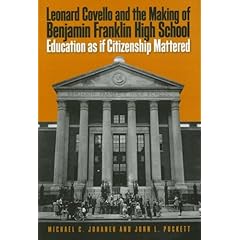
"Leonard Covello and the Making of Benjamin Franklin High School," Michael Johanek and John Puckett


"Leonard Covello and the Making of Benjamin Franklin High School: Education As If Citizenship Mattered"dissects American society's move away from the public commons and towards the individualistic principles and private sphere championed in the conservative canon, through the experience of one man at one New York City high school.

The authors Michael Johanek and John Puckett recap their effort with the closing question: "How does Covello's theory and practice of community school speak meaningfully to the problem of American's hastening retreat from the public sphere?"

"Leonard Covello and the Making of Benjamin Franklin High School" is a tough academic slog covering the first days of the community school movement, as envisioned by the education theorist John Dewey, and the way it dovetailed with the early 20th Century reform movement in the United States.

It discusses, in adequate detail, certain preliminary thrusts at integrating a school's efforts into the goals of the surrounding community, and their varying degrees of success.

But mostly, and as the title suggests, the book returns to Leonard Covello, an Italian immigrant convinced of education's value to any newcomer's development, and his efforts at applying community school principles in the well-defined terminus of East Harlem, New York City.

The book demonstrates the verity of Emerson's platitude that, "An institution is the shadow of one man," by tracing Covello's efforts at opening a school for the underserved area, teaching Italian to the children of immigrants from Italy, and grooming enough students to generate at least one formidable star -- Vito Marcantonio.

Marcantonio gave Covello the nickname by which two generations of high school boys would come to know him - "Pop."

More importantly, he helped his old mentor construct a new public high school on the banks of the East River, secured countless employees from the Depression-era Works Projects Administration to staff it, and stood guard when the experiment came in for conservative attacks.

The meat of the book covers the very specific work Covello and his team did implicating Franklin into the troubled neighborhood's affairs.

These included a sociological mapping of immigrant focal points, exhaustive surveys of area businesses, clean-up campaigns, storefront community centers, communal gardens, parades, dances, and conferences on racial tolerance crucial in a neighborhood where Italians, Puerto Ricans, Blacks, and slivers of other groups cohabitated uneasily.

The book makes clear that putting these ideas in play turned out to be a lot harder in practice than they were to write about in theory.

There is admiration for Covello and his dream, but no whitewashing of his shortcomings nor the fact that the Franklin experiment was largely over even before he retired in 1956.

There is fair analysis of the political winds buffeting attempts at improving East Harlem through the direction of a scholastic hub.

As the progressive '30s gave way to the World War, the ensuing conservative era, and Marcantonio's unseating in Congress, the very idea of "community school" carried the unpopular baggage of socialism and Covello's wings were clipped accordingly.

Finally, the authors draw conclusions about how the failure speaks to education in America today and suggest the circumstances of Covello's time prevailed over principles which were not only sound, but of enduring value.

Wednesday, February 3, 2010

"The Muckrakers"


One of the nice aspects to being sick, and there is a silver lining in just about anything, is that you, if so inclined, can get a lot of reading done. We’re talking mildly sick here; sick so that you drift in and out of swoons induced by stuff you can buy over the counter. the scribe’s Nyquil years are mostly behind him and reveries during this recent lay-up were fueled by Alka-Seltzer flu medicine, benadryl, and Vitamin-C powder packets.

the highway scribe scarfed down a good number of books and reports on them will be spread out over the next few weeks. First to be finished off was "THE MUCKRACKERS"which was edited back in 1961 by Arthur and Lila Weinberg.

The tome contains actual writings of the famed muckrakers who wrote in the first decade of the last century. Their specialty was uncovering abuses and those abuses could be committed by labor unions, or government officials, or a church, but mostly they worked to bust up the concentration of wealth as represented in the giant corporate trusts that had surfaced 20 or 30 years before.

President Theodore Roosevelt coined the expression, “muckrakers” in a speech that was largely critical of the era’s journalists who were, otherwise, mostly on his side, or at least shared the same goals of reform and a cleaner running system.

Among the offerings in “The Muckrakers” is the very speech in which Roosevelt gave them the name. He drew it from Bunyan’s “Pilgrim’s Progress” and “the description of the Man with the Muckrake, the man who could look no way but downward, with a muckrake in his hands; who was offered a celestial crown, but continued to rake to himself the filth of the floor.”

TR went on to preach caution from those leading the crusade and called for an even-handedness that would inform, but not inflame.

As they say, the name stuck.

The book spends some time on the atmosphere in which the muckrakers were born. It talks about the growth of mass circulation magazines such as “McClures” and “Cosmopolitan” that took it upon themselves to finance investigative reporters and publish their in-depth revelations to much scandle and positive affect.

Each section (The City, The State, Pure Food, Child Labor, etc.) is framed with a perusal of the issue at the time, and of a profile on the writer who did the work. Among these names are Lincoln Steffens, Ida Tarbell, Ray Stannard Baker, Upton Sinclair, and Mark Sullivan.

the scribe pulled the book for purposes related to his career as a journalist. It’s good to know what pioneers like this did and why. But coming to this book is a little like sampling Elvis after being raised on Pink Floyd. You’re not going to see the novelty in it; and from their novelty were the muckrakers' powers drawn.

This kind of reporting is done today in any number of weeklies and monthly’s on the right and left; “Harpers,” “Atlantic Monthly,” “The New Republic,” “National Review,” and so on. The techniques have hardly changed. This book is about the laying of groundwork.

What’s better and more useful about this collection of magazine articles are the portraits they render of the country in that time. It is a raw powerhouse sprawling its industrial self across a giant and empty continent, mostly lawless, if very Christian.

The essays connect the dots on how the great fortunes of the era – Frick, Vanderbilt, Morgan etc.– were built largely through the acquisition of what was supposedly the public trust. They tell the story of child labor to the tunes of millions across the southern textile belt. The muckrakers spun sturdy yarns of corrupt city machines and detailed even the battles for territory, or the love lives, of immigrant newsboys up from the streets.

It is hard to tell whether such an era of excess and abuse of public trust is a reflection on our own times, or if times simply don’t change; that for all our pomp and circumstance, being a thug pays best.

There was a law back in those times, that prevented people from leaving government to lobby the same place he just worked at.

What happened to that?

The work/slave conditions documented by William Hard and Edwin Marshall are not gone, just shipped overseas.

You can be a television cameraman and be killed in Baghdad hotel by U.S. forces (“A Dangerous Place,” March 22, 2005), or you can reveal the secrets of a seedy senate and be mysteriously assassinated like David Graham Phillips was for his articles in “The Muckrakers.”

Two pieces at the back of the book, “De Kid Wot Works at Night,” and “The City of Chicago: A Study of the Great Immoralities,” create a rather staggering portrait of the crazy town on the lake at the height of its power.

This Chicago is sprawling and active to the outskirts, a city created along mass industrial lines where the human element was not taken into consideration. The city’s largest business is vice, providing cheap (as in money) girls and cheap beer to the great swathes of workerdom serving the meat industry, the railroad, the ironworks, shipping. The girls are innocents pruned from the immigrant class and their trafficking is handled out of a city police department.

And for all that, the actions government took in response, the attention paid by the general population to the muckrackers’ message, are far beyond anything we might to expect today in terms of reform. They would not tread upon the feet of corporate titans they way they did then. They will not impose the will of the state over industry. Teddy Roosevelt, a Republican when blacks voted Republican, did.

And America listened to its muckrakers, rather than label them, and acted according to their recommendations. “The Muckrakers” as a book shows us what that interaction meant, and what has been lost between the press and its audience.