
It's no surprise that even when Jeanette Winterson is telling her own story, it reads as prime-cut literature.
This reviewer has only read one of the author's books, "The Passion," but it is a favorite for its balance of poetry and lilting plainspeak, for its fitting a world into a slim volume without it ever seeming crowded or busy.
"You play, you win. You play you lose. You play."
Argue with that.
In "Why Be Happy When You Could Be Normal?
 " Winterson recounts just how many times literature, the consumption and creation of it, saved her from mental depression, while sounding more relevant than self-involved.
Her secret?
Literature and the knowledge of its purposes and uses: "Personal stories,” she writes, “work for other people when those stories become both paradigm and parables. The intensity of a story...releases into a bigger space than the one it occupied in time and place. The story crosses the threshold from my world into yours. We meet each other on the steps of the story."
Yes we do.
In the separation from her birth mother she sees a wound each accrues and helps herself and the reader by using the Grail Myth as analytical tool, the "Odyssey," and "Gulliver's Travels."
We’re talking about Jeanette Winterson, but we’re talking about books and other stuff, too. Her approach to time's unfolding and the best way to live it out is detailed through a poem by Marvell (with who we are unfamiliar), her blueprint for approaching society extracted from Gertrude Stein's "The Autobiography of Alice B. Toklas."
The arc of Winterson's tale runs from her adoption and subsequent rejection by her adoptive parents, through all the insecurity and drive the sadness engendered, and her return to face the ghosts of her past because they have backed her, a renowned and remunerated English lady of lit, into a corner.
She mines gold out of a dark and treacherous mire, and much the same goes for this piece, which, for all its lingering in the mind's forbidden corners, is mostly optimistic.
There are more than two chances in life, she writes, "many more - I know now, after fifty years, that the finding/losing, forgetting/remembering, leaving/returning, never stops. The whole of life is about another chance, and while we are alive, till the very end, there is always another chance."
Which is good news for most of us and break from a suffocating conventional wisdom.
Apart from this book's psychological meditations, Winterson is long-lived enough to recount for us a hidebound industrial northern England where beans and toast are a treat, the bathroom is out back, and your mother locks you in a the coal pit for punishment without going to jail.
For all the difficulties she associates with that time and place, and for all the shiver-inducing abuse of her adoptive mother -- “Mrs. Winterson” she dubs her -- the author is perfectly liberal in her nostalgia for a disappeared world, one that stood out from others and they from it, one less homogenized than our own and which is recorded here for our reading pleasure as well.

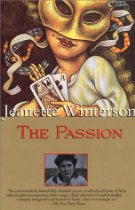
 Three readings of Jeanette Winterson's slim tome "