Showing posts with label Mexico. Show all posts

Friday, August 29, 2014

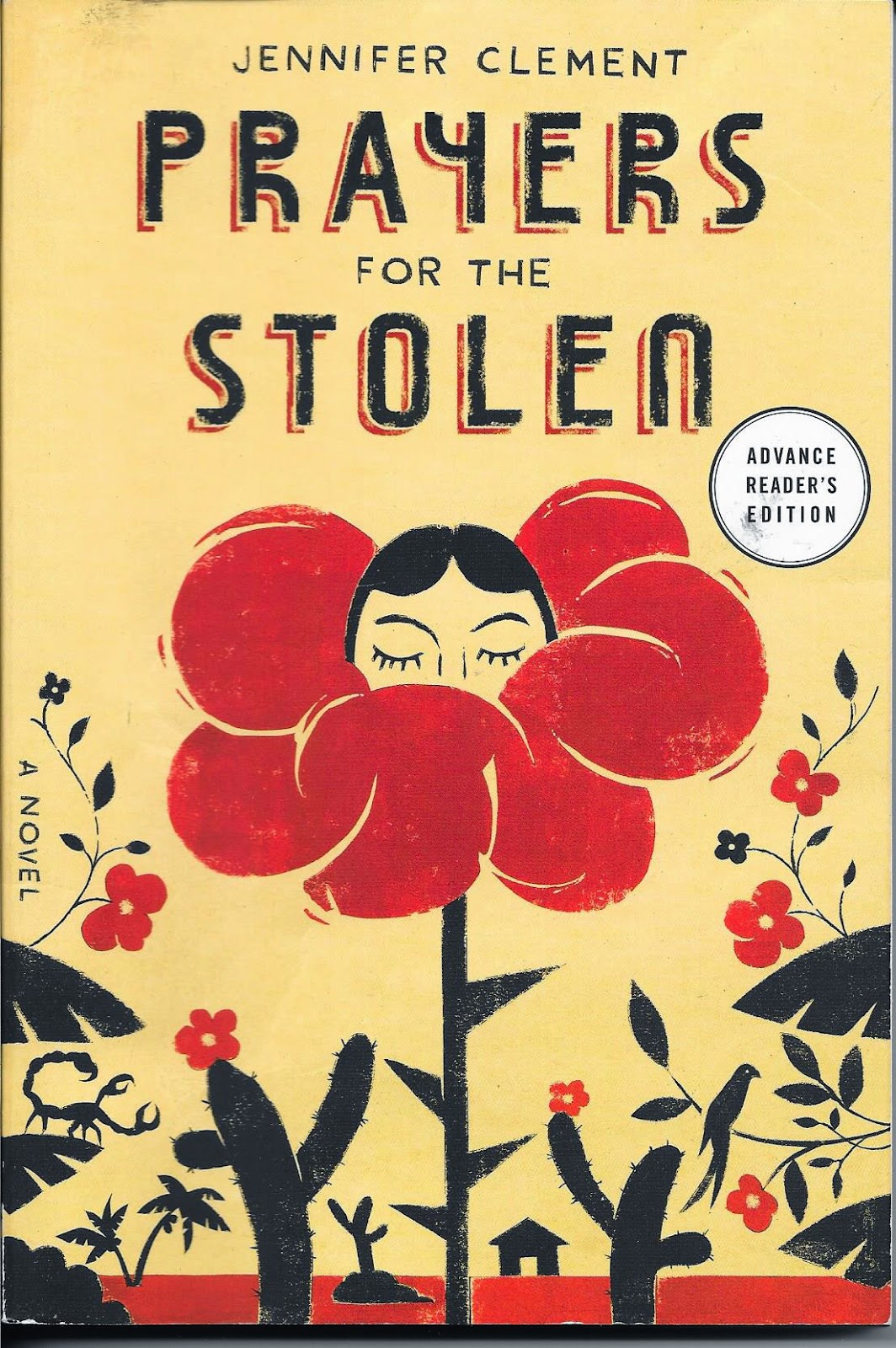
"Prayers for the Stolen," by Jennifer Clement


“Prayers for the Stolen” is a novel about innocence being violated with impunity, because it is innocence, and it is good, and it is weak.

If you are in the habit of shrugging off sanguinary stories of Mexican mass murder as the woes of people who probably got involved with things they should not have, Jennifer Clement's narrative will cure you of that habit.

“Prayers for the Stolen” depicts the lives of a dozen or so women, living on a hill in the jungles outside Acapulco, who are bereft of men and very vulnerable.

Says narrator Ladydi of the place where most of the yarn unwinds, “I thought of our angry piece of land that once held a real community, but was ruined by the criminal world of drug traffickers and the immigration to the United States. Our angry piece of land was a broken constellation and each little home was ash.”

The immigration is responsible for all the men leaving and never coming back, the drug traffickers are responsible for the “stealing” of pretty girls, without fathers to protect them, as merchandise in the sex trade.

That's the set up. Newborn baby girls are announced as boys, and little ladies are disguised as little men to throw off the drug lords' dragnets. When that no longer works, mothers strain to make the adolescent females ugly by blacking out their teeth and short-cropping their hair.

The girls and their mothers have dug deep holes on the mountainside. Their ears are attuned to the most distant rumbling of SUVs (the Narco's vehicle of choice), which triggers a run for the holes where the daughters will hide.

It's not much of a defense and the women are exposed to the most vicious kind of predators. Going any further along the narrative arc would be to drop spoilers, but it does not give too much away to say the story is also about the dissolution of traditional communities and the displacement of indigenous peoples in Mexico.

Says Ladydi of one acquaintance made along the way:

[Luna] was a small, dark brown Mayan Indian from Guatemala with straight black hair. I was a medium-sized, dark brown mix of Spanish and Aztec blood from Guerrero, Mexico, with frizzy, curly hair, which proved I also had some African slave blood. We were just two pages from the continent's history books. You could tear us out and roll us into a ball and throw us in the trash.”

Which is pretty much how their rights and plights are handled.

Clement keeps it simple, clean, yet colorful, and tells an engaging story that gives a human face to the femme fatalities in Mexico's war with its own dark soul and that of its neighbor to the North.

Wednesday, October 19, 2011

"Mexico: Mañana o Pasado?" by Jorge Castaneda


Según Jorge Castaneda, México es como un niño olvidado quien ha desarollado ciertos mecanismos para sobrevivir, pero que ya no le valen en el mundo moderno.


Los Mexicanos, por ejemplo, resultan ser individuales que acuden muy pocas veces a los proyectos colectivos como puede ser construir un estado de derecho o una sociedad civil.

Es lo principal y aqui dicho por Castaneda, "La supuesta devoción mexicana por la democracia choca con el individualismo de los mexicanos, y con su rechazo categórico a cualquier red horizontal de solidaridad, asociación, trabajo voluntario o forma simple de organización. El país presenta altos grados de desconfianza hacia sus instituciónes; carece de un sentido de la representación política y muestra un sentimiento profundo de ineficiencia e intolerancia politíca, ademas de un desapego generalizado respecto a la ley y una concomitante propensión a la corrupción."

Mucha palabrería, pero traza bien las fronteras de la propuesta encontrado en "Mañana o pasado, el misterio de los mexicanos."

Este deseo solitario nace de muchas cosas, entre ellas una "completa desconfianza mexicana hacia el gobierno y las instituciónes" en un país donde "la posesión de una parcela de tierra sigue representando la mejor defensa frente a un mundo exterior predatorio," opina el autor, un ex-ministro de asuntos exteriores en la administración de Vicente Fox.

Pero México anda camino hace el nuevo mundo. Castaneda nos informa que, "Para al final del periodo de Felipe Calderon, la población del país será, más o menos, dos terceras partes de clase media con todo lo que ello impílica política, económica, y socialmente; pero tal vez no, desafortunadamente, en terminos culturales."

Otro imperfección, o sea cosa poca perfecta, es la tendencia de esquivar el enfrentamiento.

Para el mexicano, "El único benefício posible derivado del la confrontación directa es que alguien pierda y alguien gane, y casi siempre, el que pierde va a ser mas 'mexicano' o mas' 'popular' que el ganador."

O, dicho de otra manera, el mexicano piensa que "Es mejor decir aquí corrio, que aquí murio."

Se tropieza con este tendencia en los ambitos de la economia, la política, los sindicatos o los medios de communicación.

En lo que se refiere al la democracia, los mexicanos lo valúa como un instrumento para "permitir y promover la convergencia entre fuerzas políticas" en ver de guarantizár que las divergencias "permanezcan en el rango de las resoluciónes pacíficas," tal y como el autor lo prefiere.

El país también sufre de una concentración del poder, poca sana para el futuro de la sagrada clase media.

Sugiere el autor que estas actitudes son arraigadas en la historia indígena de Mexico, "un tanto distinta de las otras por que la víctima es rey, la derrota es glorificada y las influencias y agentes extranjeros son decisivos e implacable," dice Castaneda.

El autor utilíza tal cantidad de datos que casi se aburre al lector, salvo que estos ejercícios académicos son compaginados con otros pensamientos mas curiosos, si no tan empiricos, como puede ser lo significado del cantor Juan Gabriel, el arte de Cantinflas, o el por que la selección Mexicana de futbol no vale diez pesos.

Un tóque suave ejerce Castaneda aqui. No grita, no insiste, sino sugiere y hasta entretiene con sus propuestas para México que, si no resuelven las grandes cuestiones aquí enumerados, abren camino hacía posibles debates y respuestas.

Para los que se interesan, quieren o aman a México, merece la pena sorber algúno de los pensamientos aquí presentados.


Thursday, February 11, 2010

"Tomochic," Heriberto Frias


If "The Battle of Tomochic: Memoirs of a Second Lieutenant" (Library of Latin America)were released as a new novel today, we'd be calling its author, Heriberto Frias, the "next Cormac McCarthy."

We could say the Mexican Frias, in his conjuring of a terrible military campaign against rebellious Catholic mystics in 19th-century Chihuahua, is "reminiscent" of McCarthy.

But Frias was not conjuring anything. He was an actual soldier-participant in the mission, which led to the slaughter of some 150 crazies with guns and the Virgin Mary for muse in the mountain hamlet of Tomochic.

By way of background, Frias first published chapters of his account in a short-lived newspaper called El Democrata in 1892, and was promptly tried for certain crimes against the regime of dictator Porfirio Diaz.

The editor of the newspaper stood for him, claiming he wrote the installments, not Frias, and everybody walked.

"Tomochic" is written in Spanish although a an English translation by Barbara Jamison is available. If you read Spanish, and if you've read McCarthy's "Blood Meridian," strong parallels may become apparent.

Like McCarthy (or vice versa), Frias renders a stark mountain desert landscape in gorgeous pastoral terms that contrast beautifully with the crude reality of his battle portrayals.

"Tomochic" follows an unfolding tragedy through the eyes of a misbegotten lieutenant who falls in love with a maiden on the enemy side.

It's a loose narrative with just enough development to keep the story from slipping into a straight, if poetically tinted, account of a military campaign. The narrative does not have a classic structure to the extent it is journalistic and life often follows less convenient rhythms than storytelling begs of us.

There is an opening battle in which the lieutenant's company, and comrades from other outfits, are largely routed by the defenders of Tomochic and the mayhem described is enough to send any draft-aged American sprinting for the Canadian border.

It is worth pointing out here that the people of Tomochic are not indigenous victims of criollo (white-European) expansion, but folks of good Iberian stock who take up their cudgels against what, ensuing events will confirm, is a brutal national government.

The rebels' ferocious initial stand aside, the Army gets enough booze and food into its boys to proceed in crushing the remaining band - women and children included - with a machine-like mindlessness.

That's not a spoiler. "Tomochic" is sold and packaged as the story of brutal repression in the Mexican hinterlands.

Frias doesn't go into a ton of editorializing. He takes no sides, sees heroism in the army youths sent to do a pointless job, sees nobility in the steadfast guerillas, paints the ironies of a Mexico where Pima Indians help federales put down a revolt of Catholic devout.

The author's loyal and detailed accounting of the military's actions are condemnation enough.

At a certain point, there are too few surviving Tomochitecos to harm anyone. But the army stays on partying, killing slowly, burning villagers alive in their homes and church, piling battlefield cadavers into bonfires that are then fed upon by swine roaming the impromptu death camp.

There is little in the mop-up job to recommend the dictatorship, the Mexican Army, or any other modern killing machine for that matter.

There is only a foreboding sense that humanity hasn't advanced one wit since Frias' picturesque cavalry road into the valley of Tomochic, blind, dusty, and blood-lusty.

Tuesday, February 9, 2010

"Enchanted Vagabonds," by Dana Lamb


SAN DIEGO – Enchanted Vagabondswritten by Dana Lamb is published by the Long Riders’ Guild Press, which has dedicated itself to reproducing books from something called the Equestrian Travel Classics. These are books that have fallen from mass distribution with the passing of time, but which the publishers feel “remain of global interest and importance."

“Enchanted Vagabonds,” a 414-page opus of dense reading and no plot to speak of, involves a journey made by Lamb and his wife Ginger in the thick of the great depression. Friends from childhood in then-agricultural Orange County (Southern California) Ginger and Dana had dreams of adventure. Having little to lose, they set out from San Diego in a canoe/sailboat of their own engineering, for the Panama Canal.

The sojourn took three years and it is a tale most engrossing, especially for those who hunger to know of an earlier world before crowding, pollution, modernization, and the mass endangerment of nature’s many species of plants and animals.

It is of special interest to Southern Californians of the surfing variety for its early chapters dealing with the Baja California peninsula, which today (and thanks to its ruggedness and inhospitality) remains a kind of last frontier for those seeking raw territory to discover and roam.

Revealing indeed is this portrait of a Mexico largely unsettled and a nation only in name. As they make their way down the Pacific coast of the great country, each stop into port represents a sampling of Indian/indigenous life almost unspoiled by the sullying hand of European culture.

More often than not these Indian villages welcome the sensitive and sensible travelers with open arms, grand fiestas, and kind treatment; treatment that on a few occasions represents the difference between life and death for the lusty and ingenuous adventurers.

Stricken with malaria in the jungle, mad with fever to the point of delirium, the couple awaken many weeks later in a village that has taken them in and assumed the difficult task of curing and nurturing them back to life. The difference between depression-era America and the pre-Columbian ways of the Indians marks the couple so that, as Lamb puts it, “we no longer fit in to the picture” (of modern life).

The Indians are not friendly at every turn, and particularly along a stretch of inland seas the couple must traverse to avoid death at the hands of powerful “norther” wind storms, they are hounded by a violent and malevolent tribe known as the Mareños.

The Mexican government had, at this point in time, tried to subjugate these scoundrels with an army that never made it back. And so you get an idea of the danger they faced.

So virgin is the country that the couple, on wayward ventures inland and on foot, discover lost and forbidden cities of pyramids and altars for human sacrifice. Throughout their trek, the couple is confronted with a, “strange throbbing rhythm. You felt it even more than you heard it. It was like a nerve beat. It seemed to permeate the air. We were never entirely able to dismiss the effect of this vibration upon our minds and bodies, for we were to hear it many, many times in months to come. We can offer no explanation as to what it was, where it came from, or who produced it. We called it drums for want of another name, but we do not know.”

The psychology of these two discoverers reveals much of what has changed in the human psyche and in the soul of nature in the 70 years. Their behavior is more akin to safari hunters than that of the modern day eco-tourist. When floating through the Sea of Cortez surrounded by hundreds of giant manta rays, Lamb gets it into his head to harpoon one. Later on, in a lagoon, he does the same to an alligator. In such instances, Mother Nature strikes back and the adventures become more akin to misadventures. Along the way they shoot tigers, ocelots, jaguars and anything else that gets in their way. On the Island of Cocos off Costa Rica, they clean their camp by leaving the refuse out in anticipation of the tides that will be carrying it away.

They are inhabiting a time and space where nature still rules, where man is far from indomitable, and “natural” resources are so abundant as to overwhelm and threaten human life.

Trouble with the Indians is met with the white man’s friend, the gun. Carefully planned ambushes of tribes that have it out for them are replete with powerful gun battles and although there is never once a body count, one gets the impression a few natives must have been felled along the way.

Kind and sensible when met with kindness or mild distrust, the couple are capable of matching violence with violence.

Many times they are in hell with endless strange insects that inflame and scar their skin and infect them with illnesses that threaten their very survival.

Other times, they are in paradise as this time when, after pulling themselves onto a beach to set up camp, Lamb goes for a little walk:

“I took both guns – Ginger’s automatic in case I should sight small game, and the Luger in the event of a tiger – and my new machete, and hacked my way towards a group of palms I had seen from the sea. Cutting through the last string of brush to the palm grove, I came upon a beautiful blue lagoon. I gazed in wonder. Tired and hungry as I was, I forgot everything else for the moment. This was the 'Promised Land.' A little fresh-water stream ran into the lagoon, and across it tall coco palms lined a white sand beach. Ducks floated in the water. Great blue herons, snowy egrets, sandpipers, and shorebirds were everywhere. Parrots, and other birds with gorgeous plumage whose names I did not know, flew overhead. Fish made rainbow arcs of color as they leapt and splashed. It was a scene whose beauty made me doubt the evidence of my own eyes.”

Here they meet a pair of “Azteco” Indians, relatives to the ancient Aztecs, who help them establish a hut and teach them how to live off the rich land surrounding. They stay for a number of months. The Indians tell them of a “Forbidden City” their tribe is sworn to protect.

Despite an old tale, pregnant with warning, of a Spanish army that entered the surrounding land never to return, the couple decide to search for the forbidden city and ultimately find it, replete with mounds hiding pyramids, protective walls and a limestone sacrificial altar upon which they set up camp and start a fire.

“The effect of such an experience is indescribable. We seemed to have brushed aside times’ limitations. The past and present were telescoped. The mind was able to recapture images as though it were not subject to the restrictions of space and matter. I do not tell you that what we saw with our physical eyes, or heard with our finite ears, these evocations of the past. It was rather an awareness not dependent upon either of these usual instruments of sense perception.

“We sat utterly still. The silence was broken only by the sharp staccato of the fire’s explosions; then, far off, insistent, vibrant, that rhythmic monotone.”

Lamb was an intelligent observer who renders the landscape of Mexico masterfully. The many descriptions of the troubles had at sea in their undersized “Vagabunda” can be a bit too detailed and lose those who don’t possess a command of boating terminology (the jib, stern, starboard, etc.) or a full vocabulary of the sea’s behavior (squalls, shoals, breakers, etc.). Were this a novel, one or two harrowing sequences upon the violent seas would have been sufficient, but Lamb is writing a travelogue and diary, so that these must be recorded, sometimes at the expense of a patient reader.

Sunday, January 10, 2010

"'68," by Paco Ignacio Taibo II


One of the advantages to surviving and getting older (take if from the highway scribe) is that your not-so-distant experiences of youth become worthy of recounting to those whose perspective holds them to be quite distant.

the highway scribe, fortunate enough to still be chugging along, has strong memories of the 1960s and 1970s and, unlike most everything else he thinks about, people are wont to probe that particular set of recollections.

The reason is clear, regardless of your position on the virtue of same. The generation was - and it cannot be contested - a vibrant and revolutionary one that changed many small worlds it touched and many countries, too.

Today’s book covers the version that went down in Mexico and is simply entitled: "68" by Paco Ignacio Taibo II

Taibo II, is a scribe and historian who has apparently made a career of writing detective novels and an award-winning biography of Che Guevara.

By the by, “’68” was obtained through the Web site at Labyrinth Books for the grand total of $2.98 along with the gripping “Life of An Anarchist: The Alexander Berkman Reader,” about which a patented highwayscribery “book report” will be produced in short order.

The total cost was about $12 with most being attributed to postage, which, you know, is-oh-so -digital. Both were put out by Seven Stories Press, a charming generator of radical texts that also cranked out “Targeted” by highwayscribery friend Deepa Fernandes.

Anyway, this book is short and thin, picked from Taibo’s diaries and other scribbled observations from the student rebellion of that distant year in Mexico City.

There could be more, or should be more, but there isn’t. The author confesses to having many, many pages of remembrances on what was obviously the critical chapter of his life, unfolding at the tender age of 18, but has never been able to write the novel he thought the whole thing deserved.

So here we have a disparate collection of vignettes still useful, because we know so little about all of this. In fact, we still don’t know much, because this book is written in Spanish.

Now where would you be without the highway scribe?

Today the term “globalization” conjures thoughts of an unstoppable flow of capital (even the French capitulate), tainted Chinese food, and a monoculture spread like lumpy peanut butter across every outdated boundary marking the old nation states, binding us together in a nonbinding agreement of commercial flux.

But Taibo claims that the student movements of the ’60s, and certainly that of Mexico, were forged in a new environment of shared music, news, and politics...of globalized information.

For all their left politics and social concerns, he is quick to point out that the students never really succeeded in connecting with the workers and the “people” so much as forced a despotic government into crushing them with demands it could not, by its very nature, assent to.

While the 123 days of rebellion drew up to 500,000 students and hangers-on in Mexico City to some of its demonstrations, the nucleus was perhaps 8,000 students from the education department at the National Autonomous University of Mexico, “constructed in the stew of political/cultural cultivation that had a global virtue. That integral madness surrounded us at every turn of our lives. It had to do with readings, heroes, myths, rejections, cinema, theater, love, and information.”

At the center of it all was El Che whose mini-skirted adherents were a source of constant sexual agitation to Taibo and his compañeros.

“His death in ’67 left us with an enormous void not even his ‘Diaries from Bolivia’ could fill. He was the number one ghost. He who was there, and who was not, moving through our lives, the voice, the personality, the command from above to throw everything aside and get moving, the mocking dialogue, the project, the photo that looked out at you from every corner, the anecdote that grew and grew accumulating knowledge that seemed to have no end, through whom expressions worthy of boleros such as ‘total commitment’ did not seem laughable.

"But more than anything, El Che was the guy who was everywhere even in death. Our dead.”

Mixed-in with Joan Baez and Bob Dylan, Pete Seeger and other American exports were France’s Charles Aznavour and somebody named Cuco Sánchez. The rebels were also hooked on poetry, specifically anthologies from the Cuban revolution and the anti-Franco resistance in Spain.

There was, towards the end on October 2, when the government lost patience and cared not that the world saw it for the vicious, heartless entity it was, a massacre in a square called Tlatelolco.

“Radio Rumor,” the system of street level communications, mimeographed flyers, and roving “brigades” so crucial to the amorphous and adaptive rebellion, said 200 students were killed, that their bodies were taken out over the Gulf of Mexico in airplanes and disposed of.

Shades of Pinochet in Chile five years later.

Tlatleloco became the symbol for whole thing so that semi-aware observers of Latin American history like the highway scribe are often left with the impression that was all there was; that one night some students got crazy, started marching through the streets and got shot.

Taibo’s book is valuable for the way it divests a degree of importance from the graveyard that was Tatlelolco and restores it to many other positive events in which the students’ genius for organization shines, and to smaller clashes no less important to those shot, captured or tortured for their participation.

It went on for months, the kids hunkering down in the universities, the question of whether to continue striking the university in the face of fear and increasing repression always reaffirmed by the many student councils organized around their particular fields and schools of study.

Taibo’s book gives names and faces to the players of Mexico ’68; some who went on to star in the a growing democratic intelligentsia, and some who died, disappeared in ensuing urban and jungle insurrections, or just kind of faded in the duller lights of later years.

Who?

There was David “el ruso” or the Russian who, many years before Tiananmen Square, in the absence of photographers, “grabbed a pipe and moved toward an armored car entering [Mexico City’s main square]. Eye to eye he remained stuck on the fucking machine as it advanced growling. The soldier who manned the machine gun was locked into a stare with David, who, suddenly, lurched forward and unleashed a flurry of blows against the tank, denting it in numerous places. The machine halted. We pulled him out of there, dragging him, the soldier fixed upon him. Later, David said he had no memory of the occurrence.”

And one more, Arlette, the daughter of a stationery store owner who’d helped the rebels rob 150,000 sheets of paper from her father and for the cause. Her pseudonym was La Quinta, a brand of cigarettes, and she was remarkable for her capacity to unleash a string of epithets unmatched by other comrades.

Taibo and a clandestine group of which he and La Quinta were a part, had set a date to meet in a park, Parque Hundido. As were a lot of public places, Hundido was occupied by two companies of grenadiers; the government’s tool of choice in combating the future of the country-- the students.

Anyway, Taibo recounts, “The very irresponsible one came dressed in a suit made of a short cut white vest and mini-skirt, quite content eating a mango on a stick.” Walking right past rows of armed men, La Quinta was suddenly accosted by one, who grabbed her booty. “She turned and slapped him with the sloppy mango in the face. The grenadier fell back shocked. I closed my eyes. It was far enough away so that I could not hear anything. I counted to ten. She crossed the street looking for me. I did not dare raise my hand in recognition. When she reached me, La Quinta apologized for being ten minutes late, cleaning herself with a tissue of the sticky mango. We didn’t even talk about the incident. Each of us utilized a specific brand of lunacy in those days and if anything was the source of respect it was that, that personal lunacy.”

It was serious business. The school was cordoned off. The public transportation system, once painted in the black and red of the strike, strewn with slogans, was off-limits. The kids were hiding in anonymous homes and living in fear of kidnap by government agents and certain physical abuse.

The kids knew that the wick on a Molotov cocktail must be cut short to work, not because it was cool and exciting, rather a matter of self-preservation and a sign of recalcitrance.

The mass media joined with the government spreading lies and fear about the students that even the organic flight of Radio Rumor could not combat completely. But the people were with them; in Mexico City and in a little town called Topilejo.

Mexicans for the first time since the revolution were demanding accountability from their government.

Taibo’s story is about what they got instead.

You can probably guess, but read it anyway.