Thursday, February 11, 2010

"The Family of Pascual Duarte," by Jose Camilo Cela


IN Jose Camilo Cela's The Family of Pascual Duarte (Spanish Literature Series) people, plants, animals and other natural forces take on shimmering qualities when a murderous madman projects his imagination over a gray and barren landscape.

His nameless and impoverished agrarian village is located, Pascual tells us, "some two leagues from Almendralejo, squatting athwart a road as empty and endless as a day without bread..."

He works only rarely, and his account reads like one of a low-rent bon vivant flitting about indulging self-generated paranoias and fears that might hold less sway were he out tending fields with more consistency.

His personal poverty is a relative thing. He enjoys a modicum of economic independence and the ability to make a pleasure trip with his bride to the provincial capital. The house he describes is clean and appointed for basic necessities, even if the family burro occupies the room adjacent.

Yet, for all the poverty Pascual claims to suffer, he does not seek exculpation for his serial murders by invoking a drab past or rotten luck. More important than poverty in the formation and motivation of Pascual lurks the shadow of his religion.

Compounding the grayness of the narrator’s environment are the proscriptions of Spanish Catholicism, more severe and reliant on penitence than its gentler, more charitable Italian cousin.
Spanish philosopher and author Miguel de Unamuno defined this social order as "One faith, one shepherd, one flock, unity before anything else, unity imposed from on-high, repose, submission and obedience."

The Catholic and Castilian code, Unamuno wrote, implied two worlds: "A God and a devil over each, hell to fear and a heaven to conquer through liberty and grace, gaining a merciful and just God."

Indeed, God and proper convention are never far from our murderer’s mind. After his mare kicks an old lady he stops to check on her "...for it would not be in the nature of a well-born person to ride on."

Pascual's relationship to the Church marks the real boundaries to his actions and perceptions. Its laws lend an otherworldly allure to what they forbid. Eve, after all, was naked and she gave Adam an apple to eat, not a bar of soap.

While visiting the local friar to discuss his intentions of marrying the village maiden Lola, "Don Manuel opened the door of the sacristy and pointed to a bench in church, a bench like any bench in any church, made of unpainted wood, hard and cold as stone, but a place where sometimes wonderful moments are possible."

The Lord clearly taketh in Pascual’s life, but giveth on occasion as well. To the considerable extent that Pascual has faith in God, he has faith in the devil and the archangels and demons as a result.

While out spending a placid day in the country with his hunting dog Chispa, the animal (he says) turns to gaze on him with "the look of a confessor, coldly scrutinizing, the eyes of a lynx, the look they say a lynx fixes on you."

Pascual is unable to shake the resulting shudder that wracks his body and overcomes him.

"It was hot, the heat was stifling, and my eyes began to close under the animal’s stare, which was sharp as flint.
"I picked up my gun and fired. I reloaded and fired again. The bitch’s blood was dark and sticky and it spread slowly along the dry earth."

It appears, then, to be Pascual’s destiny to kill; to that end, his assignment becomes one he fulfills consistently. Along the way, he also slashes a man in a barroom brawl and stabs to death a mare that has thrown Lola and killed the baby she carried inside.

Pascual becomes a fugutive for a number of years, but returns to kill his tormentor, Estirao (Stretch), who first abused his sister and later impregnated Lola in Pascual’s absence.

Pascual eventually lands in jail, where the peasant from Extremadura (meaning "extreme" and "hard" in Spanish) pens his memoirs from death row. These memoirs constitute the story of Pascual Duarte throughout the majority of the book.

No madman on a self-destructive binge, Pascual does manage to be released on good behavior. At that moment he begins, earnest as ever, to rebuild a life, this time marrying Esperanza. But his demons get the worst of him and his mother pays the ultimate price.

Of course,the story is about Pascual’s family, the most important social unit in agrarian settings such as this. His father is Portugese and an explosive madman who has a heart attack at the news of being cuckolded.

His sister Rosario, whom Pascual adores, is cursed with a similar, if less violent, destiny because "God did not wish any of us to be distinguished by good deeds..." She is a prostitute, which can be shameful and painful before the sacred community, not to mention fatal to her as a practitioner.

His brother, Mario, sired by a man other than Pascual’s father, is born deformed.

"The poor fellow never got beyond dragging himself along the floor as is he were a snake and making some squeaking sounds in his throat. It was all he ever learned."

The unfortunate Mario even suffers the indignity of having a pig chew off his ears. Eventually he relieves the family of his oppressive sadness by drowning in a vat of olive oil at 10 years old:

"When we lifted him out, a thin trickle of oil poured from his mouth, like a gold thread being unwound from a spool in his belly. His hair, which in life had always been the dim color of ash, shone with such lively luster that one would have thought it had resurrected in death. Such were the wonders associated with the death of little Mario."

Pascual's mother is conniving and untrustworthy, giving birth to children not her husband’s and encouraging her daughter-in-law Lola to do the same.

Back in that hornets’ nest after his term in prison, Pascual threatens the old woman so that she removes herself as instigator, none of which escapes Pascual, who observes: "It’s sad to think that in order to gain a little peace a man has to make use of fear!"

But fear is not retribution enough and, in the novel’s dramatic highpoint, Pascual kills his mother and records his first impressions..."Her blood spurted all over my face. It was warm as a soft belly and tasted like the blood of a lamb."

True to form, Pascual flees the scene. At this point his personal narration ends and outside voices, introduced by Cela in the form of public testimony and private missive, fill in the rest.

The dispassionate diaries Pascual pens to divulge his murders have prompted comparisons with Albert Camus’ The Stranger. Both books were published in 1943; Cela’s went on to become the most polemic and most prolifically translated of Spain’s 20th Century literary output. Camus did as much for French letters.

But Pascual is not empty of soul in the way of Camus’ feckless anti-hero; rather he is driven by the customs and practices of a pervasive moral code. He fears the Holy Ghost.

His narration of events is not relayed in any linear way because, as Pascual explains, "Following the footsteps of people involved rather than the order of events, I jump from beginning to end and from the end back to the beginning. Like a grasshopper being swatted."

The memoirs tell his version of events, of a good man driven by intermittent and irrational forces to kill. Pascual admits it freely in his opening.

"I am not, sir, a bad person, though in all truth I am not lacking in reasons for being one. We are all born naked, and yet, as we begin to grow up, it pleases Destiny to vary us, as if we were made of wax."

Recollections from his confessor ("the transcriber" of his testimony introduced at the beginning of the book) and the warden make clear that, following Pascual's release from jail, the murderer had more killing to do.

We learn that at the Spanish Civil War’s outset, Pascual engaged in "revolutionary activities" that led him to kill the richest man in the town. The memoirs were sent, at Pascual’s request, to the only friend of his victim "whose address he can remember."

The date of Pascual's eventual execution makes it likely, and the book works to suggest, that he was not shot in the end for his serial murdering, but, ironically, for his politics. Posted to a moral social code, Pascual is ultimately killed by the forces of Generalissimo Francisco Franco, keepers of that very same code.

Adding contrast to Pascual's atrocities are the peasant village life and style that unfold in what Unamuno called the "intra-historical" cycle of birth, marriage, procreation and death, or "the world of silences."
Pascual chooses a wife at his brother’s funeral:

"When Lola went down on her knees she showed the smooth whiteness of her legs above her black stockings, tight as blood sausage. I blush to say what I must, and may God apply the effort it cost me to say it toward the salvation of my soul, for the truth is in that moment I was glad my brother had died...Lola’s legs shone like silverplate, the blood pounded in my temples, and my heart seemed ready to burst from my chest."

Here, Cela is superimposing rituals of passage to accentuate the eventless existence of agrarian life. These rites provide the only signposts for direction and action in an otherwise mundane universe.
Pascual gains Lola, but the imprimatur of the church robs her of allure, for "that first kiss given with permission didn’t taste half as good as the kisses in the cemetery, so long ago now."

Sexual pleasure and death are also coupled in the aforementioned stabbing of the mare. "When I quit the stable my arm was aching. I was covered with blood up to my elbow. The mare hadn’t made a sound. She only breathed deeper, and faster, like when we put her to stud."

And the flow of blood is often swathed in an inviting metaphor of rejuvenation and cleansing: "When they carried him off to Don Raimundo’s pharmacy the blood was flowing from him like water from a spring..."

Cela marks a life-rhythm in Pascual’s pueblo using a trance-like dirge from a single, mournful drum. "The years passed over our heads as they do all the world. Life in our house went down the same drains as always..."

When Pascual's son dies, he is tortured by the endless chatter of the women in his family.

" ‘Oh, the agony, the death throes!’
‘I held him gasping in my arms!’ [they cry:]

It sounded like a litany, as slow and weary as a night filled with wine, as languid and heavy as the pace of an ass. And they went on in this way day after day, week after week...It was frightful, dreadful, and the curse of God, vengeance from on high."

Pascual’s is the superstition of a provincial haunted by ill-fortune, relieved only by splashes of momentary magic.
Happy in a family life, he and Lola seemingly conjure the boy’s death, inviting an ill-wind that kills him:

" ‘Did you hear that?’
‘What?’

‘The window.’

‘The window?’

‘Yes. It creaked as if the wind, as if a draft were trying to get through...’

The creaking of the window, moved as it was by the wind. Came to be mingled with a moan."

The modern mind scoffs at the individual’s dark power to conjure death, but Pascual’s mind does not. He leaves his future "in God’s hands" along with responsibility for his past transgressions, for the lamb of God takes away the sins of the earth. His very understanding of things is woven with the Catholic iconography of sacrifice and suffering.
The surrounding universe corroborates the place he sees for himself there. Lola tells him before she dies, "It’s just that blood seems like a kind of fertilizer in your life..."

When his sister Rosario asks why he says he is damned, Pascual responds, "I’m not the one who says it."

Such is the "real magicalism" of Cela, who paints the everyday gray, then drapes it in golden thread and lively luster.
In magical realism, the extraordinary is invited to accompany the ordinary on its daily rounds; in the real magicalism of Pascual’s mind, the very ordinary takes on the cast of something extraordinary by the projection of his fevered mind on the contrasting drabness and boredom of his surroundings

Camilo José Cela's inspiration to write The Family of Pascual Duarte might be seen as having an intrinsic connection to his own colorful political life in Spain. Cela was born in May 1916 in Iria Flavia, Galicia; a province steeped in fog, drizzle and a black magic mythology to match them.

In 1934, he began the study of medicine, but soon wound up under the tutelage of Pedro Salinas, a poet and member of the legendary "Generation of 1927" which counted, among its numbers, one of Spain’s most triumphant literary exports, Federico Garcia Lorca.

Set up in Madrid’s well-heeled Barrio Salamanca at the outset of the Civil War, Cela signed on with the Fascist fighting units of General Millan Ashtray whose war cry was "Long Live Death!" This experience could explain Pascual's righteous obsession with death and murder.

Later, Cela would serve for a time as a censor to the Franco regime only to see his own work receive the same rough treatment later. In 1974, he resigned his post as president of the prestigious Madrid Atheneum over the anarchist Salvador Puig Antich’s execution. It seems Cela was always living at odds with the power brokers of his time. In 1962, he dedicated the 13th edition of The Family of Pascual Duarte to his "enemies, who have been of such help to me in my career."

Cela, by all accounts, was a man who planned to be famous, and to be so as a writer. He was prolific throughout his life, crafting internationally acclaimed novels, less critically adored plays, countless essays and articles.

He won the Nobel Prize in 1989 and quickly turned it to his commercial advantage, developing what he himself considered "the business of Camilo José Cela." Until his death in 2002 he roamed the streets and bars of Madrid with his youngish wife, living the old-style literary life in a European capital, collecting caviar prizes and stipends, expounding in electronic and print media on any number of topics, contemporary and otherwise.

In the years following Franco’s death he was disdained by the political right over his criticism of the Franco regime and reviled by the reigning cultural elites of the ruling Socialist Party.

He could have cared less and if moved to, gave as good as he got. None of it could dent his hard-earned triumph, rooted more firmly in the quality and variety of his work than the meticulously crafted public persona he employed in shadowboxing the world around him.

Tuesday, February 9, 2010

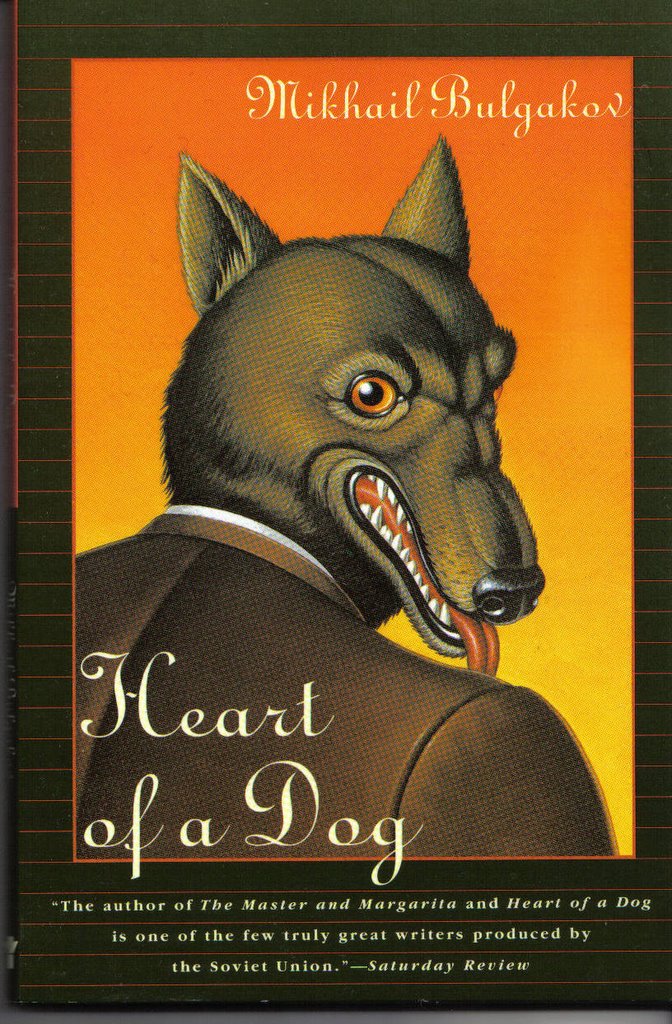
"Heart of a Dog," by Mikhail Bulgakov


SAN DIEGO – the scribe just finished reading Mikhail Bulgakov’s “Heart of a Dog” and, as promised in the review of Italo Svevo’s book (“Emilio’s Carnival,” Nov. 17), will now tell you a little about it.

For starters, "Heart Of A Dog"was recommended by Omar Torrez, the ultraflash guitar wiz with whom the scribe will do a recitation of passages to his novel, “Vedette” on Dec. 15, 8 p.m. at 33 1/3 Books & Gallery Collective, in L.A. (Call 213-483-3100) for info.

Omar has just returned from a small tour in Russia to which he is wed both through a personal fascination, and through the woman he has chosen to live his life with. the scribe thought the guitarist might be interested in working on a reading when he saw him at Pastis in L.A. where he mentioned Bulgakov, which is not a very common occurrence in these here parts.

Torrez’ new album, “Dynamisto” has a song called “Dog Heart,” based on the book.

“Moaning, howling,
my dog heart is growling,
darling, play your
requiem for me...”

That verse is something of a send-up on the opening pages of the (short) book in which the author does a very good job of explaining things from a stray dog’s perspective.

Here’s the very first of it:

“Whoo-oo-oo-oo-hooh-hoo-oo! Oh look at me, I am perishing in this gateway. The blizzard roars a prayer for the dying, and I howl with it. I am finished, finished. That bastard in the dirty cap – the cook of the Normal Diet Cafeteria for employees of the People’s Central Economic Soviet – threw boiling water at me and scalded my left side. The scum, and he calls himself a proletarian! Lord, oh lord, how it hurts! My side is cooked to the bone. And now I howl and howl, but what’s the good of howling?”

Get it?

“Moaning, howling,
my dog heart is growling,
darling, play your
requiem for me...”


One of the most delightful aspects of Bulgakov’s work, which was banned until well after his death, is the success with which he presents the workings and concerns of a dog’s mind.

Here’s how the dog learned to hunt for food in post-revolutionary Moscow without a proper education and reading lessons:

“After that, his learning proceeded by leaps and bounds. He learned the letter ‘t’ from ‘Fish Trust’ on the corner of Mokhovaya, and then the letter ‘s’ (it was handier for him to approach the store from the tail end of the word, because of the militiaman who stood near the beginning of ‘Fish’).

“Tile squares set into corner houses in Moscow always and inevitably meant ‘cheese.’ A black samovar faucet over the word indicated the former owner of Chichkin’s, piles of red Holland cheese, beastly salesmen who hated dogs, sawdust on the floor, and that most disgusting, evil-smelling Beckstein.

“If somebody was playing an accordion, which was not much better than ‘Celeste Aida,’ and there was a smell of frankfurters, the first letters on the white signs very conveniently added up to the words ‘no inde...,’ which meant ‘no indecent language and not tips.’ In such places there were occasional messy brawls and people got hit in the face with fists, and sometimes with napkins or boots.

“If there were stale hams hanging in a window and tangerines on the sill, it meant... Grr.... grr... groceries. And if there were dark bottles with a vile liquid, it meant...Wshi-w-i-wines...The former Yeliseyev Brothers.”

You get the idea. The charm of “Heart of a Dog” lies in the simple sci-fantasy chosen by the author to regale us with true portraiture of life in the time and place with which it concerns itself, without ever appearing episodic, preachy, or issue-driven.

The four paragraphs abstracted above move the story along, maintaining the humor (and pathos) involved in mapping a dog’s mind, but also telling us something of the moment’s popular music, of the behavior that could be witnessed on the city streets, and rendering a street economy that one would assume is a thing of the past.

But the story, in the end, is not entitled “Mind of Dog.” It is “Heart of a Dog,” and soon we move beyond the concerns of the canine, to those of the larger cast assembled by the author to make certain points about the reorganization of Russian life into soviet structures and concepts.

Truly revolutionary.

The dog is taken in off the street by Doctor Philip Philippovich Preobrazhensky who, even in the leveling times he was tapped to live, is a man of prestige and means.

“Heart of a Dog,” falls clearly into the category of satire and, as such, spares no one.

Preobrazhensky is up to no good with some scary eugenic operations that are enhancing the vitality and sexual capacity for some of Moscow’s wealthier denizens. When the communist housing committee comes to bust his chops about the size of his apartment and the new times which the doctor must reconcile himself to, he makes a call to one of his patients, influential in the recently imposed Bolshevik order, that results in the committee delegates leaving his place with tails between their legs.

But Philip Philipovich’s time will come.

The dog, whom he and his helper Bormenthal have dubbed “Sharik” is startled from the peaceful life in the too-big-apartment he could hardly believe luck had placed him, to have the brain stem of a deceased common criminal grafted onto his own.

The experiment goes awry and Sharik slowly morphs into a man; a complicated man with opinions, desires, and an appetite for cats - a man with a dog’s heart that the doctors Preobrazhensky and Bormenthal are ill-equipped to control.

He smokes, has no sense of social correctness, hits on the resident young girl Zina, and has a wise-guy’s mouth to boot. “An exceptional scoundrel,” in Preobrazhensky’s words.

Disdained and pushed to the margins by the bourgeois technicians who created him, Sharik does what came naturally to people (or dogs) in those days. He becomes a communist and gets “papers” attesting to his officially recognized existence as Polygraph Polygraphovich Sharik.

He gets a good job in the municipal department, purging cats, and finally forces the hand of Philip Philippovich by again springing the local aparatchiks on him over the size of his apartment and the way its space is apportioned.

Pushed to the brink, the doctors do something to Sharik, it is not clear what, that returns him to the state of grateful mongrel in which he originally entered the premises.

We can view this story as a commentary on the open-ended fear the aspirations of science and modernity imposed upon people at the turn of the last century. It can also be savored as a parable on Soviet life as it seemed shortly after the revolution.

Okay, the scribe doesn’t really know what a parable is, he just wanted to sound lit-critical for a second.

Perhaps the better expression is “analogy” or even, “metaphor.” the scribe thinks that these words along with ‘simile’ and a few others only serve to slice the same ham a lot of thin ways and that they should come up with a better, all purpose, word to meet the utilitarian tone of our times.

In any case, it’s clear Bulgakov had an ironic view of the Bolshevik order and the underlying idea of sweeping away all that had come before to replace it with something more egalitarian. We don’t get a sense he was against it on principles, rather that he was mortified by what happened when it was applied to a giant and backward czarist peasant state.

the scribe’s sense is that he is saying a dog’s a dog, and a prole’s a prole, regardless of what rational experiment, social or scientific, you expose them, too.

There will always be, Bulgakov seems to be saying, complicated matters of the heart that surpass the grasp of even our most enlightened and talented citizens.

Post-revolutionary Russia is now a ways off. We do not know what song the doctor is always singing, “from Granada to Seville...” and so we miss its cultural significance and what it means to come out of Preobrazhensky’s mouth as well.

Still, the literature transports us.

The version read by the scribe (Grove Press) is translated by Mirra Ginsburg. Translations are always tricky. We can only hope they approximate what the original language was cleverly employed to convey. Ginsburg recreates an over-the-top type of nineteenth century idiom in the tone of, let’s say, G.K. Chesterton (“The Club of Queer Trades”).

“My good sir, I will not be made a guy of with this preposterous...”

Maybe, hopefully, that is what Bulgakov had in mind. To be sure, the high-flown pompousness of his hosts certainly contrasts with the low-flung desires and needs of the proletarian dog.

Woof.

"Sinn Fein: A Hundred Turbulent Years," by Brian Feeney


the scribe is reporting back to you regarding this book he just read on the Sinn Féin. Going into the job highwayscribery knew the Sein Féin to be the political arm of the Irish Republican Army about which he knew little.

This book, "Sinn Fein: A Hundred Turbulent Years,"goes back to the late 19th century when the group was formed under the moniker which translates to “Ourselves Alone.”

Prime movers of the early formation were one Arthur Griffith who did the heavy "Sinn Fein: A Hundred Turbulent Years," goes back to the late 19th century when the group was formed under the moniker which translates to "Ourselves Alone."

Primary movers of the early formation were one Arthur Griffith who did the heavy intellectual lifting, and Eamon de Valera who turned out to be the natural politician of a bunch that included Michael Collins, about whom Hollywood made a movie starring Liam-whatever-his-name-is some 14 years ago.

The group became the crucible for a push toward a republican and Irish state independent of Great Britain around the end of World War I. Since this was something of a leisure read (!) the scribe doesn't have it all ordered perfectly in his mind, but the upshot was one of heavy repression and finally a partition, granting a new Irish state to most of the island, but leaving the northern part which has, to complicate life for everyone involved, a protestant and unionist (pro-Britain) majority, outside it.

De Valera moved toward the center when the "Free State" of Ireland, separated from the North, was born and the republican movement, and Sinn Féin in particular, got lost in a netherworld of self-generated "theology" as per author Brian Feeney's choice of word.

The result was years out on the margins debating whether or not to participate in politics, or stay on the outside of things, because neither the Irish Republic nor Westminster in London were recognized as legitimate rulers of Ireland (which they were doing anyway).

By mid-century Sinn Féin had practically disappeared, reduced to a club for a few keepers of the free, republican, Irish state flame. The "armed struggle," which was both a noble effort to defend Catholics from Protestant pogroms and a stupid campaign that killed many innocent people, took center stage.

The IRA found Sinn Féin's credentials useful and decided to take it over and make use of the party for its own purposes.

Sometime in the 1980s, a young bearded fellow named Gerry Adams, who hailed from a family with strong roots in the Republican movement, began a slow campaign to "run down" the armed struggle and modernize the political wing into a legitimate and independent mass electoral party.

Feeney, whose prose are typical for a historian (okay), does a good job of connecting the dots, interviewing survivors of that time, and detailing the daunting task that Adams faced in seeking to, surreptitiously and slowly, divest the IRA of relevance.

It makes a good and easy read, the 442-page length notwithstanding. Like many historical works, it does a fine job of cutting and pasting events according to the dates they happen and producing documents to support it all.

highwayscribery rented "The Boxer" with Daniel Day Lewis, to get a sense of what the atmosphere in which all of this transpired was like.

The film, shot through a graying blue lens, essays a Northern Ireland stunted economically and spiritually by poverty and violence since the beginning of "The Troubles," as the IRA's last, longest and most deadly campaign was known. It brings to life the hardliners, who resisted political participation and the decommissioning of arms, while capturing the desperation and exhaustion everyone doing a daily dance with violence felt.

The movie fills in the facts with some sentiment and rounds out the portrait, for those interested in a deeper understanding.

"Enchanted Vagabonds," by Dana Lamb


SAN DIEGO – Enchanted Vagabondswritten by Dana Lamb is published by the Long Riders’ Guild Press, which has dedicated itself to reproducing books from something called the Equestrian Travel Classics. These are books that have fallen from mass distribution with the passing of time, but which the publishers feel “remain of global interest and importance."

“Enchanted Vagabonds,” a 414-page opus of dense reading and no plot to speak of, involves a journey made by Lamb and his wife Ginger in the thick of the great depression. Friends from childhood in then-agricultural Orange County (Southern California) Ginger and Dana had dreams of adventure. Having little to lose, they set out from San Diego in a canoe/sailboat of their own engineering, for the Panama Canal.

The sojourn took three years and it is a tale most engrossing, especially for those who hunger to know of an earlier world before crowding, pollution, modernization, and the mass endangerment of nature’s many species of plants and animals.

It is of special interest to Southern Californians of the surfing variety for its early chapters dealing with the Baja California peninsula, which today (and thanks to its ruggedness and inhospitality) remains a kind of last frontier for those seeking raw territory to discover and roam.

Revealing indeed is this portrait of a Mexico largely unsettled and a nation only in name. As they make their way down the Pacific coast of the great country, each stop into port represents a sampling of Indian/indigenous life almost unspoiled by the sullying hand of European culture.

More often than not these Indian villages welcome the sensitive and sensible travelers with open arms, grand fiestas, and kind treatment; treatment that on a few occasions represents the difference between life and death for the lusty and ingenuous adventurers.

Stricken with malaria in the jungle, mad with fever to the point of delirium, the couple awaken many weeks later in a village that has taken them in and assumed the difficult task of curing and nurturing them back to life. The difference between depression-era America and the pre-Columbian ways of the Indians marks the couple so that, as Lamb puts it, “we no longer fit in to the picture” (of modern life).

The Indians are not friendly at every turn, and particularly along a stretch of inland seas the couple must traverse to avoid death at the hands of powerful “norther” wind storms, they are hounded by a violent and malevolent tribe known as the Mareños.

The Mexican government had, at this point in time, tried to subjugate these scoundrels with an army that never made it back. And so you get an idea of the danger they faced.

So virgin is the country that the couple, on wayward ventures inland and on foot, discover lost and forbidden cities of pyramids and altars for human sacrifice. Throughout their trek, the couple is confronted with a, “strange throbbing rhythm. You felt it even more than you heard it. It was like a nerve beat. It seemed to permeate the air. We were never entirely able to dismiss the effect of this vibration upon our minds and bodies, for we were to hear it many, many times in months to come. We can offer no explanation as to what it was, where it came from, or who produced it. We called it drums for want of another name, but we do not know.”

The psychology of these two discoverers reveals much of what has changed in the human psyche and in the soul of nature in the 70 years. Their behavior is more akin to safari hunters than that of the modern day eco-tourist. When floating through the Sea of Cortez surrounded by hundreds of giant manta rays, Lamb gets it into his head to harpoon one. Later on, in a lagoon, he does the same to an alligator. In such instances, Mother Nature strikes back and the adventures become more akin to misadventures. Along the way they shoot tigers, ocelots, jaguars and anything else that gets in their way. On the Island of Cocos off Costa Rica, they clean their camp by leaving the refuse out in anticipation of the tides that will be carrying it away.

They are inhabiting a time and space where nature still rules, where man is far from indomitable, and “natural” resources are so abundant as to overwhelm and threaten human life.

Trouble with the Indians is met with the white man’s friend, the gun. Carefully planned ambushes of tribes that have it out for them are replete with powerful gun battles and although there is never once a body count, one gets the impression a few natives must have been felled along the way.

Kind and sensible when met with kindness or mild distrust, the couple are capable of matching violence with violence.

Many times they are in hell with endless strange insects that inflame and scar their skin and infect them with illnesses that threaten their very survival.

Other times, they are in paradise as this time when, after pulling themselves onto a beach to set up camp, Lamb goes for a little walk:

“I took both guns – Ginger’s automatic in case I should sight small game, and the Luger in the event of a tiger – and my new machete, and hacked my way towards a group of palms I had seen from the sea. Cutting through the last string of brush to the palm grove, I came upon a beautiful blue lagoon. I gazed in wonder. Tired and hungry as I was, I forgot everything else for the moment. This was the 'Promised Land.' A little fresh-water stream ran into the lagoon, and across it tall coco palms lined a white sand beach. Ducks floated in the water. Great blue herons, snowy egrets, sandpipers, and shorebirds were everywhere. Parrots, and other birds with gorgeous plumage whose names I did not know, flew overhead. Fish made rainbow arcs of color as they leapt and splashed. It was a scene whose beauty made me doubt the evidence of my own eyes.”

Here they meet a pair of “Azteco” Indians, relatives to the ancient Aztecs, who help them establish a hut and teach them how to live off the rich land surrounding. They stay for a number of months. The Indians tell them of a “Forbidden City” their tribe is sworn to protect.

Despite an old tale, pregnant with warning, of a Spanish army that entered the surrounding land never to return, the couple decide to search for the forbidden city and ultimately find it, replete with mounds hiding pyramids, protective walls and a limestone sacrificial altar upon which they set up camp and start a fire.

“The effect of such an experience is indescribable. We seemed to have brushed aside times’ limitations. The past and present were telescoped. The mind was able to recapture images as though it were not subject to the restrictions of space and matter. I do not tell you that what we saw with our physical eyes, or heard with our finite ears, these evocations of the past. It was rather an awareness not dependent upon either of these usual instruments of sense perception.

“We sat utterly still. The silence was broken only by the sharp staccato of the fire’s explosions; then, far off, insistent, vibrant, that rhythmic monotone.”

Lamb was an intelligent observer who renders the landscape of Mexico masterfully. The many descriptions of the troubles had at sea in their undersized “Vagabunda” can be a bit too detailed and lose those who don’t possess a command of boating terminology (the jib, stern, starboard, etc.) or a full vocabulary of the sea’s behavior (squalls, shoals, breakers, etc.). Were this a novel, one or two harrowing sequences upon the violent seas would have been sufficient, but Lamb is writing a travelogue and diary, so that these must be recorded, sometimes at the expense of a patient reader.

Friday, February 5, 2010

"Dishing It Out," by Dorothy Sue Cobble


Caution to flirts, cads, and ladies' men: Dishing It Out: Waitresses and Their Unions in the Twentieth Century (Working Class in American History)will change the way you look at waitresses for forever.

And if you think a book about waitressing falls into the hum-drum category, "Dishing It Out" demonstrates how a well-researched idea, presented with passion, can bring seemingly less-enticing topics to colorful life.

Sometimes, subjects can appear devoid of interest because of their very neglect and let us note how Microsoft Works Word Processor spell-check doesn't recognize the expression "waitressing."

But Dorothy Sue Cobble's book suggests that, to a certain degree, the rise and fall of waitress unionism traces our evolution (devolution?) as a country.

highwayscribery first came across Cobble through "Lost Ways of Unionism: Historical Perspective on Reinventing the Labor Movement," one in a larger collection of essays entitled "Rekindling the Movement: Labor's Quest for Relevance in the Twenty-First Century" (Frank W. Pierce Memorial Lectureship and Conference Series, No. 11), wherein she challenged the widely held view that skilled craft unions of the American Federation of Labor were less progressive than the Congress of Industrial Organizations' mass unions.

In her, "The Other Women's Movement: Workplace Justice and Social Rights in Modern America (Politics and Society in Twentieth Century America)" Cobble posits that dominant feminist analysis passes over a generation of mid-century "labor women."

Picking up on a theme developed in that book, Cobble writes that, in contrast to the later wave of feminists, waitresses did not want to be treated the same as the boys, rather, "They wanted equality and special treatment and did not see the two as incompatible."

"Dishing it Out," kicks the can a little further down the path, by focusing on the specific craft.

"The craft of waitressing has always been, she writes, "one of the principal jobs for women, it was distinguished by certain characteristics that enabled female servers to formulate and sustain a culture of solidarity at the workplace. Most female food servers shared share a similar racial and ethnic background. The relative ethnic and racial homogeneity of waitresses fostered group cohesion as it has for other groups of workers, men and women. In addition, more than women in other occupations, waitresses lived outside a traditional family setting and hence turned quite readily to their workplace community for friendship and support. If young and single, they often chose to live apart from their families, frequently residing with other waitresses in small apartments or rented rooms. The high proportion who were divorced, separated, or widowed lived alone, with friends, or with dependent relatives or children. Unable to rely financially on their family of origin or on a husband, waitresses were often primarily self-supporting and attached to the work force in a permanent fashion."

Cobble fleshes out how these attributes lent themselves to a sorority-like adhesion that fostered unionization. The heyday of waitresses syndicates took root around the same time the larger movement took wings, back in the 1930s and '40s and the better part of this story takes place then.

She notes that, "The separation of workers by trade provided women with a space apart from male hostility and allowed the development of female perspectives and leadership."

The self-conducting nature of craft union locals allowed for "female autonomy" and were, generally speaking, "superior in sustaining female participation and leadership."

Rather than focus primarily on moving individual women into higher-paying jobs held by men, this generation of lady unionists opted for improvements in the jobs they traditionally called their own.

"Dishing It Out," details the restaurant industry's growth and is worthy of one's precious attention.

It comes as something of a revelation that the nation was not always strewn with "public" eateries and that a long march toward the "feminization of food service" brought us the hospitality model we're familiar with today.

Less surprisingly, early 20th century mores held waitressing to be an "improper trade," running counter to the reigning Victorian sensibilities as it did. The ladies, after all, interacted with males customers and labored where alcohol was served.

(!)

Discussion of the job's sexual component and its double-edged nature make for great reading and should deepen a reader's understanding of the person catering to their needs at "Hooters."

Not coincidentally, the craft was widely held to be rife with loose women and attitudes intimated a kinship with prostitution.

The ladies, with few options, rolled with it: "[Waitresses] acceptance of the sexual character of their work was rooted in their distinctive mores, but it also derived from their situation as service workers in an occupation in which their livelihood depended upon attractiveness and allure."

There was a kind of self-generating, autonomous effort to fight such perceptions by raising professional standards and forming unions were a way of gaining legitimacy.

"They spoke of their work as a skilled craft," says Cobble, "and they engaged in practices that have long been associated with craft unionism: organization along craft lines, emphasis on craft identity and specialization, restrictive membership rules, and union monitoring of performance standards."

As combative unionists, "waitresses could hurt business by suggesting the least expensive menu item, ignore the poor tippers, offer food and drink on the house, or simply provide lackluster, un-inspired service, even though it jeopardized their own tip income. Waitresses could also go out of their way to add that special attentive, anticipatory touch that would cement the customers patronage."

Which makes perfect (economic) sense.

The book dissects the unique and bygone arrangement whereby unions increased their members' value by cornering the labor market and parceling the work via hiring halls.

It turns out to not have been all bad for restaurateurs, "because culinary employers relied on the hiring hall for 'good and reliable' full-time workers as well as for the extras needed in emergencies"

The gals liked the hiring hall because "it gave them, rather than the employer, control over when and how much they worked. As long as they maintained their union standing, waitresses could quit a job and 'lay off' for however long they chose."

Lamentably, Cobble is obligated to tell her tale in the past-tense, waitressing unionism being more a study of history than a dissection of current events. The unions examined here were done-in by the same forces that have reduced organized labor's power globally.

But as either history or prescription for sound industrial relations, "Dishing It Out," sets the table beautifully.

Thursday, February 4, 2010

"An American Family: The Buckleys" by Reid Buckley


An American Family: The Buckleys is the story of a youthful and ambitious clan that grew great together with the young and ambitious country in which they lived.

We have before us a gaggle of children born with the 20th Century. Children reared by proper and upright parents who accepted nothing less than perfection from them. In exchange they gained lives on sprawling estates with names like "Great Elm," and "Kamschatka."

They pursued overseas educations and employed nannies who alternately taught French and administered castor oil. They rode horses, walked their property lines shooting quail and rabbits...

Of course, the Buckleys were not just any American family. the large brood of William Sr., and Aloise grew up to be a rather potent bunch who left their traces upon the thin ice of American culture.

This story charts trajectories of the famed conservative ideologue William Jr., the one-term Conservative Party senator from New York, James, and a bevy of other sisters and brothers in lesser, if equally loving, detail.

Nonetheless, brother Reid's real purpose here is scripting a Valentine to his parents. He crafts a recollection demonstrating the strength of their imprint on the offspring.

"Our bonding as a family of individuals has expressed itself in the social, spiritual, and intellectual dimensions in astonishing degree," the author writes. "Though we differ widely among ourselves, and almost always, when coming together, argue fiercely, it's often as though the ten of us were extruded from the same toothpaste tube."

Which is to say, not a single one of The Buckley's sprawling progeny strayed from the family's profound Catholicism or credo of self-reliance.

Buckley's mom has an interesting background out of old New Orleans, a sturdy character with positive energy, and discrete charms, and Buckley canonizes her in the way those of us who love our mothers do.

But the chestnut here is Bill Sr.

For those of you who thought the Buckleys were a blue-blooded crowd with fake English accents out of Connecticut, the family’s southern, even Confederate, roots may come as something of a surprise.

Big Buckley hailed out of deep south Texas and made his first bundle of serious money in, of all places, Mexico. There he successfully "wildcatted," for oil and helped develop Tampico before his catholic principles ran afoul of the new revolutionary (and anti-clerical) government, which threw him out of the country.

Dad was forced to "start all over," but not in the way most of us would, which is why his story is worth a read.

Buckley lived large for a number of years, popping children hither and thither, housing them in impressive realty, without letting on that his was a shirtsleeve operation. He eventually struck some more oil in Venezuela. Only then was the future security and prominence of the family America came to know was assured.

The children's textured lives in Texas, Mexico, Connecticut and South Carolina make for worthy recounting and Reid, like all the lucky long-lived, enjoys the reserved grace of explaining a disappeared world to us.

An accomplished, if not widely celebrated novelist, Buckley's well-developed mind and pen combine to render credentialed insight regarding Mexico. He is, too, great at recalling the eccentric and authentic characters populating his past, delighting and reveling in them.

He is looking back on a fulfilling and eventful life.

The book's lure may dim for some when Reid Buckley steps aside to punch in an article written by one or another of his many siblings about the good old days, which they certainly were.

He declares conservatism, such as the clan purveyed it, dead. And the brainy Buckleys do not appear to have much in common with that breed of rural no-nothing carrying the banner today.

"On the ideological level, we inherited an anachronism that we have tried lifelong to defend and perpetuate," he writes of the family's run through American politics. "Vain endeavor. Our parents were the product of a nation that has vanished, and we, their children, have manned the ramparts in defense of that ghost. From this standpoint, our existences have been futile, our works folly."

Indeed, "An American Family," views the world through the dark lens of an aged fellow looking backward, weighed down by the loss of so much family and so many contemporaries. It is a tome that loves the past.

His parents' time, he notes, "was the age of American infallibility. How lucky they were, both of them, born to the simultaneous emergence of our country from its international status as an exotic experiment in a faraway and uncouth region of the globe to become economically and militarily the central power on earth."

Reid Buckley is something of a fuddy-duddy. He seems proud of it, and even makes it look good. He likes what he likes, and don’t be surprised if your lifestyle or personal philosophy doesn‘t meet with his approval.

The things he approves of, and the type of person he admires, are gone from the scene, and this book recuperates their memory one last time.

Wednesday, February 3, 2010

"To the Lighthouse," by Virginia Woolf


It’s a phenomenon that a place so unliterary as Hollywood is often responsible for renewed interest in a writer’s work or personal story.

Virginia Woolf got a giant boost a couple of years ago with a major film production called “The Hours.” Nicole Kidman received an Academy Award for her portrayal of today’s subject/author.

The edition of Woolf’s "To the Lighthouse"read to produce this book report has a 1927 copyright and was published by Harcourt, Brace and Company; a brown-paged and rickety offering in gray cloth cover.

the scribe, a screenwriter himself, took it up because of the awareness of Woolf gained from “The Hours” and surrounding media.

It is difficult to say what the book is truly about. Like many good novels it’s about many things, but no single thing you follow, anticipating development, comfortable with the pace of revelation. You hardly know what’s being revealed.

The story does not move many places or ever truly “get going” in the dramatic sense; that’s not considered a flaw at highwayscribery, rather a virtue. Woolf’s long ruminations and interior examinations are where the energy is, inside the characters who act little, but think much.

The language is exacting, taxing, and sometimes the author’s sentences finish somewhere else than they’re supposed to. It’s hard to imagine that such a baroque and delving prose would stand a snowball’s chance in hell of getting published today.

It was written, you see, before the vast commercialization of that same revolutionary film-making--as-storytelling process and the homogenizing effect it had on most people’s treatment of literature.

A family called the Ramsays have a coastal house somewhere in Britannia before the First World War. They are genteel; he a famous philosopher, she a hothouse flower of heightened sensibility.

Three-quarters of the book take place in a 24-hour expanse as Woolf takes us through the minds of nearly a dozen people; people thinking about their relationship to a larger world, to themselves, to the people gathered at the Ramsays.

Although not wealthy, the Ramsays can afford to keep some illustrious guests at the summer home and their brood numbers five or six. And so the author’s mind-mining finds plenty of fertile ground for topics worldly and domestic alike:

“...children never forget. For this reason, it was so important what one said, and what one did, and it was a relief when they went to bed. For now she need not think about anybody. She could be herself, by herself. And that was what now she often felt the need of – to think; well, not even to think.”

So what?

If you’re a parent it rings true. It tells you something you knew innately, but had never crystallized into a solid idea. Good literature does that. Pulls us in by making us relate and instructs, turns pleasure into profit, while you’re laying beneath the warm glow of a golden late-night lamp.

But the scribe’s writing like Woolf here (that happens).

Mrs. Ramsay is the star of this gentile warm-season gathering, the looking glass through whom we experience the day-turned-evening event, the one who judges the motives and shortcomings of the guests, although we are treated to the points-of-view from other characters, too.

A fading beauty, but a beauty both spiritual and cosmetic nonetheless, Mrs. Ramsay’s particular gift is the arrangement of sublime moments and her conflict is that she enjoys them so much more than those she deigns to design them for:


“Everything seemed possible. Everything seemed right. Just now (but this cannot last, she thought, dissociating herself from the moment while they were all talking about boots) just now she had reached a security; she hovered like a hawk suspended; like a flag floating in an element of joy which filled every nerve of her body fully and sweetly, not noisily, solemnly rather...”

Looking for a little post-reading help, the scribe read an article by Louise DeSalvo on Woolf’s relationship with writer Rita Sackville-West, during which she wrote “To the Lighthouse.”

It’s from a book entitled “Significant Others, Creativity & Intimate Passion,” edited by Whitney Chadwick and Isabelle de Courtivron, and published by Thames and Hudson in 1993. Some of the other couplings it assays are Clare and Andre Malraux, Lillian Hellman and Dashiell Hammett, Camille Claudel and Auguste Rodin.

According to DeSalvo, the younger lover and writer saw that Woolf needed social interaction, and made sure she got it, because “Virginia based her fiction primarily upon observation, not upon her imagination.”

So Mrs. Ramsay may very well be Woolf’s mother, a woman affected by withdrawal and depression.

While together, they generated the finest work of their lives, Woolf informing Sackville-West’s writing with a greater literary quality, Rita giving Virginia an openness and the tools to reach a wider, best-selling audience.

“To the Lighthouse” was one in a troika of novels (“The Waves” and “The Years) that “examined her childhood in the Stephen Family, a childhood riddled with violence, sexual abuse, and emotional neglect,” according to DeSalvo.

The Mr. Ramsay of “To the Lighthouse,” corresponds to Woolf’s characterization of life with her father as, “living in a cage with a lion.” His “self-absorbed” grief is on display and much-detailed in the novel.

Not an unsympathetic man, Mr. Ramsay is falling just short of being a great philosopher and the resulting worries keep him from strengthening the fading connection he has with his wife. She must repress the need to quote the price of a roofing job to stay out of his fuzzy head where he is very busy. Those around him cannot help but be charmed by his magnetism and intelligence, but his overbearing nature (sometimes he’s just being a father), leads mostly to resentment.

So, “To the Lighthouse” is a work pegged to her childhood and perhaps Virginia is Lily, a minor character and more minor painter. Here she alternates between artistic courage and terror, enriching before a blank canvas.


“For what could be more formidable than that space? Here she was again, she thought, stepping back to look at it, drawn out of gossip, out of living, out of community with people into the presence of this formidable ancient enemy of hers – this other things, this truth, this reality, which suddenly laid hands on her, emerged stark at the back of appearances and commanded attention.”

If you want to read a map of your precious individual self, you might want to try Virginia. If you don’t, maybe you shouldn’t.

Or maybe you should read it no matter what, because it’s reading. Listen to how Woolf weaves her own enjoyment of books into the fabric of the character Mrs. Ramsay:

“And she waited a little, knitting, wondering, and slowly those words they had said at dinner, ‘the China rose is all abloom and buzzing with the honey bee,’ began washing from side to side of her mind rhythmically, and as they washed, words, like little shaded lights, one red, one blue, one yellow, lit up in the dark of her mind, and seemed leaving their perches up there to fly across and across, or to cry out and be echoed: so she turned and felt on the table beside her for a book.”

On this particular outing the family situation seems vulnerable, threatened by a crumbling roof and cracks in the emotional edifice, but it’s difficult to tell if the looming threat is extraordinary or just the stuff we all live with. In any case, Mrs. Ramsay triumphs once more, creating a sublime moment that is gone more quickly than it took to manufacture. The guests enjoy a magic they’ve come to expect, but without guessing at the work behind it.

The story breaks suddenly as Mrs. Ramsay turns the lights out on her children for the evening and the reader is then vaulted into a second book entitled: “Time Passes.”

World War I comes. Some of those present on the summer weekend have been taken by it. Mrs. Ramsay has died, “suddenly” and the family has ceased returning to the beach house. Pages-long, majestic descriptions of the house’s decrepitude, of nature’s advances upon the property, of the lingering spirits that once warmed it unwind under Woolf’s careful, intricate hand.

Such stretches recall Italo Calvino who observed that literature represents a rare moment of order in a universe heading toward dissolution: “The literary work is one of those small points of privilege where things crystallize into a form which acquires such meaning.”

Finally the Ramsays return, robbed of their life force, a pale facsimile of the prior clan, stitched to one another by grief only. Again it is Lily, the old maid and mediocre turtle artist, who brings us to the point of the piece. Veiled and indirect throughout, Woolf now bids attention be paid in her first sentence:


“The great revelation perhaps never did come. Instead there were little daily miracles, illuminations, matches struck unexpectedly in the dark; here was one. This, that, and the other; herself and Charles Tansley and the breaking wave; Mrs. Ramsay bringing them together; Mrs. Ramsay saying, “Life stand still here”; Mrs. Ramsay making of the moment something permanent (as in another sphere Lily herself tried to make of the moment something permanent) – this was of the nature of a revelation. In the midst of chaos there was shape; this eternal passing and flowing (she looked at the clouds going and the leaves shaking) was struck into stability. Life stand still here, Mrs. Ramsay said. “Mrs. Ramsay! Mrs. Ramsay!” she repeated. She owed it all to her.”

So mostly, “To the Lighthouse,” is a character sketch and Valentine to Mrs. Ramsay: perhaps Woolf’s mother, perhaps Rita Sackville-West, perhaps somebody else, an amalgamation, or nobody at all. Just somebody she thought we’d like to see.

For time travelers, the tale offers the privilege of vacationing with a homogeneous family of middle-class gentility at the beginning of the 20th Century. It’s no wonder Woolf could wander and wade through the psyches of those present. Isolated, far from the news of the moment, without any means of communicating to the outside world, everybody is obligated to be present and consider one another and the landscape of dunes, long lawns at dusk, and wind-rippled tide pools.

And then it’s modern literature and the modern world. The politics discussed at the table sound familiar and strangely up-to-date, the strivings and shortcomings of the characters are not far at all from our own: to be great, to be respected, to get to the lighthouse.

"The Muckrakers"


One of the nice aspects to being sick, and there is a silver lining in just about anything, is that you, if so inclined, can get a lot of reading done. We’re talking mildly sick here; sick so that you drift in and out of swoons induced by stuff you can buy over the counter. the scribe’s Nyquil years are mostly behind him and reveries during this recent lay-up were fueled by Alka-Seltzer flu medicine, benadryl, and Vitamin-C powder packets.

the highway scribe scarfed down a good number of books and reports on them will be spread out over the next few weeks. First to be finished off was "THE MUCKRACKERS"which was edited back in 1961 by Arthur and Lila Weinberg.

The tome contains actual writings of the famed muckrakers who wrote in the first decade of the last century. Their specialty was uncovering abuses and those abuses could be committed by labor unions, or government officials, or a church, but mostly they worked to bust up the concentration of wealth as represented in the giant corporate trusts that had surfaced 20 or 30 years before.

President Theodore Roosevelt coined the expression, “muckrakers” in a speech that was largely critical of the era’s journalists who were, otherwise, mostly on his side, or at least shared the same goals of reform and a cleaner running system.

Among the offerings in “The Muckrakers” is the very speech in which Roosevelt gave them the name. He drew it from Bunyan’s “Pilgrim’s Progress” and “the description of the Man with the Muckrake, the man who could look no way but downward, with a muckrake in his hands; who was offered a celestial crown, but continued to rake to himself the filth of the floor.”

TR went on to preach caution from those leading the crusade and called for an even-handedness that would inform, but not inflame.

As they say, the name stuck.

The book spends some time on the atmosphere in which the muckrakers were born. It talks about the growth of mass circulation magazines such as “McClures” and “Cosmopolitan” that took it upon themselves to finance investigative reporters and publish their in-depth revelations to much scandle and positive affect.

Each section (The City, The State, Pure Food, Child Labor, etc.) is framed with a perusal of the issue at the time, and of a profile on the writer who did the work. Among these names are Lincoln Steffens, Ida Tarbell, Ray Stannard Baker, Upton Sinclair, and Mark Sullivan.

the scribe pulled the book for purposes related to his career as a journalist. It’s good to know what pioneers like this did and why. But coming to this book is a little like sampling Elvis after being raised on Pink Floyd. You’re not going to see the novelty in it; and from their novelty were the muckrakers' powers drawn.

This kind of reporting is done today in any number of weeklies and monthly’s on the right and left; “Harpers,” “Atlantic Monthly,” “The New Republic,” “National Review,” and so on. The techniques have hardly changed. This book is about the laying of groundwork.

What’s better and more useful about this collection of magazine articles are the portraits they render of the country in that time. It is a raw powerhouse sprawling its industrial self across a giant and empty continent, mostly lawless, if very Christian.

The essays connect the dots on how the great fortunes of the era – Frick, Vanderbilt, Morgan etc.– were built largely through the acquisition of what was supposedly the public trust. They tell the story of child labor to the tunes of millions across the southern textile belt. The muckrakers spun sturdy yarns of corrupt city machines and detailed even the battles for territory, or the love lives, of immigrant newsboys up from the streets.

It is hard to tell whether such an era of excess and abuse of public trust is a reflection on our own times, or if times simply don’t change; that for all our pomp and circumstance, being a thug pays best.

There was a law back in those times, that prevented people from leaving government to lobby the same place he just worked at.

What happened to that?

The work/slave conditions documented by William Hard and Edwin Marshall are not gone, just shipped overseas.

You can be a television cameraman and be killed in Baghdad hotel by U.S. forces (“A Dangerous Place,” March 22, 2005), or you can reveal the secrets of a seedy senate and be mysteriously assassinated like David Graham Phillips was for his articles in “The Muckrakers.”

Two pieces at the back of the book, “De Kid Wot Works at Night,” and “The City of Chicago: A Study of the Great Immoralities,” create a rather staggering portrait of the crazy town on the lake at the height of its power.

This Chicago is sprawling and active to the outskirts, a city created along mass industrial lines where the human element was not taken into consideration. The city’s largest business is vice, providing cheap (as in money) girls and cheap beer to the great swathes of workerdom serving the meat industry, the railroad, the ironworks, shipping. The girls are innocents pruned from the immigrant class and their trafficking is handled out of a city police department.

And for all that, the actions government took in response, the attention paid by the general population to the muckrackers’ message, are far beyond anything we might to expect today in terms of reform. They would not tread upon the feet of corporate titans they way they did then. They will not impose the will of the state over industry. Teddy Roosevelt, a Republican when blacks voted Republican, did.

And America listened to its muckrakers, rather than label them, and acted according to their recommendations. “The Muckrakers” as a book shows us what that interaction meant, and what has been lost between the press and its audience.

"Snitch Jacket," by Len Bracken


Today a little anarchist literature.

Len Bracken’s "Snitch Jacket"examines the inner phantoms and outer realities of full-time anarchists and dedicated revolutionaries of the anti-globalization movement.

One of the novel developments coming out of the famous Battle for Seattle at the 1990 World Trade Organization talks was the resurgence of anarchists and the prominent role its rank-and-file, popularized through the image of the black bloc, played in the street skirmishes there, and in later protests across the world.

Bracken takes us inside that movement.

“Snitch Jacket” concerns itself with the longings and angers of Alex, whose nature and actions are most characterized by an outsized incisor that makes him look like a wolf. Drunk on Situationist strategies and something called Vin Mariana, a wine either distilled from coca or made something else by the infusion of coca leaf, Alex is a guy for whom crossing over the line is the test to living in truth.

The book opens with him seducing an attractive young media magnate in the Library of Congress, which he sets on fire in the process. During the escape, Alex kills a guy; not his first murder, either.

The setting is Washington D.C. on the eve of George W. Bush’s first inauguration. The anti-global set has gathered to make as much of a mess as possible. Alex serves as a literary tour guide through the local group of anarchists, and other things; the rank-and-file made up of drifters, folks with an axe to grind, former criminals, and journalists who don’t know where the ethical line of their profession lies.

To a certain extent, nobody is completely what they portray themselves to be and, while everybody’s goals are pure and noble, their means are another matter altogether. Some are spying, might be spying, are converted over form the enemy, and there is not structure other than the sex and beer bash through which they might be sorted out.

There are three beautiful women, Chilean, Chinese, and Russian, all with murky backgrounds and deadly dangerous with whom Alex spends of a goodly portion of his time mixing revolution and seduction; later wrestling (but not much) with the friction between his anti-paternal politics and the pull of his prick.

Anyway, these are folks on “the list.” There are no angels and the authorities know of and about them. And for all that, as mentioned, they spend a lot of time partying. Bracken’s portrait of the easy-come-and-go world of true relations between true leftists, influenced still by hippie codes, are lively and enthusiastic and you can feel yourself in the warm spring air of colonial region at an indoor/outdoor beer party.

This has always been one of the left’s downfalls visa a vis conservatives and fascists. They like to party and talk a lot about discipline. The enemy doesn’t and are truly disciplined. The eternal question, of course, (from an anarcho-syndicalist perspective) is who do you want organizing the whole big shindig?

Bracken, a resident of Washington D.C., knows the city well and details every moment of transit with a dissection of what is being seen. Not so much the monuments everyone knows, but the buildings housing lesser-prominent bureaucracies where, the author gives us a sense, less virtuous goings-on are being concocted.

Throughout the street roaming and street life of his protagonist the author tells some of what our government is up to, and where it is done, achieving a sinister portrait of what (and the why) his angry anarchists are up against.

Bracken goes farther along in weaving the sexual lives of his characters into the larger yarn than most writers, dishing up detailed imagery of the numerous couplings not only between Alex and his paramours, but for the uber-kinky, girl-on-girl and all that. The overall achievement is clear as, by mid-book, the sex scenes are really read with a a curiosity about whose using what on whom. Sex as part of the story, as opposed to a forced extraction from the story that says, the story’s stopping here for that great an universal timeout that is “SEX.”

And that’s from an anarcho-syndicalist perspective, too, which is to say Bracken is in friendly territory at highwayscribery.

He is a self-published authored in the same way the scribe is. Like the scribe he also self-brushes his teeth, self-bathes himself, and takes responsibility for himself; all of which makes self-publishing that much easier.

"Dreams from My Father," by Barack Obama

(written before the 2008 elections)

highwayscribery wanted to spend this day on a book report of Illinois Democratic Senator Barack Obama’s autobiography, 'Dreams from My Father: A Story of Race and Inheritance"

The book was a Christmas gift from the scribe’s sister Rosemary and was received with the usual mild surprise that accompanies the reception of a book you don’t really want to read.

highwayscribery enjoyed Obama’s colorful and deftly delivered speech at the 2004 Democratic National Convention (included in the book put out by Three Rivers Press). But in ensuing months it seemed the newly elected senator’s name popped up too often in association with positions a little beyond his experience, like vice president or president.

There’s a Democratic Party discussion in there somewhere: Is the glass half full because Obama’s rise among what former Sen. Sam Nunn (D-Georgia) used to call “the great mentioners” reflects his amazing talent? Or is it half empty because a guy starts jumping ranks thanks to his world beat name and a decent speech two years ago?

The highwayscribery creed encourages the acceptance of given books as a kind of natural instruction from the world itself, from forces beyond our own (book) consuming impulses.

And the book is quite good as it goes about detailing Obama’s unique, yet quintessentially American pedigree and journey. A kind of Tiger Woods to the progressive political world, Obama is African-American, without the tragedy of slavery separating him from old country forebears.

He knows his lineage, his father, his grandfather. He returns to his native Kenya where a grandmother explains how, “First there was Miwiri. It’s not known who came before. Miwiru sired Sigoma, Sigoma sired Owiny, Owiny sired Kisodhi, Kisodhi sired Ogelo, Ogelo sired Otondi, Otonidi sired Obongo, Obongo sired Okoth, and Okoth sired Opiyo. The women who bore them, their names are forgotten, for that was the way of our people.”

His father, a scholarship student from Kenya to the University of Hawaii, met his mother in that distant American outpost. She came from Kansas stock, her father a soldier of fortune and westward drifter on the trail of the big break.

His place in time as a man educated in the west at the height of the African liberation from its European colonizers forces the senior Barack Obama home, abandoning the young boy in Hawaii for good.

That is the DNA, much explained and dissected for it is the point of the book, and somewhat the point of the politician – race and its subtleties.

The greatest surprise was the book’s prose. Obama was, at one time, editor of the “Harvard Law Review.” highwayscribery has never had occasion to read that particular publication, but must admit to a sense that brand name conjures up ponderous articles short on good and engaging narrative content.

But it may be a place where good writing is encouraged because he possesses a comfortable mastery of the written word. We’re not talking the heights of prosodic beauty, but a facile ability to render crucial insights his unique path and intelligence have provided, into the written word. One thing is to have led an interesting life, it is another to successfully convey why.

The highpoint of the book may be the following passage. The set up is that Obama Sr. has come to meet his son, who is ten years old, and it really doesn’t go too well. As the father is leaving, he decides to play a recording of music from the families tribe, the Luo:

“‘Come Barry,’ my father said, ‘You will learn from the master.’ And suddenly his slender body was swaying back and forth, the lush sound was rising, his arms were swinging as they cast an invisible net, his feet wove over the floor in off-beats, his bad leg stiff but his rump high, his head back, his hips moving in a tight circle. The rhythm quickened, the horns sounded, and his eyes closed to follow his pleasure, and then one eye opened to peek down at me and his solemn face spread into a silly grin, and my mother smiled, and my grandparents walked in to see what all the commotion was about. I took my first tentative steps with my eyes closed, down, up, my arms swinging, the voices lifting. And I hear him still: As I follow my father into the sound, he lets out a quick shout, bright and high, a shout that leaves much behind and reaches out for more, a shout that cries for laughter.”

So you get an idea that it’s not some kind of policy book or rhetorical disquisition. It’s a young man’s story and takes the reader through Obama’s developing sense of the black reality in America, his clumsy first steps as an organizer on Chicago’s South Side, a rare portrait of the legendary Mayor Harold Robinson, and over to Africa in discovery of family lore and luggage.

Obama’s rise to prominence represents something of a bellwether in less than obvious ways. Sure, he’s one of only a handful of blacks ever to serve in the U.S. Senate, but in this story he weaves the consumption of marijuana, alcohol and even cocaine into the fabric without using overly bright colors and without trying to sugar-coat it either.

He plays basketball, he “adopts” in his own parlance an identity from those being offered-up by the pop culture of the 1980s - the years of his flaming youth. And now he’s a senator and all of that without having had to live like a Mormon.

And that’s good, as there is much else good about Obama, a writer to rank with those who make a permanent vocation of writing, an intelligent fellow with the honesty to talk about black-on-black gripes, to wrestle with the loss of blackness success in the white world represents, to convey the suffocating sense that the white world is the only game in town.

"Talk Talk," by T.C. Boyle


The hardest thing about being an unconsecrated novelist for the highway scribe, is being an unconsecrated novelist.

Or at least it used to be. There is nothing more boring after 20 years of scribbling to sit around and stew in one’s own bitter brew of what writer Steve Almond calls “fame angst.”

In the end, all the clichés apply. As an artist, you’re not racing anybody, rather engaged in a most particular and personal journey of learning that has nothing to do with other creatives.

The point being that the scribe is at a good place where he knows being the BEST BIGGEST WRITER IN THE WORLD, COUNTRY, STATE (or just on the block), is an illusory goal, that such things are hard to quantify, least of all through immediate commercial success.

And so it’s nice to sit and read a novel by someone like T.C. Boyle, with fame and many, many more novels and achievements to his credit than the scribe, and simply be able to enjoy it for the good writing it is, as opposed to the good writing it is next to the scribe’s equally good writing etc.

the scribe’s sister Rosemany (Ro) sent Boyle’s latest, Talk Talkas a gift for Christmas.

Ro turned the scribe onto Boyle with a book of short stories she loaned him a few years ago. the scribe took it to a Boyle reading and had the author sign it to the sister, which he sent back to her. It (the book) soon found its way to another Boyle reading on the very same tour, but in Boston.

One of us (probably her) must have made an impression because a minor character in “Talk Talk” is a pizza chef named, Skip Siciliano.

Anyway, who the hell cares about that. “Talk Talk,” is a wonderful novel and a great read. Go out and get it and rip through it the way the scribe did.

Boyle’s been at this for so long, done so many (he’s at a clip of one novel per year), that “Talk Talk” reads like he wrote it off the top of his head in a weekend.

The story is simple enough: a deaf woman is a victim of identity theft. She and her digital nerd boyfriend take off to parts mostly unknown in search of the thief, and wind up on the other side of the country, in new lives not easily shaken off.

Super contemporary, there’s something almost “potboiler-ish” about this story of Dana Halter, Dana Halter, and Bridger Martin. No tricks, no experimentation: a straight narrative that only on occasion pulls up to provide a little background, but this, too, is done seamlessly.

Despite the straight ahead and forging plot, the literature is there, so unobtrusively, it serves as a great lesson for scribes both aspiring and accomplished.

It’s there in the neat contrasting Boyle achieves by switching back and forth between Dana and Bridger, the identity theft victims, and Dana Halter (nee, Will Peck Williams) the identity thief.

If taste is the same as class, a low-rent upstate New York boy, can certainly acquire class. Williams knows about the best things (or at least the agreed-upon best things) and possesses them thanks to his excellent performance as a thief of personhood.

As Dana and Bridger sleep in crappy motels, eat crappier food, and wear thin the fabric of the strained relationship (she is, after all, deaf), Dr. Halter (that’s Peck Williams) bones his beautiful Russian wife after preparing dinners described with such culinary delectation by Boyle that one finds their gastronomic juices flowing again and again.

“Talk Talk,” will make you hungry if you don’t eat ahead of time.

The literature is found in the dead-on contrast between central California’s coastal world and the muggy, mossy, watery summers of upstate New York.

It’s there in the simple metaphors, verbal and contextual, that Boyle constructs so easily.

Of course, if you’ve read Terry Eagleton, you know literature can’t truly be defined.

As has been suggested, the story is simple enough. A road movie if you will, with the images in your mind instead of on-screen. Dana and Bridger follow their antagonist all the way back to upstate New York, the thief’s identity (or lack thereon) begins to unravel in both the public and private sense as they slowly, almost unwittingly corner him.

He’s stolen identities before and things have gone smoothly. He’s just never done it to someone as persistent as Dana Halter.

Boyle’s end has good guys and bad, while still dishing out the right touch of ambiguity and space for personal interpretation that elevates “Talk Talk” just above a thin yarn.

It’s hard to know where he’s going until the end when Bridger, now single, spends a moment graphically exalting his ex-girlfriend Dana on his weapon of the choice, the computer screen. Dana’s personal quest has cost him, and others, dear and the obstinacy with which she pursues the man who had her temporarily jailed makes those around Dana want to wring her neck.

“Talk Talk,” is what deaf people call their own conversational get togethers and, at the end, we realize Boyle has given us a portrait in deafness; the soul of someone defined by the silent yet histrionic world around them; the portrait of a learning curve and final product somewhat beyond the norm.

A story about the special someone, and then some.

"On The Road (The Scroll Version)" by Jack Kerouac


The continent "groans" again and again.

The night is too often "sad," the cities are "mad" or "wild" and "sad" some more. New York is the "edge of the continent," and San Francisco, too and sometimes they're the "rim of the world," or some similar allusion.

Jack Kerouac and his friends, hanging outside New York City's Harmony Bar in this jazz/romantic video capturing their "beat" essence, would be considered drunks and losers by the standards of most. The author's muse and messiah, Neal Cassady, is a fellow too easily distracted, undisciplined and, by today's measurements, a candidate for depression medication.

In the recently released On the Road: The Original Scroll (Penguin Classics Deluxe Edition)Cassady's criminal bent and complete disregard for his friends' concerns or the safety of strangers are drawn in much starker contrast than they are in the (we now know for sure) much toned-down Viking Press version of the 1950s.

But it works and wonderfully so.

Whatever the personal flaws of the roadgoers, and they are multiple, whatever the prosodic sins of their faithful secretary Jack, equally numerous, The Scroll is blessed with energy and truth and dynamism, a beatific rhythm and sound that hold up, even though 50 years on we've read it all before.

But where what was once novel becomes cliché with the passing of time, The Scroll takes on enhanced value as snapshot of a country long-disappeared.

The Scroll contains a hundred pages more than the edited "On the Road," and that's a lot of adventure and resulting ruminations, as Kerouac takes us to Denver and San Francisco, and back out to New York and down to North Carolina, back up again, and then down through Louisiana back up to San Francisco, New York again and finally through Texas to damp and sexy San Antonio before shooting through "biblical" Mexico, now gone, too.

Even the "normal" people in this frantic tome, those with wives and jobs they stick with are not like us anymore, working on ships and in factories as they do, residing in company towns and city centers.

The Scroll is a sweeping panorama of America and of thought beaten out on teletype paper by a guy on speed; maybe drug speed, maybe coffee, but probably something else that burned out of Kerouac like heavy kerosene and which caused his death when the last vapors rose from his being and poofed into the dusty firmament.

It has politics without the jeremiads and program points, just whole manifestoes in a masterful word-stroke such as "sullen unions," a flavor and entire reality nailed to the mind's wall.

"The American police are involved in psychological warfare against those Americans who don't frighten them with imposing papers and threats. There's no defense. Poor people have their lives interfered with ad infinitum by these neurotic busybodies. It's a Victorian police force; it peers out of musty windows and wants to inquire about everything, and can make crimes if the crimes don't exist to their satisfaction."

It is loving landscape portraiture as in this passage laid down about Neal, his "whore wife" Luanne (meant here as flattery), and Jack's departure from New Orleans:

"Port Allen -- Poor Allen -- where the river's all rain and roses in a misty pinpoint darkness and where we swung around a circular drive in yellow foglight and suddenly saw the great black body below a bridge and crossed eternity again. What is the Mississippi River -- a washed clod in the rainy night, a soft plopping from drooping Missouri banks, a dissolving, a riding of the tide down the eternal waterbed, a contribution to brown foams, a voyaging past endless vales and trees and levees down, down along, down along, by Memphis, Greenville, Eudora, Vicksburg, Natchez, Port Allen, and Port Orleans and Point of the Deltas, by Venice and the Night's Great Gulf out. So the stars shine warm in the Gulf of Mexico at night. From the soft and thunderous Carib comes electricity, and from the continental Divide where rain and rivers are decided come swirls, and the little raindrop that in Dakota fell and gathered mud and roses rises resurrected from the sea and flies on back to go and bloom again in waving mells of the Mississippi's bed, and lives again."

The passage lies almost exactly at the book's midpoint; stands as strong backbone to all the word swirling before and after, a fine spine, like the Mississippi in its marriage with the landscape.

Everywhere lively applications, symbols, poetry pulled from the very map that is America, multiple magic in Missouri and Mississippi, no invention with Port Orleans and Point of the Deltas, by Potash, and Venice, just the natural ordering of an evident and obvious song about the land itself.

Early on in this passage the prose become unnecessary, the point made, ripe for a Sixth Avenue editor's pen. But gripped by the author's sweaty hand, we are yanked along, pointed here and there on the keyboard toward ecstatic sites he has taken the time to see for us.

Can the Carib be both soft and thunderous? Does the oscillation between them make electricity? On paper it does. Is there such a thing as a mell or does his lazy resort to something that sings make it go down so much easier, and isn't that part of the job?

Mell is a swell on the Mississippi and we know that, even if we didn't before.

It is not easy to sift through all the postmodern swill that has come after and still be awed at the pure audacity of Kerouac; the audacity to make up words, to appear at his New York editor's office sweating and stinking of chemical ooze with a manuscript written on 120 feet of rolled paper demanding respect of The Scroll as if it were plumbed from Dead Sea depths.

So goes it with the aspiring philosopher whom, even if he is a bum, still philosophizes for all of us and not just for those of high brow and intentions:

"death will overtake us before heaven. The one thing that we yearn for in our living days, that makes us sigh and groan and undergo sweet nauseas of all kinds, is the remembrance of some lost bliss that was probably experienced in the womb and can only be reproduced -- tho we hate to admit it -- in death. But who wants to die. More of this later."

Beyond bum philosophy or travel writing The Scroll renders social commentary still relevant today:

"On the sidewalk characters swarmed. Everybody was looking at everybody else. It was the end of the continent no more land. Somebody had tipped America like a pinball machine and all the goofballs had come rolling to LA in the southwest corner. I cried for all of us. There was no end to the American sadness and the American madness. Someday we'll all start laughing and roll on the ground when we realize how funny it's been. Until then there is a lugubrious seriousness I love in all of this."

There's that "end of the continent" bit while "sadness and madness" appear elsewhere in a vignette of Kerouac's entitled "October In the Railroad Earth," as "end of the land sadness end of the land gladness" not precisely alike, but essentially the same literary trick.

Yet if you're hip to all of this, if you can dig it and know time, then it's not lack of imagination so much as your favorite band playing the same songs at a second show. And Kerouac likened his writing to "blowing," which is what the trumpeters and saxophoners of his time did, in fact, do.

And then there's Neal; stripped of Dean Moriarity's mask and draped in a legend Cassady came to embody for three generations of misspent youths, stealing four cars at a roadhouse party outside Denver, denied entry into the homes of kith and kin alike, boy to his father's bum and disappeared dad, wrangler, brakeman, seducer of everybody else's girlfriends (and boyfriends), absentee father himself.

Says "Naked Lunch" author William Burroughs of Cassady when they visit him in the Louisiana swamps, "He seems to be headed for his ideal fate, which is compulsive psychosis dashed with a jigger of psychopathic irresponsibility and violence."

Pretty smart fellow Bill Burroughs, as were they all, in spite of their nasty habits.

Cassady floats free of all preconceived notions regarding expected behavior, free of the bars others attempt to bind him with through holy judgments...part-time N.Y. hipster and happy pervert to Kerouac's ambiguous French-Catholic curiosities.

"He lived with Diane in a coldwater flat in the East Seventies. When he came home at night he took off all his clothes and put on a hiplength Chinese silk jacket and sat in his easy chair to smoke a waterpipe loaded with tea. These were his coming-home pleasures: together with a deck of dirty cards. 'Lately I've been concentrating on this deuce of diamonds. Have you noticed where her other hand is? I'll bet you can't tell. Look long and try to see.' He wanted to lend me this deuce of diamonds, which depicted a tall mournful fellow and a lascivious sad whore on a bed trying a position. 'Go ahead man, I've used it many times!'"

Drunken romantics bound early to your graves. Who should purchase your peddlings? A dank Detroit theater is no palace at 4 a.m. and an alley is an alley is an alley in the crappy part of a marginal Texas town. Or is it? Throwing down your challenge, your example was enjoyment. "Man can you dig the beauty and kicks!"

"We wandered out and negotiated several dark mysterious blocks. Innumerable houses hid behind verdant almost jungle-like yards we saw glimpses of girls in front rooms, girls on porches, girls in the bushes with boys. "I never knew this mad San Antonio! Think what Mexico'll be like. Lessgo! Lessgo!"

Yet for all its ebullience, "On the Road" is but a marginally successful search for joy that, at bottom, asserts something is not right in these sojourners nor in the America which spawned them.

"Looking at snapshots of Cassady's children," Kerouac writes, "I realized these were all the snapshots which our children would look at someday with wonder, thinking their parents had lived smooth and well-ordered lives and got up in the morning to walk proudly on the sidewalks of life, never dreaming the raggedy madness of the riot, or our actual lives, our actual night, the hell of it, the senseless nightmare road. Juices inform the world, children never know."

Nightmare and dream sit on different sides of the same coin and to know one, you must be familiar with the other.

The extension of the Mexico trip, trimmed to a classical dénouement in the edited version, renders the American break with an organic world wrought by the big bomb drops on Japan.

It is mentioned vaguely, as if to do so more emphatically might conjure another nuclear massacre, but in this passage we hear it and understand that, for all their rebellion and dissociation, the roadgoers are tainted by food from the same poisoned factory farm.

The indigenous peoples they saw, "knew who was the father and who was the son of antique life on earth, and made no comment. For when destruction comes to the world people will stare with the same eyes from the caves of Mexico as well as from the caves of Bali, where it all began and where Adam was suckled and taught to know."

Jack and Neal and the third wheel rolling with them are no heroes. They are car escapees from the psychic slaughter unleashed in their homeland, a sudden clanking folly from America with its three broken bozos inside. And the choice has been the same for half a century now: to be with them or against them.

Lead the way you lost and lonely bozos.