Wednesday, August 11, 2010

"The Red and Black" by Stendahl


Post-Napoleonic France was no meritocracy.

Stendahl's ambitious and ambiguous protagonist, Julien Sorel, is a peasant with a great memory for Latin and Biblical passages. These academic talents are joined to a youthful sensuality that earns him the romantic admiration of two women, one a bourgeois and the other a titled aristocrat.

The young intellectual does well to depart the family run mill where his father metes out brutal beatings as reward for his lack of interest in the enterprise.

This unfortunate childhood means that Julien, like most people, has multiple dimensions, some of which are off-putting to those around him (and to the reader).

Sorel’s cold calculations, his toying with the feelings of smitten and repressed women, serve him well on the way up, but rampant internal dialogues and painful inexperience litter his progress with self-made obstacles.

Julien is a closet admirer of Napolean (Red) during the post-revolutionary restoration (Black) and opts for the life of an aspiring Catholic cleric to ensure his future, staining himself with the same hypocrisy he sees and loathes all around him.

As such, "The Red and the Black" sketches a panorama of what the social climber faced both in the provincial setting, where this “Bildungsroman” begins, and among the Parisian aristocracy, where it ends.

The novel is a confirmed classic with a compelling narrative that should hold a reader’s attention all on its own.

However, an interest in how young Dukes and Counts of the era conversed with, and considered, each other will increase the appeal of "The Red and Black." A curiosity about bourgeois comportment and France generally will help, too.

Diane Johnson, tapped to pen the introduction of the Kindle version review here, notes that Stendahl’s portraits of the two principal female characters, Madame to Renal, and the aristocrat Mademoiselle de La Mole, are deeper and more loving than those typically found in novels of the time.

The ladies are, like Julien, alternately admirable and flawed and therefore realistically rendered, chafing at the limitations of their classes and gender.

To give away the end is to give away the book so prospective readers will have to take the plunge content in knowing that “The Red and Black” maps a rake’s progress while exposing, via the author’s own experiences as a man of consequence and leisure, 19th century French society and its maladies.

Monday, August 9, 2010

"A Diary from Dixie" by Mary Boykin Miller Chesnut


If the Confederacy had survived Lincoln's invasion, Mary Boykin Miller Chesnut might be a household name in the literary world.

And that's pretty good when one considers that her oeuvre was written without the slightest whiff of literary pretension or ambition.

highwayscribery is not sure if a deep interest in the Civil War, from the southern side of things, is necessary for her scribbling prowess to impress. But if it's there, "A DIARY FROM DIXIE" is for you.

Chesnut was well-positioned to chronicle Dixie's misery both as a South Carolina lady intimate with Jefferson Davis and his wife, and wife to a Confederate officer whose competence is apparent in his upward trajectory throughout the book's (and war's) course.

The authoress succeeds in engaging the reader without any real structure other than the natural chronology of events as she lives them. The gentle lady moseys from one happening to another, recounting those things she witnesses, and those others have told her about, with nary a transition.

But the recounting is so casual, the prose so clean, the reader is niever tried, taxed or bored. Chesnut was a feeling, seeing person with the literary chops to put what she felt and saw into words, as in this passage describing the family plantation, Mulberry, in Camden, South Carolina:

"It is so lovely here in spring. The giants of the forest -- the primeval oaks, water-oaks, live-oaks, willow-oaks, such as I have not seen since I left here -- with opopanax, violets, roses, and yellow jessamine, the air is laden with perfume. Araby the Blest was never sweeter."

There are fascinating, first-hand insights in "Diary" as to the way slaves and masters interacted, and the ambiguous attitude of negroes in the south when freedom beckoned, but their familiar world crumbled.

Chesnut's tones are not the stark blacks and whites of Harriet Beecher Stowe's south, rather a wide array of grays.

The relations between the furiously independent member states are also depicted, with Virginians, and Kentuckians, and Carolinians both north and south, remarked upon for their peculiar, geographically bound traits.

In these times, as a single electronic culture inexorably engulfs humanity, it is interesting to read about the differences between neighboring communities and see how they celebrated those differences.

The book's tone morphs from light to dark as the northern noose tightens around the Confederacy's neck. Noteworthy is the early opinion, expressed by rebels in high places, that the South had no chance of winning the war.

"Diary" tells us that had clearer heads prevailed, the cataclysm might have been averted.

The dominant portrait is that of a small, agrarian society confronting a behemoth that will leave no stone unturned, no home unburned, and kill-off a generation of fine young men -- not all of them enamored with slavery -- so much as loyal to their homeland.

"Others dropped in after dinner; some without arms, some without legs; von Boreke, who can not speak because of a wound in his throat. Isabella said, 'We have all kinds now, but a blind one.' Poor fellows, they laugh at wounds. 'And they yet can show many a scar.'"

Chesnut is in the rearguard, her lofty status slowly reduced to a state of hunger bourn with ladylike dignity. Hers is the Confederate women's story, a dreadful enumeration of lost sons, sundered families, and mothers literally dying from grief.

"Isabella says that war leads to love-making. She says these soldiers do more courting here in a day than they would do at home, without a war, in ten years."

Perhaps most valuable are those anecdotes Chesnut recorded which give the war between the states, and the Confederacy in particular, a greater depth and richer texture.

Without her we might not have known that President Davis' little boy died at home, nor of the suspicions that a turncoat on staff, or a spy snuck into the house, actually killed him in a cruel effort to demoralize Dixie.

The tragic deaths of innocents stepping out from a cave for some air in Vicksburg during the Union siege might have gone unrecorded. We could not be aware that France's last Count de Choiseul had thrown his lot in with the south and died for it, too.

Without her desperate scribblings, we would have known only the winner's account, and been denied the terrible beauties associated with losing, which is so much a part of life.

Friday, August 6, 2010

Mr. Sammler's Planet


"Mr. Sammler's Planet" (Penguin Classics) makes the case for sticking with an author's big hits before delving into their more exotic offerings.

Saul Bellow, of course, is/was a famous writer whose big triumphs were "The Adventures of Augie March" (Penguin Classics)and "Herzog." (Penguin Classics)

highwayscribery decided upon "Mr. Sammler's Planet," thanks to its being mentioned in a column by David Brooks of the "New York Times."

In "Children of the '70s," Brooks sought to put a damper on recent enthusiasms for 1970s New York as a dangerous, but freewheeling and artistically sympathetic urban landscape that, on balance, was much better than the white flight and capital disinvestment that characterized it.

highwayscribery, who grew up in that New York, indulged just such a flight of fancy in his post memorializing the recently deceased downtown poet, Jim Carroll.

Brooks noted in his piece that, when the city tried slum clearance on the upper West Side, "Crime did not abate. Passivity set in, the sense that nothing could be done. The novel, 'Mr. Sammler's Planet,' by Saul Bellow captured some of the dispirited atmosphere of that era -- the sense that New York City was a place of no-go zones, a place where one hunkered down."

Some.

"Mr. Sammler's Planet," to the extent that it is about anything, fleshes out the post-Holocaust relationships between Jewish folk in New York: their mutual aid toward one another and the friendships forged by their unique and tragic recent history.

It is, briefly, about a pick-pocket Sammler watches and with whom he later experiences an unfortunate encounter. It is about the pending death of a close friend and benefactor. It is about his wacky daughter and her personal quest to make a father whose claim to fame is a long-ago relationship with H.G. Wells relevant to fast-changing times.

But these story threads are a skimpy skeleton upon which Mr. Bellow hung a lot of issues swimming around in his mind. It almost works until he gets into a discussion with Dr. Govinda Lal from whom his daughter Shula has stolen a manuscript.

The exchange is characterized by long-winded discourses from both men on the nature of things, which, to their minds, cannot be described in elementary terms. The two gents hold court with only the rarest authorial interjections to remind us these are characters talking and not just a stream of raw, unplugged Bellow.

The author was a Nobel Prize winner whose thoughts are novel and well-expressed. There is certainly valuable currency in "Mr. Sammler's Planet," but less of a story than one might expect from someone quite so celebrated.

Bring on "Herzog."

Tuesday, April 27, 2010

"Magnificent Catastrophe," by Edward Larson


Ambitious people don't always come off too well in literature, and "A Magnificent Catastrophe: The Tumultuous Election of 1800, America's First Presidential Campaign" shows that our hallowed founding fathers were no exception.

The "Founding Fathers" are usually presented as an archetype of monolithic cohesion; high-minded patriots, with a nascent American polity's well-being the driving force behind their every action.

There is a wistful, almost universal, sentiment that says, “they just don’t make them like that anymore.”

But this book establishes that they were monolithic only in their desire for independence from England, and thereafter took radically different positions.

Pulitzer Prize-winning author Edward Larson's portrayal of names as revered as Alexander Hamilton, Thomas Jefferson, John Adams, and the not-so-revered, Aaron Burr or Thomas Cotesworth Pinckney, leaves hardly a hair of difference between the high- and low-minded amongst them.

These gentlemen were, in the end, politicians. And like all specimens of that species, they craved power and stepped on people to get it.

Alexander Hamilton comes off particularly bad, or good, depending on your politics.

As a member of the "high Federalist" faction, which ruled before the presidential election covered here, Larson marks him for a pro-British, almost monarchical, presence on the American political scene. A guy who managed to finagle his own standing army out of the Federalist majority and was known as “General Hamilton.”

And he wasn’t the only founder with aristocratic tendencies.

Larson writes that the aforementioned Pinckney, “fought the Revolution to preserve what he, as a South Carolina patrician, viewed as the traditional rights of Englishmen, which for him included the God-given right to enslave Africans -- a right that prewar legal developments in Britain appeared to threaten.”

"Liberty or Death!" indeed.

It comes as quite a shock, in fact, that beacons such as Hamilton, John Adams, and other Federalists in power at the time had a strong aversion to, well, democracy.

They didn't like it, feared it, figured it for a precursor to the mobs, massacres, and guillotines that were all the rage in France at the time.

In fact, they made it a practice to tar Thomas Jefferson's Republican Party (not THAT Republican Party) as "Jacobins," after the unruliest faction of the tumultuous French political scene. Much the way today's Republicans go on about the Democrats being "socialists."

There is, perhaps, something calming in all of this. A vote of confidence for those who shrug at today's Washington shenanigans, confident that our Republic shall survive this, too.

The debate so marvelously detailed here traces the pedigrees of our current political divide.

It may come as a surprise, for those who went into paroxysms over the Bush administration’s scant deference to the rule of law, that such behavior has roots in the guy gracing our ten dollar bill.

Concerned that changes in Maryland’s election law would deliver the presidency to Jefferson, Alexander Hamilton wrote a fellow Federalist, “I am aware of strong objections to the measure, but if it be true, as I suppose, that our opponents aim at revolution and employ all means to secure success, the contest must be unequal if we not only refrain from unconstitutional and criminal measures, but even from such as may offend against the routine of strict decorum.”

In blog-ese, Hamilton is saying, “If we don’t act unconstitutionally or criminally, and risk offending everyone’s sensibilities, we’ll lose the election.”

Al Hamilton, meet Karl Rove.

This book makes clear that today’s rabid partisanship is hardly a new phenomenon.

As the complex election of 18000 is being resolved, things in Washington are at fever pitch. Members of the warring parties no longer socialize as they did up in Philadelphia and Massachusetts Federalist Harrison Gray Otis writes his wife to say, “I have concluded to go to no more balls. I do not enjoy myself with these people.”

Seeking to forge some kind of bipartisan sentiment, the victorious Jefferson is obligated to point out that, “Every difference of opinion is not a difference of principle.”

Sound familiar?

Well, the founders reacted in much the same way their legislative offspring do today, and they didn’t need Fox News or the Internet to slime far and wide.

Messenger on horseback was sufficient to spreading a rumor that the mostly forgotten Pinckney, a frequent and viable presidential candidate in those days, had gone to England in search of four mistresses for sharing with John Adams, who quipped in response: “If this be true, General Pinckney has kept all for himself and cheated me out of my two.”

There isn’t enough of such stuff in “Magnificent Catastrophe.” It's a dense, if worthwhile read.

That’s not Larson’s fault. The people he’s researching did what they did and said what they said, and the business of resolving the dangerous partisan rift was indeed a grim one.

In fact, “Magnificent Catastrophe,” suffers from its almost exclusive focus on the inside ball associated with the party politics that followed the death of George Washington who preferred that grand and national coalitions conduct the country’s business.

Readers may yearn for a wider portrait of America, such as that rendered in the account of John Adams’ time on the hustings, when an agrarian, English-styled nation filled with country villages surfaces, if only too briefly.

“Magnificent Catastrophe” doesn't quite live up to its grandiose title. The founding fathers’ low-brow dealings are anything but magnificent, and the catastrophe was ultimately averted.

But it is a revelatory document detailing the way presidents were chosen in the nation’s early days, and dissecting the numbers, myriad votes, and concomitant conniving employed to affect them, in a tense political season that might have doomed the country.

Monday, April 5, 2010

"Just Kids," Patti Smith


"Just Kids" is just another Jersey-factory-girl-runs-to-New York-and-hooks-up-with-bisexual-art-pornographer-on-her-way-to-rock 'n roll-stardom story.

It details Patti Smith's evolution from tentative neophyte to rock-and-roll poetess, woven through with her unique relationship to Robert Mapplethorpe, a triumphant artist whose own untimely ending, alas, makes for engaging literature.

The place is lower Manhattan. The time-period is the mid-1960s and 1970s when Mapplethorpe and Smith are, age-wise, a "beat behind" the reigning princes and princesses of rock's golden age.

As such, she is influenced artistically by the Rolling Stones, The Beatles, Jimi Hendrix, Bob Dylan, and Janice Joplin for whom she pens poetic cycles while absorbing political pointers from Jean-Luc Goddard's "One-Plus-One."

The life-as-artist anecdotes have a familiar ring: hunger, rejection, perseverance, and a healthy amount of name dropping.

Smith has affairs with Jim Carroll, Sam Sheppard and a guy from Blue Oyster Cult. Allen Ginsberg mistakes her for a pretty boy in the Automat, and Gregory Corso imparts stern advice to the budding scribe inside her.

They are revealing tales that highlight Smith's achievement as survivor of an era peopled with fascinating characters demolished by addictions and carelessness.

"Just Kids" is the portrait of a New York City not completely subsumed into the grid of overpriced realty, before the Internet, where artistic ambition had a geographic component and required settling into some dump on the mighty Isle.

Here is "art" before its subsequent elevation to bourgeois respectability. To an artist of today's saturated market, the idea that you could install yourself at the Chelsea Hotel and initiate apprenticeships with living legends seems, with the benefit of hindsight, a no-brainer.

One can only assume that, in those days, choosing art meant the painful burden of rejection from loved ones and dangerous uncertainty on the path ahead.

So, as time capsule, "Just Kids" is just great.

But autobiographies should tell us something we don't know about somebody. They can be intriguing when it comes to artists; usually reinvented characters very mindful of their own brands, of what they show and don't show the world.

And who does Patti Smith tell us who she is/was?

For starters, because it's really how she got it going, Patti Smith is/was American as apple pie; thrifty, industrious, entrepreneurial, and self-involved, her Rimbaud-inspired disdain and punk rock posture notwithstanding.

Here Smith describes her efforts in the opening stanzas of the couple's bohemian idyll:

"I scoured secondhand stores for books to sell. I had a good eye, scouting rare children's books and signed first editions for a few dollars and reselling them for much more. The turnover on a pristine copy of 'Love and Mr. Lewisham' inscribed by H.G. Wells covered rent and subway fares for a week."

And she is a fashionista of the first rank.

Long before Patti Smith was confident enough to confront an imposing poetry world, she parsed a personal vocabulary in clothing ensembles that, 30 years on, she remembers down to the last accessory.

Here she describes a successful attempt at sartorially seducing Television guitar-star Tom Verlaine to work with her band:

"I dressed in a manner that I thought a boy from Delaware would understand: black ballet flaps, pink shantung capris, my kelly green silk raincoat, and a violet parasol, and entered Cinemabilia where he worked part time."

And she is materialistic. Not flat-screen TV materialistic, for sure, but tightly tied to and moved by objects tactile and tangible.

Before joining Mapplethorpe for a photography shoot she, "laid a cloth on the floor, placing the fragile white dress Robert had given me, my white ballet shoes, Indian ankle bells, silk ribbons, and the family Bible, and tied it all in a bundle."

During the shoot she is stricken with anxiety that is eased by Mapplethorpe's knowing voice and a change into dungarees, boots, an old black sweatshirt.

Smith interprets this evolution as an expression of certain ideas she and the photographer have discussed prior. Ideas about the artist seeking contact with the gods, but returning to the world for the purpose of making things.

Her conclusion to the section does not surprise: "I left Mephistopheles, the angels, and the remnants of our hand-made world, saying, 'I choose Earth.'"

As for Mapplethorpe, especially if you're a foot soldier in the art world, he seems a rather common phenomenon: ambitious and single-minded in his craving for fame. Patti's lazy percolation into what she would ultimately become makes for an infinitely more interesting yarn.
One gets the feeling he might agree. In one of the most charming parts of the book he tells her through a cloud of cigarette smoke, "Patti, you got famous before me."

She dubs Mapplethorpe her "knight," but this reader cared thanks to the love she invested in him.

Mapplethorpe, of course, was an artist and all the writing about art in the world cannot replace the actual experience of it. Perhaps he is shortchanged by the autobiographical form; try as his muse does to honor him.

Although we rarely accuse anybody of being too old to rock 'n roll anymore, writing remains a mature person's game. So it was Smith's good fortune to be a writer first, a musician later, and a writer now, because she brings lit-passion and a high level of skill to "Just Kids."

This is especially true towards the end of the book. In earlier stanzas she is more a chronicler of the famous and idiosyncratic characters surrounding. When the poetess describes the artistic vision, purpose, and goals upon which she ultimately settles, the narrative assumes the force of that direction:

"We imagined ourselves as the Sons of Liberty with a mission to preserve, protect, and project the revolutionary spirit of rock and roll. We feared that the music which had given us sustenance was in danger of spiritual starvation. We feared it was losing its sense of purpose, we feared it falling into fattened hands, we feared it floundering in a mire of spectacle, finance, and vapid technical complexity. We would call forth in our minds the image of Paul Revere, riding through the American night, petitioning the people to wake up, to take up arms. We too would take up arms, the arms of our generation, the electric guitar and the microphone."

Pretty grandiose stuff.

But she is, in "Just Kids," nothing if not a dramatist scripting the play of her own life, decorating it with universal symbols, inserting Patti Smith into art history's larger arc.

There are persons and outlets, many in the very cultural current Smith helped generate, who find such self-positioning both cloying and pretentious.

Not highwayscribery.

Worms squirm in the mud and we are all welcome to join them. Walking with the deities is the tougher task and should be worthy of our admiration.

Monday, March 22, 2010

"Crazy Good," by Charles Leerhsen


Chances are you don't care much about harness racing, but the author of "Crazy Good: The True Story of Dan Patch, the Most Famous Horse in America" makes a worthy effort to change that.

Charles Leerhsen openly admits there is a gap between what interests today's readers and his story of a horse most people have never heard of -- Dan Patch.

The author could have chosen any number of more commercial topics and not written a book that wound up at the 99 cents store where the highway scribe's wife found it.

Instead, Leerhsen opted to write about something that struck his own fancy and asserted, through this labor of love, that there is value in the story of a bygone America where a horse could be quite so famous.

And that's what "Crazy Good" is: Not just a racing story, but portraiture of a country where most people still farm, the automobile is a curiosity, and the business of breeding horses to pull carts, wagons, and coaches an important one.

Dan Patch came of age at the outset of the 19th Century. His America is that chronicled in the novels of Theodore Dreiser. An America where cities clustered around the Great Lakes are pistons in the country's mighty industrial engine.

It is Ragtime America where John Philip Sousa, Scott Joplin, Helen Keller, and Thomas Edison pass for celebrities.

Leerhsen does a yeoman's labor in reconstructing the horse's distant past in Oxford, Indiana, painting in strokes both broad and fine, the Midwestern American landscape surrounding.

His joy in doing so knows no bounds and helps in overcoming some of the inherent weaknesses to this tale.

The primary one is that harness racing is a sport and, even for a veteran of "Sports Illustrated," writing about such spectacles rarely equals the beauty of the thing itself.

This is compounded by the fact Dan Patch's avaricious owner, one M.W. Savage, pulled the pacer out of racing in favor of a traveling road show on which the goal was breaking time records.

Which leaves you reading a lot of times 2:01, 1:57and 1/4, 1:55...

Dan Patch was, in fact, crazy good and his unbeatable stature takes a little drama out of his own story which is hung as a skeleton on which the rustic lives of men with mutton chops and thick mustaches could be draped.

The horse was so sweet-natured and courtly that his lack of eccentricity almost blunts the impact of his story.

But we should allow nice guys to finish first and sticking with "Crazy Good" until its rather sad ending is a worthwhile way of doing so.

Leerhsen has combined superb research, a hokey kind of humor, an engaging structure linking past and present, and a loveable subject in his effort to rescue Dan Patch from oblivion and apply him as a unique lens through which to view an important phase in American history.

Monday, February 22, 2010

"This Coffin Has No Handles," by Thomas McGrath


With a title like "This Coffin Has No Handles: A Novel" you can't help but know what you're in for.

Thomas McGrath's depiction of working class, west side Manhattan in the days immediately after World War II is told in a noir style not uncommon to mid-century American literature.

Its tone is tense and grim, the prose dense, the plot thin.

There is a labor action going on -- the 1945 longshoreman's strike -- but the real conflict takes place inside McGrath's scattershot collection of characters. None of whom are particularly happy, settled, or comfortable in their own skins.

It is a rare book that understands or properly depicts the crosscurrents of lethargy and hyperactivity that characterize an industrial strike (one provokes authority and then takes a metaphorical seat on their ass), but "This Coffin Has No Handles" is one of them.

McGrath's tome is passport to a time when American cities were home to factory workers and wharf rats. Where people lived stacked atop one another in crowded warrens shot-through with the smell of someone else's cooking and a soundtrack of baby's crying and married couples fighting.

McGrath's characters are desperate, caught in dead-end alleyways with thugs, "metal gleaming in their hands," blocking the escape route.

Blackie Carmody must choose between joining the rackets in order to pay for his mother's cancer treatment, or take the work-a-day job he knows will make the woman happy while sealing her fate.

McGrath's cast is led by one Joe Hunter, a card-carrying Communist Party member just back from a turn in the European theater with the U.S. Army.

The other characters revolve around him in greater and lesser arcs, although sometimes the author follows a different tortured soul on their individual rounds for a bit.

There is a crooked union leader. There are rank-and-file strikers, each standing in for the various degrees of commitment typically found in such industrial battles. There is misbegotten hitman and a teenage girl growing up too quick.

Tremendous, if petty, violence and racketeering abound. There is a grim, philosophical striving from some of the players in this tale and directionless ennui from others.

The Communists are the good guys, incorruptible, committed, diligent as an army of ants in their well-organized and underfunded effort to secure worldwide justice for the working stiff through countless shop-floor scuffles.

The positive portrayal landed McGrath before the House UnAmerican Activities Committee, where an unhelpful turn as witness cost him his job as professor at Los Angeles State University.

The point being, you have to understand where the poet was coming from.

In "Manhattan '45" Janet Morris opens with ebullient soldiers returning triumphant from World War II to a New York City at the height of its power and prestige.

Her New York shimmers with possibility and prosperity, McGrath's "iron city" is a decidedly darker place:

"Black cliffs rising into the dark sky to the south were expensive hotels. They were hung with ladders of light and were crowned with the aureole of luminous mist. To Hunter they looked as if they were enormous chunks of black ice, rotted loose from the bottom of some great ice island, rising slowly from the depths of a cold midnight sea hung with chains of freezing phosphorescent light."

McGrath, who died in 1990, was a fine writer and the book maintains a nice tension that succeeds in pulling one through the thicket of ruminations that, at times, veer off into authorial exposition.

This is especially true at the end where this poet's sharp and complex mind draws a portfolio's-worth of conclusions from the strike's outcome.

For the Big Apple buff, students of unionism, and scholars of the American city, this "political noir" serves of plenty of good "Red" meat.

(The photo is of Rep. Vito Marcantonio at strike headquarters during the 1945 longshoremen's walkout).

Thursday, February 11, 2010

"Hope and Other Dangerous Pursuits," by Laila Lalami


"Hope and Other Dangerous Pursuits,"provides a window on a different world.

It is a finely crafted book written by a woman who takes both her literature and her homeland seriously.

You have to care about Morocco and you have to care about the plight that millions of people in the Third World endure to care about this book also - and you should.

"Hope" provides us with a insider's understanding of how countries battling with the onslaught of Western modernity - the aspirations it inflames and the limitations it imposes - transform and mutate in ways independent of governmental policy and intention. It personalizes the headlines one sees about immigrants killed in their efforts to reach "the world" (in this case Spain, but probably relevant to Haitians hoping to reach Florida).

This is what literature does better than anything else, creates characters through which we can actually "live" the meaning of news reports and Ms. Lalami achieves it with this book.

It fascinatingly details the battle (and the embracing) of sectarian Muslim thought in the Middle East and North Africa: the religiously pure and doctrinaire Faten exercises a death grip on a westernized middle-class friend only to be chased from her country to Spain, where she becomes a prostitute fulfilling the Arab Harem fantasies of Spanish johns.

The men in "Hope" struggle with a loss of identity and roots as they ponder the difficult launch northward and into the industrial world. They struggle with imposed, idle lives of quiet desperation and apply their good, but inapplicable, educations to piquant and humorous observations of tourists in search of a Morocco that can only be found in books or with the help of a guide adept at moving aside the cobwebs of the past.

All in all, easy to read and engaging.

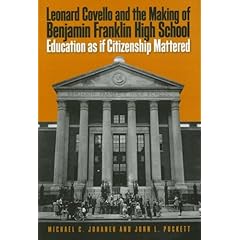
"Leonard Covello and the Making of Benjamin Franklin High School," Michael Johanek and John Puckett


"Leonard Covello and the Making of Benjamin Franklin High School: Education As If Citizenship Mattered"dissects American society's move away from the public commons and towards the individualistic principles and private sphere championed in the conservative canon, through the experience of one man at one New York City high school.

The authors Michael Johanek and John Puckett recap their effort with the closing question: "How does Covello's theory and practice of community school speak meaningfully to the problem of American's hastening retreat from the public sphere?"

"Leonard Covello and the Making of Benjamin Franklin High School" is a tough academic slog covering the first days of the community school movement, as envisioned by the education theorist John Dewey, and the way it dovetailed with the early 20th Century reform movement in the United States.

It discusses, in adequate detail, certain preliminary thrusts at integrating a school's efforts into the goals of the surrounding community, and their varying degrees of success.

But mostly, and as the title suggests, the book returns to Leonard Covello, an Italian immigrant convinced of education's value to any newcomer's development, and his efforts at applying community school principles in the well-defined terminus of East Harlem, New York City.

The book demonstrates the verity of Emerson's platitude that, "An institution is the shadow of one man," by tracing Covello's efforts at opening a school for the underserved area, teaching Italian to the children of immigrants from Italy, and grooming enough students to generate at least one formidable star -- Vito Marcantonio.

Marcantonio gave Covello the nickname by which two generations of high school boys would come to know him - "Pop."

More importantly, he helped his old mentor construct a new public high school on the banks of the East River, secured countless employees from the Depression-era Works Projects Administration to staff it, and stood guard when the experiment came in for conservative attacks.

The meat of the book covers the very specific work Covello and his team did implicating Franklin into the troubled neighborhood's affairs.

These included a sociological mapping of immigrant focal points, exhaustive surveys of area businesses, clean-up campaigns, storefront community centers, communal gardens, parades, dances, and conferences on racial tolerance crucial in a neighborhood where Italians, Puerto Ricans, Blacks, and slivers of other groups cohabitated uneasily.

The book makes clear that putting these ideas in play turned out to be a lot harder in practice than they were to write about in theory.

There is admiration for Covello and his dream, but no whitewashing of his shortcomings nor the fact that the Franklin experiment was largely over even before he retired in 1956.

There is fair analysis of the political winds buffeting attempts at improving East Harlem through the direction of a scholastic hub.

As the progressive '30s gave way to the World War, the ensuing conservative era, and Marcantonio's unseating in Congress, the very idea of "community school" carried the unpopular baggage of socialism and Covello's wings were clipped accordingly.

Finally, the authors draw conclusions about how the failure speaks to education in America today and suggest the circumstances of Covello's time prevailed over principles which were not only sound, but of enduring value.

"Dry Manhattan," by Michael Lerner


"Dry Manhattan: Prohibition in New York City" tells you a lot about New York, a little less about Prohibition, and somehow gets the mix right.

The Eighteenth Amendment, if author Michael Lerner's research and interpretations are correct, was birthed by the boozy saloons of New York City's immigrant quarters and foundered upon the same immovable rock of intemperance.

Protestant folks in middle America couldn't abide by the sin-soaked goings-on in the Big Apple and other urban centers. In the end, making something almost everybody approved of a matter of general disapproval did not present the property recipe (if ever one existed).

Lerner dissects William H. Anderson's stealth effort to make alcohol illegal in New York and the lackadaisical response of local politicians and citizens to his ultimately successful campaign.

It is a fatalistic march marked with the same strange inertia that led to other historical debacles like Hitler’s rise to power, the South’s secession from the union, or George W. Bush.

"Dry Manhattan," is a story about how Manhattan was never dry at all, even when defying the law landed a goodly number of people in jail or ruined lives.

In the end, there was something stuffy, Anglo, and very 19th Century about the Eighteenth Amendment that quickly wore out the efficacy of its most persuasive arguments.

Prohibition didn't make America better. It made it much worse. Especially through illegal mafias that sought to accumulate windfall profits associated with the risk of moving such contraband around.

Crazy innovating entrepreneurs! They're as American as the Martini.

More than anything else, Lerner's book details how the cool crowd (yes, even then) was able to infuse illegal drinking with a cachet all those Mabels and Myrtles from the Women’s Christian Temperance Union could never combat.

And most importantly, there was New York and its drinking habit, alone atop the country's media circus. It was not the only place America looked to for pointers on style and novelty, but the dry folks could hardly expect help from the wacky western pole that harbored Hollywood.

"Cosmopolitanism" is what Lerner sees as a key to the Wet counter-reformation on alcohol. And what place was more so than Manhattan?

The book resuscitates the name of New York Governor Al Smith and discusses how his losing campaign for president actually laid the groundwork for a national Democratic coalition that would reign supreme over five decades; on-and-off, and more-or-less.

"Sister Carrie," "Jennie Gerhardt," "Twelve Men," by Theodore Dreiser


Theodore Dreiser's works in "Theodore Dreiser : Sister Carrie, Jennie Gerhardt, Twelve Men" (Library of America)
hold up well as storytelling while offering the added advantage of being timepieces.

"Sister Carrie" and "Jennie Gerhardt" are similar tales of young girls whose youthful sexuality aid their flight from poverty.

Carrie and Jennie are sympathetic, nonetheless, because their climbs up the social latter are propelled, not by their own guile, but by that of the wealthy men who would deign to enjoy their youthful bounty.

Both attain fates that are only satisfactory and we will leave it at that so as not to spoil either novel's end point.

Dreiser wrote in a smooth style with more than a touch of density to it. He often erred on the side of expository writing, describing events and also telling you what they meant, rather than hitching them to action.

Nonetheless, the tales can hook you and make for engrossing reading because of the writer's thoroughness and the extreme polish he gave the prose.

The "Twelve Men" portion of the book is lengthy as either novel, without the advantage of narrative continuity, but still offers much. The characters are colorful, but unique mostly as products of a time that has passed and therefore impossible to duplicate or find in contemporary types.

Althought he lived well into the 1940s, these works are essentially post-Civil War works rendered by a younger man of German family reared in Indiana. His America is that of the Industrial Revolution. It is that bygone America where the beehive of industry is clustered along the shores of the Great Lakes.

Its gritty capitals are Chicago and Detroit and their supporting casts are the smaller towns of his home state, Illinois, and Ohio. Railroads are king and the poor loiter around tracks looking for spare bits of coal that drop from hopper cars to warm their homes.

His New York is the New York of Broadway when Broadway was alone and uncontested by the film business for supremacy in the world of spectacle. It is the New York of the horse-drawn carriage and mule-driven dray, of the great Gilded Age fortunes.

This Library of America collection offers a view of these bygone eras and the people who strove in them through the skilled writing hand and practiced journalist's eye of an American literary stalwart.

"Tomochic," Heriberto Frias


If "The Battle of Tomochic: Memoirs of a Second Lieutenant" (Library of Latin America)were released as a new novel today, we'd be calling its author, Heriberto Frias, the "next Cormac McCarthy."

We could say the Mexican Frias, in his conjuring of a terrible military campaign against rebellious Catholic mystics in 19th-century Chihuahua, is "reminiscent" of McCarthy.

But Frias was not conjuring anything. He was an actual soldier-participant in the mission, which led to the slaughter of some 150 crazies with guns and the Virgin Mary for muse in the mountain hamlet of Tomochic.

By way of background, Frias first published chapters of his account in a short-lived newspaper called El Democrata in 1892, and was promptly tried for certain crimes against the regime of dictator Porfirio Diaz.

The editor of the newspaper stood for him, claiming he wrote the installments, not Frias, and everybody walked.

"Tomochic" is written in Spanish although a an English translation by Barbara Jamison is available. If you read Spanish, and if you've read McCarthy's "Blood Meridian," strong parallels may become apparent.

Like McCarthy (or vice versa), Frias renders a stark mountain desert landscape in gorgeous pastoral terms that contrast beautifully with the crude reality of his battle portrayals.

"Tomochic" follows an unfolding tragedy through the eyes of a misbegotten lieutenant who falls in love with a maiden on the enemy side.

It's a loose narrative with just enough development to keep the story from slipping into a straight, if poetically tinted, account of a military campaign. The narrative does not have a classic structure to the extent it is journalistic and life often follows less convenient rhythms than storytelling begs of us.

There is an opening battle in which the lieutenant's company, and comrades from other outfits, are largely routed by the defenders of Tomochic and the mayhem described is enough to send any draft-aged American sprinting for the Canadian border.

It is worth pointing out here that the people of Tomochic are not indigenous victims of criollo (white-European) expansion, but folks of good Iberian stock who take up their cudgels against what, ensuing events will confirm, is a brutal national government.

The rebels' ferocious initial stand aside, the Army gets enough booze and food into its boys to proceed in crushing the remaining band - women and children included - with a machine-like mindlessness.

That's not a spoiler. "Tomochic" is sold and packaged as the story of brutal repression in the Mexican hinterlands.

Frias doesn't go into a ton of editorializing. He takes no sides, sees heroism in the army youths sent to do a pointless job, sees nobility in the steadfast guerillas, paints the ironies of a Mexico where Pima Indians help federales put down a revolt of Catholic devout.

The author's loyal and detailed accounting of the military's actions are condemnation enough.

At a certain point, there are too few surviving Tomochitecos to harm anyone. But the army stays on partying, killing slowly, burning villagers alive in their homes and church, piling battlefield cadavers into bonfires that are then fed upon by swine roaming the impromptu death camp.

There is little in the mop-up job to recommend the dictatorship, the Mexican Army, or any other modern killing machine for that matter.

There is only a foreboding sense that humanity hasn't advanced one wit since Frias' picturesque cavalry road into the valley of Tomochic, blind, dusty, and blood-lusty.

"The Heart is the Teacher," by Leonard Covello


"The Heart is the Teacher" reads as clear-headed and purposeful as the man it describes.

Its string of anecdotes are rendered in a straight-ahead, clean prose, chronologically scripted from educator Leonard Covello's earliest days in the Italian village of Avigliano, to his retirement from the New York City school system.

It is a narrative which deals only in the essential and does the good job of conveying his ideas.

"The Heart," does a marvelous mapping of the disconnect endured by those who left pre-industrial, rural Italy to settle in urban ghettoes like Manhattan's Lower East Side or East Harlem.

There is much pathos in Covello's story. His mother expired from depression born of that chasm between old world and new, which she could not find it in herself to bridge. "Cara Mamma!" he cries to the reader when recounting her departure.

Similarly, his first love died in the opening phases of their well-suited marriage.

And, of course, as an educator, he bore certain students' failures as fully as he permitted the success of others to fill his sails with wind.

The early chapters fully divulge the difficulties of the Italian-American experience: the gulf between foreign-born parents and their United States-born children; the gap between success Italian-style, via family loyalty, and the American promise of independent self-realization.

And "The Heart..." is also a possible prescription for a particular kind of American success. Covello did not become a wealthy industrialist, but his academic commitment, first as a student and later as teacher, carved out a significant niche as intellectual and policy wonk.

Himself the subject of certain books on education, Covello's approach was hardly rocket science. Socialist of bent, his approach to kids was strictly old school:

"A child," he wrote, "cannot be left to his own devices. He must have discipline, must be given responsibilities. He is a part of the family and the community and must be made to feel from the beginning that he has a duty toward that family and that community."

The start of World War II stunted his efforts at making Benjamin Franklin High School an engine for change in the surrounding East Harlem neighborhood. It convinced him that such violence, however far away, fed his young charges with the same unfortunate inclinations.

Covello's autobiography is terribly understated so that it suffers somewhat from a lack of drama, although his life was hardly devoid of it. But through the narrative's calmness, the reader may be sensing the affect the educator had on those he spent his life trying to help.

"Manhattan '45," by Jan Morris


Jan Morris does such a great job of recreating New York City - Manhattan - so well in its golden moment that a fun exercise for a writer would be to draft some characters and we've them throughout the structure of this entertaining text and see what comes out.

Morris establishes a framework for his study, a Manhattan that is the last great city standing in the wake of World War II, the product of a recent building boom and sturdy enough to handle the business of two continents rather than one.

Intelligently broken up into novel but digestible categories such as style, system, movement, race and class, "Manhattan '45" manages to tell a story while not getting lost in the complexity of its remarkable topic.

Morris writes light and breezy like some of the newspaper columnists of era mentioned and one can't help but wonder the extent to which the place and era have come to infuse the writers technique.

Reeling through the '40s requires a certain degree of listing. The listing of names, the listing of places and eateries, the listing and Manhattan's less-that-evocative grid of numbered streets and avenues, but Morris drops in just enough prosody to make it work as in the passage about the nightlife so typical of the work:

The Beau Nash of Manhattan, though, was Sherman Billingsley of the Stork Club. Where but the Stork Club could one see Cobina Wright, "the city's loveliest debutante" in the same room as H.L. Mencken, Madame Chiang Kai-shek, the Duke and Duchess of Windsor or the Ernest Hemingways? Billingsley, known to his often fawning customers as "Sherm," at once basked in their reflected fame and vigorously exploited it. He employed two teams of press agents, one on day shift, one on night, and he assiduously cultivated the friendship of newspapers columnists like Walter Winchell (the King), or Leonard Lyons, of the "The Lyons Den," who were by then celebrities themselves. Some said he had actually invented Cafe Society; he had first advertised his club in college newspapers, and given publicity to suitably prepossessing and sufficiently moneyed students as "prominent members of Cafe Society."

The author's passion for Manhattan shines throughout and is so infectious even the odd reader who picks up the book because nothing else is at hand my catch the fever.

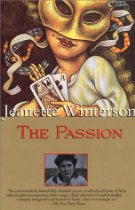
"The Passion," by Jeanette Winterson


Three readings of Jeanette Winterson's slim tome "The Passion" in the past ten years do not yield a conclusion that each time it gets better, but it certainly holds up well.

This story of a peasant boy who cooks chickens for Napolean and the cross-dressing card dealer in a Venice, Italy casino is blessed with sparing touches of magical realism, informative research about the time and place(s)that are woven into the author's poetic prose, and a brand of contemplation about life's meanings and mysteries that cannot be taught.

"This morning I smell the oats and I see a little boy watching his reflection in a copper pot he's polished. His father comes in and laughs and offers him his shaving mirror instead. But in the pot he can see all the distortions of his face. He sees many possible faces and so he sees what he might become."

Of Venice, the card dealer Villanelle observes, "This is the city of uncertainty, where routes and faces look alike and are not. Death will be like that. We will forever be recognizing people we have never met.

But darkness and death are not the same.

The one is temporary, the other is not."


The story is rich in such passages and even when they may not ring true, the music seems always pleasing.

"The heart is so easily mocked, believing that the sun can rise twice or that roses bloom because we want them to."

I often recommend "The Passion" to nonfiction readers who say they can't stick with literature, because it is of the highest kind, but taxes only as much as you let it.

Villanelle's dealer's perspective may say it all: "You play, you win. You play, you lose. You play."

"The Family of Pascual Duarte," by Jose Camilo Cela


IN Jose Camilo Cela's The Family of Pascual Duarte (Spanish Literature Series) people, plants, animals and other natural forces take on shimmering qualities when a murderous madman projects his imagination over a gray and barren landscape.

His nameless and impoverished agrarian village is located, Pascual tells us, "some two leagues from Almendralejo, squatting athwart a road as empty and endless as a day without bread..."

He works only rarely, and his account reads like one of a low-rent bon vivant flitting about indulging self-generated paranoias and fears that might hold less sway were he out tending fields with more consistency.

His personal poverty is a relative thing. He enjoys a modicum of economic independence and the ability to make a pleasure trip with his bride to the provincial capital. The house he describes is clean and appointed for basic necessities, even if the family burro occupies the room adjacent.

Yet, for all the poverty Pascual claims to suffer, he does not seek exculpation for his serial murders by invoking a drab past or rotten luck. More important than poverty in the formation and motivation of Pascual lurks the shadow of his religion.

Compounding the grayness of the narrator’s environment are the proscriptions of Spanish Catholicism, more severe and reliant on penitence than its gentler, more charitable Italian cousin.
Spanish philosopher and author Miguel de Unamuno defined this social order as "One faith, one shepherd, one flock, unity before anything else, unity imposed from on-high, repose, submission and obedience."

The Catholic and Castilian code, Unamuno wrote, implied two worlds: "A God and a devil over each, hell to fear and a heaven to conquer through liberty and grace, gaining a merciful and just God."

Indeed, God and proper convention are never far from our murderer’s mind. After his mare kicks an old lady he stops to check on her "...for it would not be in the nature of a well-born person to ride on."

Pascual's relationship to the Church marks the real boundaries to his actions and perceptions. Its laws lend an otherworldly allure to what they forbid. Eve, after all, was naked and she gave Adam an apple to eat, not a bar of soap.

While visiting the local friar to discuss his intentions of marrying the village maiden Lola, "Don Manuel opened the door of the sacristy and pointed to a bench in church, a bench like any bench in any church, made of unpainted wood, hard and cold as stone, but a place where sometimes wonderful moments are possible."

The Lord clearly taketh in Pascual’s life, but giveth on occasion as well. To the considerable extent that Pascual has faith in God, he has faith in the devil and the archangels and demons as a result.

While out spending a placid day in the country with his hunting dog Chispa, the animal (he says) turns to gaze on him with "the look of a confessor, coldly scrutinizing, the eyes of a lynx, the look they say a lynx fixes on you."

Pascual is unable to shake the resulting shudder that wracks his body and overcomes him.

"It was hot, the heat was stifling, and my eyes began to close under the animal’s stare, which was sharp as flint.
"I picked up my gun and fired. I reloaded and fired again. The bitch’s blood was dark and sticky and it spread slowly along the dry earth."

It appears, then, to be Pascual’s destiny to kill; to that end, his assignment becomes one he fulfills consistently. Along the way, he also slashes a man in a barroom brawl and stabs to death a mare that has thrown Lola and killed the baby she carried inside.

Pascual becomes a fugutive for a number of years, but returns to kill his tormentor, Estirao (Stretch), who first abused his sister and later impregnated Lola in Pascual’s absence.

Pascual eventually lands in jail, where the peasant from Extremadura (meaning "extreme" and "hard" in Spanish) pens his memoirs from death row. These memoirs constitute the story of Pascual Duarte throughout the majority of the book.

No madman on a self-destructive binge, Pascual does manage to be released on good behavior. At that moment he begins, earnest as ever, to rebuild a life, this time marrying Esperanza. But his demons get the worst of him and his mother pays the ultimate price.

Of course,the story is about Pascual’s family, the most important social unit in agrarian settings such as this. His father is Portugese and an explosive madman who has a heart attack at the news of being cuckolded.

His sister Rosario, whom Pascual adores, is cursed with a similar, if less violent, destiny because "God did not wish any of us to be distinguished by good deeds..." She is a prostitute, which can be shameful and painful before the sacred community, not to mention fatal to her as a practitioner.

His brother, Mario, sired by a man other than Pascual’s father, is born deformed.

"The poor fellow never got beyond dragging himself along the floor as is he were a snake and making some squeaking sounds in his throat. It was all he ever learned."

The unfortunate Mario even suffers the indignity of having a pig chew off his ears. Eventually he relieves the family of his oppressive sadness by drowning in a vat of olive oil at 10 years old:

"When we lifted him out, a thin trickle of oil poured from his mouth, like a gold thread being unwound from a spool in his belly. His hair, which in life had always been the dim color of ash, shone with such lively luster that one would have thought it had resurrected in death. Such were the wonders associated with the death of little Mario."

Pascual's mother is conniving and untrustworthy, giving birth to children not her husband’s and encouraging her daughter-in-law Lola to do the same.

Back in that hornets’ nest after his term in prison, Pascual threatens the old woman so that she removes herself as instigator, none of which escapes Pascual, who observes: "It’s sad to think that in order to gain a little peace a man has to make use of fear!"

But fear is not retribution enough and, in the novel’s dramatic highpoint, Pascual kills his mother and records his first impressions..."Her blood spurted all over my face. It was warm as a soft belly and tasted like the blood of a lamb."

True to form, Pascual flees the scene. At this point his personal narration ends and outside voices, introduced by Cela in the form of public testimony and private missive, fill in the rest.

The dispassionate diaries Pascual pens to divulge his murders have prompted comparisons with Albert Camus’ The Stranger. Both books were published in 1943; Cela’s went on to become the most polemic and most prolifically translated of Spain’s 20th Century literary output. Camus did as much for French letters.

But Pascual is not empty of soul in the way of Camus’ feckless anti-hero; rather he is driven by the customs and practices of a pervasive moral code. He fears the Holy Ghost.

His narration of events is not relayed in any linear way because, as Pascual explains, "Following the footsteps of people involved rather than the order of events, I jump from beginning to end and from the end back to the beginning. Like a grasshopper being swatted."

The memoirs tell his version of events, of a good man driven by intermittent and irrational forces to kill. Pascual admits it freely in his opening.

"I am not, sir, a bad person, though in all truth I am not lacking in reasons for being one. We are all born naked, and yet, as we begin to grow up, it pleases Destiny to vary us, as if we were made of wax."

Recollections from his confessor ("the transcriber" of his testimony introduced at the beginning of the book) and the warden make clear that, following Pascual's release from jail, the murderer had more killing to do.

We learn that at the Spanish Civil War’s outset, Pascual engaged in "revolutionary activities" that led him to kill the richest man in the town. The memoirs were sent, at Pascual’s request, to the only friend of his victim "whose address he can remember."

The date of Pascual's eventual execution makes it likely, and the book works to suggest, that he was not shot in the end for his serial murdering, but, ironically, for his politics. Posted to a moral social code, Pascual is ultimately killed by the forces of Generalissimo Francisco Franco, keepers of that very same code.

Adding contrast to Pascual's atrocities are the peasant village life and style that unfold in what Unamuno called the "intra-historical" cycle of birth, marriage, procreation and death, or "the world of silences."
Pascual chooses a wife at his brother’s funeral:

"When Lola went down on her knees she showed the smooth whiteness of her legs above her black stockings, tight as blood sausage. I blush to say what I must, and may God apply the effort it cost me to say it toward the salvation of my soul, for the truth is in that moment I was glad my brother had died...Lola’s legs shone like silverplate, the blood pounded in my temples, and my heart seemed ready to burst from my chest."

Here, Cela is superimposing rituals of passage to accentuate the eventless existence of agrarian life. These rites provide the only signposts for direction and action in an otherwise mundane universe.
Pascual gains Lola, but the imprimatur of the church robs her of allure, for "that first kiss given with permission didn’t taste half as good as the kisses in the cemetery, so long ago now."

Sexual pleasure and death are also coupled in the aforementioned stabbing of the mare. "When I quit the stable my arm was aching. I was covered with blood up to my elbow. The mare hadn’t made a sound. She only breathed deeper, and faster, like when we put her to stud."

And the flow of blood is often swathed in an inviting metaphor of rejuvenation and cleansing: "When they carried him off to Don Raimundo’s pharmacy the blood was flowing from him like water from a spring..."

Cela marks a life-rhythm in Pascual’s pueblo using a trance-like dirge from a single, mournful drum. "The years passed over our heads as they do all the world. Life in our house went down the same drains as always..."

When Pascual's son dies, he is tortured by the endless chatter of the women in his family.

" ‘Oh, the agony, the death throes!’
‘I held him gasping in my arms!’ [they cry:]

It sounded like a litany, as slow and weary as a night filled with wine, as languid and heavy as the pace of an ass. And they went on in this way day after day, week after week...It was frightful, dreadful, and the curse of God, vengeance from on high."

Pascual’s is the superstition of a provincial haunted by ill-fortune, relieved only by splashes of momentary magic.
Happy in a family life, he and Lola seemingly conjure the boy’s death, inviting an ill-wind that kills him:

" ‘Did you hear that?’
‘What?’

‘The window.’

‘The window?’

‘Yes. It creaked as if the wind, as if a draft were trying to get through...’

The creaking of the window, moved as it was by the wind. Came to be mingled with a moan."

The modern mind scoffs at the individual’s dark power to conjure death, but Pascual’s mind does not. He leaves his future "in God’s hands" along with responsibility for his past transgressions, for the lamb of God takes away the sins of the earth. His very understanding of things is woven with the Catholic iconography of sacrifice and suffering.
The surrounding universe corroborates the place he sees for himself there. Lola tells him before she dies, "It’s just that blood seems like a kind of fertilizer in your life..."

When his sister Rosario asks why he says he is damned, Pascual responds, "I’m not the one who says it."

Such is the "real magicalism" of Cela, who paints the everyday gray, then drapes it in golden thread and lively luster.
In magical realism, the extraordinary is invited to accompany the ordinary on its daily rounds; in the real magicalism of Pascual’s mind, the very ordinary takes on the cast of something extraordinary by the projection of his fevered mind on the contrasting drabness and boredom of his surroundings

Camilo José Cela's inspiration to write The Family of Pascual Duarte might be seen as having an intrinsic connection to his own colorful political life in Spain. Cela was born in May 1916 in Iria Flavia, Galicia; a province steeped in fog, drizzle and a black magic mythology to match them.

In 1934, he began the study of medicine, but soon wound up under the tutelage of Pedro Salinas, a poet and member of the legendary "Generation of 1927" which counted, among its numbers, one of Spain’s most triumphant literary exports, Federico Garcia Lorca.

Set up in Madrid’s well-heeled Barrio Salamanca at the outset of the Civil War, Cela signed on with the Fascist fighting units of General Millan Ashtray whose war cry was "Long Live Death!" This experience could explain Pascual's righteous obsession with death and murder.

Later, Cela would serve for a time as a censor to the Franco regime only to see his own work receive the same rough treatment later. In 1974, he resigned his post as president of the prestigious Madrid Atheneum over the anarchist Salvador Puig Antich’s execution. It seems Cela was always living at odds with the power brokers of his time. In 1962, he dedicated the 13th edition of The Family of Pascual Duarte to his "enemies, who have been of such help to me in my career."

Cela, by all accounts, was a man who planned to be famous, and to be so as a writer. He was prolific throughout his life, crafting internationally acclaimed novels, less critically adored plays, countless essays and articles.

He won the Nobel Prize in 1989 and quickly turned it to his commercial advantage, developing what he himself considered "the business of Camilo José Cela." Until his death in 2002 he roamed the streets and bars of Madrid with his youngish wife, living the old-style literary life in a European capital, collecting caviar prizes and stipends, expounding in electronic and print media on any number of topics, contemporary and otherwise.

In the years following Franco’s death he was disdained by the political right over his criticism of the Franco regime and reviled by the reigning cultural elites of the ruling Socialist Party.

He could have cared less and if moved to, gave as good as he got. None of it could dent his hard-earned triumph, rooted more firmly in the quality and variety of his work than the meticulously crafted public persona he employed in shadowboxing the world around him.

Tuesday, February 9, 2010

"Heart of a Dog," by Mikhail Bulgakov


SAN DIEGO – the scribe just finished reading Mikhail Bulgakov’s “Heart of a Dog” and, as promised in the review of Italo Svevo’s book (“Emilio’s Carnival,” Nov. 17), will now tell you a little about it.

For starters, "Heart Of A Dog"was recommended by Omar Torrez, the ultraflash guitar wiz with whom the scribe will do a recitation of passages to his novel, “Vedette” on Dec. 15, 8 p.m. at 33 1/3 Books & Gallery Collective, in L.A. (Call 213-483-3100) for info.

Omar has just returned from a small tour in Russia to which he is wed both through a personal fascination, and through the woman he has chosen to live his life with. the scribe thought the guitarist might be interested in working on a reading when he saw him at Pastis in L.A. where he mentioned Bulgakov, which is not a very common occurrence in these here parts.

Torrez’ new album, “Dynamisto” has a song called “Dog Heart,” based on the book.

“Moaning, howling,
my dog heart is growling,
darling, play your
requiem for me...”

That verse is something of a send-up on the opening pages of the (short) book in which the author does a very good job of explaining things from a stray dog’s perspective.

Here’s the very first of it:

“Whoo-oo-oo-oo-hooh-hoo-oo! Oh look at me, I am perishing in this gateway. The blizzard roars a prayer for the dying, and I howl with it. I am finished, finished. That bastard in the dirty cap – the cook of the Normal Diet Cafeteria for employees of the People’s Central Economic Soviet – threw boiling water at me and scalded my left side. The scum, and he calls himself a proletarian! Lord, oh lord, how it hurts! My side is cooked to the bone. And now I howl and howl, but what’s the good of howling?”

Get it?

“Moaning, howling,
my dog heart is growling,
darling, play your
requiem for me...”


One of the most delightful aspects of Bulgakov’s work, which was banned until well after his death, is the success with which he presents the workings and concerns of a dog’s mind.

Here’s how the dog learned to hunt for food in post-revolutionary Moscow without a proper education and reading lessons:

“After that, his learning proceeded by leaps and bounds. He learned the letter ‘t’ from ‘Fish Trust’ on the corner of Mokhovaya, and then the letter ‘s’ (it was handier for him to approach the store from the tail end of the word, because of the militiaman who stood near the beginning of ‘Fish’).

“Tile squares set into corner houses in Moscow always and inevitably meant ‘cheese.’ A black samovar faucet over the word indicated the former owner of Chichkin’s, piles of red Holland cheese, beastly salesmen who hated dogs, sawdust on the floor, and that most disgusting, evil-smelling Beckstein.

“If somebody was playing an accordion, which was not much better than ‘Celeste Aida,’ and there was a smell of frankfurters, the first letters on the white signs very conveniently added up to the words ‘no inde...,’ which meant ‘no indecent language and not tips.’ In such places there were occasional messy brawls and people got hit in the face with fists, and sometimes with napkins or boots.

“If there were stale hams hanging in a window and tangerines on the sill, it meant... Grr.... grr... groceries. And if there were dark bottles with a vile liquid, it meant...Wshi-w-i-wines...The former Yeliseyev Brothers.”

You get the idea. The charm of “Heart of a Dog” lies in the simple sci-fantasy chosen by the author to regale us with true portraiture of life in the time and place with which it concerns itself, without ever appearing episodic, preachy, or issue-driven.

The four paragraphs abstracted above move the story along, maintaining the humor (and pathos) involved in mapping a dog’s mind, but also telling us something of the moment’s popular music, of the behavior that could be witnessed on the city streets, and rendering a street economy that one would assume is a thing of the past.

But the story, in the end, is not entitled “Mind of Dog.” It is “Heart of a Dog,” and soon we move beyond the concerns of the canine, to those of the larger cast assembled by the author to make certain points about the reorganization of Russian life into soviet structures and concepts.

Truly revolutionary.

The dog is taken in off the street by Doctor Philip Philippovich Preobrazhensky who, even in the leveling times he was tapped to live, is a man of prestige and means.

“Heart of a Dog,” falls clearly into the category of satire and, as such, spares no one.

Preobrazhensky is up to no good with some scary eugenic operations that are enhancing the vitality and sexual capacity for some of Moscow’s wealthier denizens. When the communist housing committee comes to bust his chops about the size of his apartment and the new times which the doctor must reconcile himself to, he makes a call to one of his patients, influential in the recently imposed Bolshevik order, that results in the committee delegates leaving his place with tails between their legs.

But Philip Philipovich’s time will come.

The dog, whom he and his helper Bormenthal have dubbed “Sharik” is startled from the peaceful life in the too-big-apartment he could hardly believe luck had placed him, to have the brain stem of a deceased common criminal grafted onto his own.

The experiment goes awry and Sharik slowly morphs into a man; a complicated man with opinions, desires, and an appetite for cats - a man with a dog’s heart that the doctors Preobrazhensky and Bormenthal are ill-equipped to control.

He smokes, has no sense of social correctness, hits on the resident young girl Zina, and has a wise-guy’s mouth to boot. “An exceptional scoundrel,” in Preobrazhensky’s words.

Disdained and pushed to the margins by the bourgeois technicians who created him, Sharik does what came naturally to people (or dogs) in those days. He becomes a communist and gets “papers” attesting to his officially recognized existence as Polygraph Polygraphovich Sharik.

He gets a good job in the municipal department, purging cats, and finally forces the hand of Philip Philippovich by again springing the local aparatchiks on him over the size of his apartment and the way its space is apportioned.

Pushed to the brink, the doctors do something to Sharik, it is not clear what, that returns him to the state of grateful mongrel in which he originally entered the premises.

We can view this story as a commentary on the open-ended fear the aspirations of science and modernity imposed upon people at the turn of the last century. It can also be savored as a parable on Soviet life as it seemed shortly after the revolution.

Okay, the scribe doesn’t really know what a parable is, he just wanted to sound lit-critical for a second.

Perhaps the better expression is “analogy” or even, “metaphor.” the scribe thinks that these words along with ‘simile’ and a few others only serve to slice the same ham a lot of thin ways and that they should come up with a better, all purpose, word to meet the utilitarian tone of our times.

In any case, it’s clear Bulgakov had an ironic view of the Bolshevik order and the underlying idea of sweeping away all that had come before to replace it with something more egalitarian. We don’t get a sense he was against it on principles, rather that he was mortified by what happened when it was applied to a giant and backward czarist peasant state.

the scribe’s sense is that he is saying a dog’s a dog, and a prole’s a prole, regardless of what rational experiment, social or scientific, you expose them, too.

There will always be, Bulgakov seems to be saying, complicated matters of the heart that surpass the grasp of even our most enlightened and talented citizens.

Post-revolutionary Russia is now a ways off. We do not know what song the doctor is always singing, “from Granada to Seville...” and so we miss its cultural significance and what it means to come out of Preobrazhensky’s mouth as well.

Still, the literature transports us.

The version read by the scribe (Grove Press) is translated by Mirra Ginsburg. Translations are always tricky. We can only hope they approximate what the original language was cleverly employed to convey. Ginsburg recreates an over-the-top type of nineteenth century idiom in the tone of, let’s say, G.K. Chesterton (“The Club of Queer Trades”).

“My good sir, I will not be made a guy of with this preposterous...”

Maybe, hopefully, that is what Bulgakov had in mind. To be sure, the high-flown pompousness of his hosts certainly contrasts with the low-flung desires and needs of the proletarian dog.

Woof.

"Sinn Fein: A Hundred Turbulent Years," by Brian Feeney


the scribe is reporting back to you regarding this book he just read on the Sinn Féin. Going into the job highwayscribery knew the Sein Féin to be the political arm of the Irish Republican Army about which he knew little.

This book, "Sinn Fein: A Hundred Turbulent Years,"goes back to the late 19th century when the group was formed under the moniker which translates to “Ourselves Alone.”

Prime movers of the early formation were one Arthur Griffith who did the heavy "Sinn Fein: A Hundred Turbulent Years," goes back to the late 19th century when the group was formed under the moniker which translates to "Ourselves Alone."

Primary movers of the early formation were one Arthur Griffith who did the heavy intellectual lifting, and Eamon de Valera who turned out to be the natural politician of a bunch that included Michael Collins, about whom Hollywood made a movie starring Liam-whatever-his-name-is some 14 years ago.

The group became the crucible for a push toward a republican and Irish state independent of Great Britain around the end of World War I. Since this was something of a leisure read (!) the scribe doesn't have it all ordered perfectly in his mind, but the upshot was one of heavy repression and finally a partition, granting a new Irish state to most of the island, but leaving the northern part which has, to complicate life for everyone involved, a protestant and unionist (pro-Britain) majority, outside it.

De Valera moved toward the center when the "Free State" of Ireland, separated from the North, was born and the republican movement, and Sinn Féin in particular, got lost in a netherworld of self-generated "theology" as per author Brian Feeney's choice of word.

The result was years out on the margins debating whether or not to participate in politics, or stay on the outside of things, because neither the Irish Republic nor Westminster in London were recognized as legitimate rulers of Ireland (which they were doing anyway).

By mid-century Sinn Féin had practically disappeared, reduced to a club for a few keepers of the free, republican, Irish state flame. The "armed struggle," which was both a noble effort to defend Catholics from Protestant pogroms and a stupid campaign that killed many innocent people, took center stage.

The IRA found Sinn Féin's credentials useful and decided to take it over and make use of the party for its own purposes.

Sometime in the 1980s, a young bearded fellow named Gerry Adams, who hailed from a family with strong roots in the Republican movement, began a slow campaign to "run down" the armed struggle and modernize the political wing into a legitimate and independent mass electoral party.

Feeney, whose prose are typical for a historian (okay), does a good job of connecting the dots, interviewing survivors of that time, and detailing the daunting task that Adams faced in seeking to, surreptitiously and slowly, divest the IRA of relevance.

It makes a good and easy read, the 442-page length notwithstanding. Like many historical works, it does a fine job of cutting and pasting events according to the dates they happen and producing documents to support it all.

highwayscribery rented "The Boxer" with Daniel Day Lewis, to get a sense of what the atmosphere in which all of this transpired was like.

The film, shot through a graying blue lens, essays a Northern Ireland stunted economically and spiritually by poverty and violence since the beginning of "The Troubles," as the IRA's last, longest and most deadly campaign was known. It brings to life the hardliners, who resisted political participation and the decommissioning of arms, while capturing the desperation and exhaustion everyone doing a daily dance with violence felt.

The movie fills in the facts with some sentiment and rounds out the portrait, for those interested in a deeper understanding.

"Enchanted Vagabonds," by Dana Lamb


SAN DIEGO – Enchanted Vagabondswritten by Dana Lamb is published by the Long Riders’ Guild Press, which has dedicated itself to reproducing books from something called the Equestrian Travel Classics. These are books that have fallen from mass distribution with the passing of time, but which the publishers feel “remain of global interest and importance."

“Enchanted Vagabonds,” a 414-page opus of dense reading and no plot to speak of, involves a journey made by Lamb and his wife Ginger in the thick of the great depression. Friends from childhood in then-agricultural Orange County (Southern California) Ginger and Dana had dreams of adventure. Having little to lose, they set out from San Diego in a canoe/sailboat of their own engineering, for the Panama Canal.

The sojourn took three years and it is a tale most engrossing, especially for those who hunger to know of an earlier world before crowding, pollution, modernization, and the mass endangerment of nature’s many species of plants and animals.

It is of special interest to Southern Californians of the surfing variety for its early chapters dealing with the Baja California peninsula, which today (and thanks to its ruggedness and inhospitality) remains a kind of last frontier for those seeking raw territory to discover and roam.

Revealing indeed is this portrait of a Mexico largely unsettled and a nation only in name. As they make their way down the Pacific coast of the great country, each stop into port represents a sampling of Indian/indigenous life almost unspoiled by the sullying hand of European culture.

More often than not these Indian villages welcome the sensitive and sensible travelers with open arms, grand fiestas, and kind treatment; treatment that on a few occasions represents the difference between life and death for the lusty and ingenuous adventurers.

Stricken with malaria in the jungle, mad with fever to the point of delirium, the couple awaken many weeks later in a village that has taken them in and assumed the difficult task of curing and nurturing them back to life. The difference between depression-era America and the pre-Columbian ways of the Indians marks the couple so that, as Lamb puts it, “we no longer fit in to the picture” (of modern life).

The Indians are not friendly at every turn, and particularly along a stretch of inland seas the couple must traverse to avoid death at the hands of powerful “norther” wind storms, they are hounded by a violent and malevolent tribe known as the Mareños.

The Mexican government had, at this point in time, tried to subjugate these scoundrels with an army that never made it back. And so you get an idea of the danger they faced.

So virgin is the country that the couple, on wayward ventures inland and on foot, discover lost and forbidden cities of pyramids and altars for human sacrifice. Throughout their trek, the couple is confronted with a, “strange throbbing rhythm. You felt it even more than you heard it. It was like a nerve beat. It seemed to permeate the air. We were never entirely able to dismiss the effect of this vibration upon our minds and bodies, for we were to hear it many, many times in months to come. We can offer no explanation as to what it was, where it came from, or who produced it. We called it drums for want of another name, but we do not know.”

The psychology of these two discoverers reveals much of what has changed in the human psyche and in the soul of nature in the 70 years. Their behavior is more akin to safari hunters than that of the modern day eco-tourist. When floating through the Sea of Cortez surrounded by hundreds of giant manta rays, Lamb gets it into his head to harpoon one. Later on, in a lagoon, he does the same to an alligator. In such instances, Mother Nature strikes back and the adventures become more akin to misadventures. Along the way they shoot tigers, ocelots, jaguars and anything else that gets in their way. On the Island of Cocos off Costa Rica, they clean their camp by leaving the refuse out in anticipation of the tides that will be carrying it away.

They are inhabiting a time and space where nature still rules, where man is far from indomitable, and “natural” resources are so abundant as to overwhelm and threaten human life.

Trouble with the Indians is met with the white man’s friend, the gun. Carefully planned ambushes of tribes that have it out for them are replete with powerful gun battles and although there is never once a body count, one gets the impression a few natives must have been felled along the way.

Kind and sensible when met with kindness or mild distrust, the couple are capable of matching violence with violence.

Many times they are in hell with endless strange insects that inflame and scar their skin and infect them with illnesses that threaten their very survival.

Other times, they are in paradise as this time when, after pulling themselves onto a beach to set up camp, Lamb goes for a little walk:

“I took both guns – Ginger’s automatic in case I should sight small game, and the Luger in the event of a tiger – and my new machete, and hacked my way towards a group of palms I had seen from the sea. Cutting through the last string of brush to the palm grove, I came upon a beautiful blue lagoon. I gazed in wonder. Tired and hungry as I was, I forgot everything else for the moment. This was the 'Promised Land.' A little fresh-water stream ran into the lagoon, and across it tall coco palms lined a white sand beach. Ducks floated in the water. Great blue herons, snowy egrets, sandpipers, and shorebirds were everywhere. Parrots, and other birds with gorgeous plumage whose names I did not know, flew overhead. Fish made rainbow arcs of color as they leapt and splashed. It was a scene whose beauty made me doubt the evidence of my own eyes.”

Here they meet a pair of “Azteco” Indians, relatives to the ancient Aztecs, who help them establish a hut and teach them how to live off the rich land surrounding. They stay for a number of months. The Indians tell them of a “Forbidden City” their tribe is sworn to protect.

Despite an old tale, pregnant with warning, of a Spanish army that entered the surrounding land never to return, the couple decide to search for the forbidden city and ultimately find it, replete with mounds hiding pyramids, protective walls and a limestone sacrificial altar upon which they set up camp and start a fire.

“The effect of such an experience is indescribable. We seemed to have brushed aside times’ limitations. The past and present were telescoped. The mind was able to recapture images as though it were not subject to the restrictions of space and matter. I do not tell you that what we saw with our physical eyes, or heard with our finite ears, these evocations of the past. It was rather an awareness not dependent upon either of these usual instruments of sense perception.

“We sat utterly still. The silence was broken only by the sharp staccato of the fire’s explosions; then, far off, insistent, vibrant, that rhythmic monotone.”

Lamb was an intelligent observer who renders the landscape of Mexico masterfully. The many descriptions of the troubles had at sea in their undersized “Vagabunda” can be a bit too detailed and lose those who don’t possess a command of boating terminology (the jib, stern, starboard, etc.) or a full vocabulary of the sea’s behavior (squalls, shoals, breakers, etc.). Were this a novel, one or two harrowing sequences upon the violent seas would have been sufficient, but Lamb is writing a travelogue and diary, so that these must be recorded, sometimes at the expense of a patient reader.